Heavy Equipment Wash Rack Wastewater Compliance Guide: Clean Machines Without Dirty Fines
Learn how to manage heavy equipment wash water, sludge, and runoff so your fleet stays clean, compliant, and out of trouble with preventable wastewater violations.
Key Takeaways:
- Washing heavy equipment is good maintenance, but uncontrolled runoff can create environmental violations, cleanup costs, and ugly customer impressions
- The safest approach is a designated wash area with containment, solids capture, and a documented disposal routine for sludge and wastewater
- Soap choice matters less than most people think. Dirt, grease, fuel residue, and suspended solids are usually the bigger compliance problem
- Crews need a simple decision rule: what can be washed in the field, what must return to the yard, and what requires spill-response handling first
- FieldFix helps fleets track cleaning intervals, wash-bay inspections, recurring contamination issues, and proof that procedures were followed
Why wash water compliance matters
Cleaning heavy equipment is not just cosmetic. A clean machine is easier to inspect, safer to service, and less likely to hide leaks, cracks, loose hardware, or overheating problems under a layer of packed mud and grease. That part is obvious.
What gets ignored is what leaves the machine during cleaning.
The runoff coming off an excavator, loader, dozer, crusher, trailer, or service truck is usually not “just water.” It can carry oil film, hydraulic residue, coolant traces, diesel grime, grease, concrete slurry, asphalt residue, fine sediment, and whatever else the machine picked up on the job. Once that mess flows across gravel, into a ditch, toward a storm drain, or off a yard toward a neighbor’s property, the problem stops being maintenance and becomes environmental exposure.
That matters whether your fleet has three machines or three hundred. Regulators do not care that the leak was small, the wash was rushed, or the foreman “always does it that way.” Customers do not love watching black runoff snake across a jobsite entrance either. It makes a company look sloppy.
For most contractors, the goal is simple: keep the maintenance benefits of regular washing without creating wastewater, sludge, or runoff headaches that punch you in the throat later.
Important: Local, state, and site-specific wastewater rules vary. This guide is operational best practice, not legal advice. If your yard discharges to a sanitary system, storm system, septic setup, or private treatment arrangement, verify the exact local requirements before assuming your current setup is fine.
What counts as contaminated wash water
This is where people fool themselves. If the machine looked nasty before you washed it, the runoff is probably not clean enough to treat casually afterward.
Contaminated wash water can include:
- mud and suspended solids
- grease and petroleum residue
- hydraulic oil mist or seepage
- fuel drips around tanks and caps
- coolant residue near engine compartments
- concrete dust or slurry
- herbicide, fertilizer, or site-specific residue on specialty equipment
- metal fines, paint chips, and rust particles
Even plain water becomes a disposal problem when it picks up enough contaminants. That is why “we only used water” is not a strong defense. The issue is what the water carries when it leaves the wash area.
Machines fresh off demolition, utility, milling, forestry, landfill, or spill-response work deserve even more caution. Their residue profile is often worse than crews think. If a machine has an active leak, that leak should be addressed before or during washing, not politely redistributed across the yard.
Warning: Never wash obviously fuel-soaked or oil-saturated equipment into uncontrolled gravel, bare soil, or storm-drain paths. That is not “cleanup.” That is spreading contamination.
The hidden cost of washing equipment the lazy way
The lazy version of cleaning feels efficient. Pull the machine to the edge of the yard. Blast off the mud. Let the water find somewhere to go. Everybody moves on.
That shortcut creates four different bills.
First, there is compliance risk. If runoff reaches a storm drain, drainage swale, pond, public road, or neighboring property, you may have reporting, cleanup, or enforcement exposure.
Second, there is yard damage. Repeated washing in the wrong area creates muddy low spots, erodes aggregate, makes slippery work zones, and leaves contaminated sediment where people walk and drive every day.
Third, there is maintenance blindness. When runoff is uncontrolled, crews rush. They are not inspecting while cleaning. They are just hosing grime off and calling it a day. That defeats half the value of washing in the first place.
Fourth, there is reputation. Customers notice when your operation looks sharp. They also notice oily wash trails, stained pavement, and equipment that gets cleaned like a high-school mud truck.
Field Example: The “Quick Rinse” That Became a Bigger Problem
A small contractor routinely washed skid steers and attachments on open gravel behind the shop. It felt harmless because the volume was low and no one used detergent. After several months, one section of the yard stayed dark and slick after every rain. The real issue was not soap. It was repeated buildup of sediment, grease, and oil residue from machines with small seepage points. Cleanup required hauling contaminated material, regrading the area, and finally building a dedicated wash zone anyway. The cheap method turned out to be the expensive one.
Wash rack vs improvised field washing
Most fleets do not need a fancy municipal-scale treatment plant. They do need a repeatable system.
Wash Setup Comparison
Designated wash rack or contained pad:
- Keeps runoff in one known place
- Makes solids capture and separator maintenance possible
- Supports safer inspections during cleaning
- Produces cleaner records and better crew habits
Improvised yard or field washing:
- Creates uncertain runoff paths
- Makes sludge buildup harder to control
- Encourages rushed cleaning with poor inspection quality
- Raises the odds of repeat contamination and ugly cleanup work
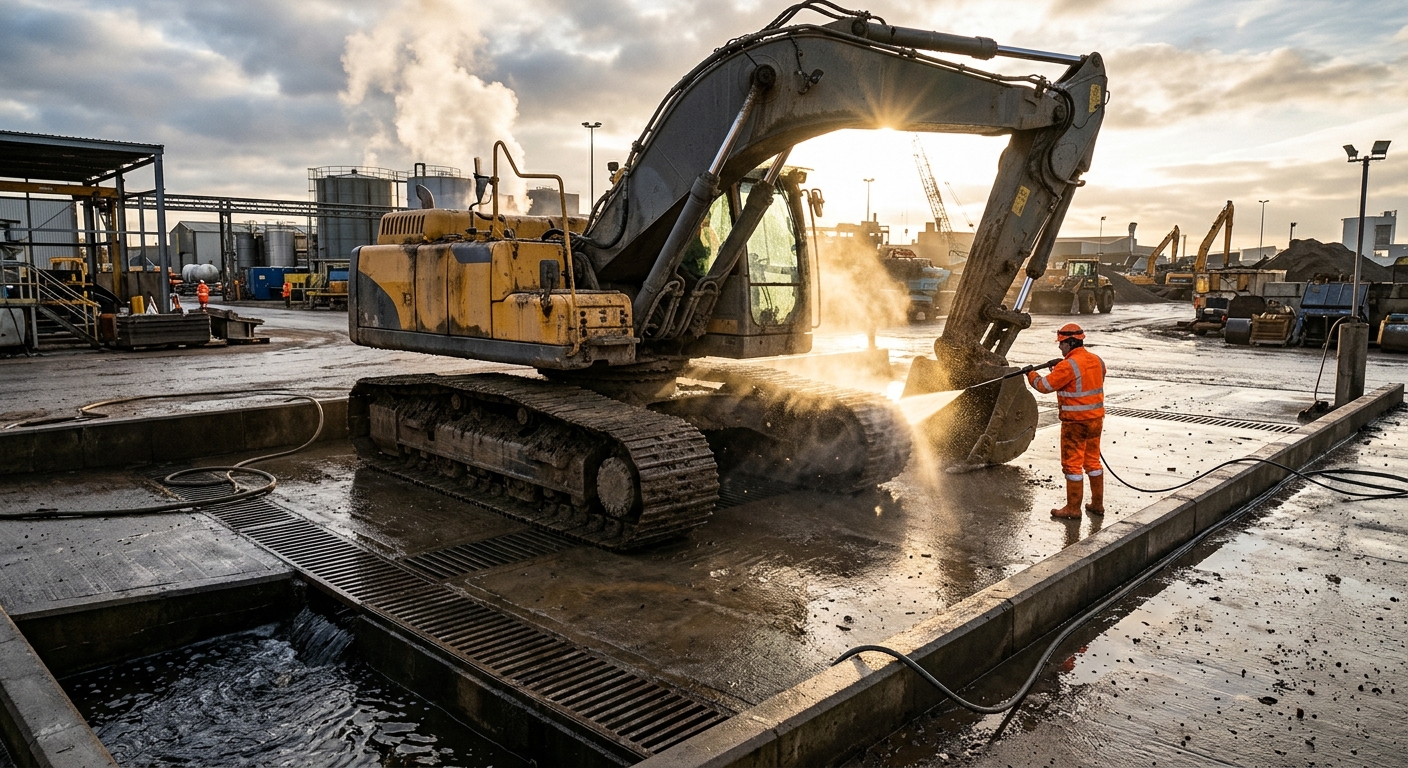
The ideal setup for a contractor yard usually includes a defined pad, slope control, solids capture, and some way to separate or manage oily water before disposal or approved discharge. Even a modest setup can outperform the common “hose it off behind the fence” approach by a mile.
Field washing is not always wrong, but it should be limited. If the goal is knocking loose dirt off tracks or preventing a transport issue before loading, that may be one thing. Full degreasing, engine-bay washing, or leak-covered cleanup in an uncontrolled area is a different beast entirely.
How to build a practical compliant wash process
The smartest fleets make washing boring. Boring is good. Boring means consistent.
Start with a designated wash location. That area should be away from storm-drain paths and designed so water moves toward containment instead of escaping wherever gravity feels like taking it.
Then build the process around five steps:
1. Dry-remove heavy buildup first
Scrape packed mud, knock loose debris from steps and frames, and shovel out thick accumulations before adding water. Less solids in the runoff means less trouble downstream.
2. Inspect for active leaks before the wash begins
If a machine is dripping hydraulic oil or diesel, stop pretending this is a normal wash. Contain the leak, repair or tag it, and decide whether the machine should even be washed yet.
3. Use controlled washing, not chaos
Train crews where to aim, where not to aim, what pressure is safe around seals and electronics, and when detergent is actually necessary. Too much pressure creates its own damage while adding volume to the wastewater problem.
4. Capture solids and oily residue
Your system should have a way to trap mud, fines, and floating oils before the water leaves the wash area or enters downstream equipment.
5. Close the loop with cleanup and records
Someone needs to inspect the wash area, empty traps on schedule, document separator service, and flag unusual contamination events.
Tip: If crews can describe the wash process in two calm sentences, it is probably usable. If the process needs a five-minute speech every time, it is too loose and people will freelance it.
What crews should inspect before washing
Wash time is inspection time if you do it right. Before the water starts, crews should look for:
- fresh oil or coolant residue
- missing caps, plugs, or covers
- damaged electrical connectors
- open grease fittings or broken hose routing
- packed debris near radiators, belly pans, steps, and articulation points
- cracked glass, loose lights, and damaged cameras
- structural cracks that dirt may have been hiding
During and after the wash, they should confirm whether any leak becomes easier to see once the grime is gone. That is one of the best reasons to keep washing disciplined. Clean machines tell on themselves.
How to handle sludge, separators, and disposal records
This is the part everybody wants to forget, which is exactly why it matters.
Wash compliance is not just about where the water goes today. It is also about what accumulates over time. Solids traps fill. Oil-water separators need service. Sludge builds up. If nobody owns that maintenance, the wash system quietly degrades until the “compliant setup” becomes theater.
At minimum, fleets should define:
- who inspects the wash area
- how often solids are removed
- how separator performance is checked
- where sludge and recovered waste go
- what receipts, manifests, or service records get retained
- what happens after an abnormal contamination event
If a machine comes in coated with hydraulic oil from a hose failure, that is not routine wash waste. Treat it like an incident. Contain it, document it, and handle cleanup intentionally.
Danger: A wash system nobody maintains becomes a false sense of security. Overflowing solids pits, neglected separators, and missing disposal records are exactly the kind of details that look stupid when a complaint or inspection happens.
Common compliance mistakes contractors make
The biggest mistakes are not technical. They are cultural.
One mistake is assuming small volume means small risk. A little runoff, repeated often enough, still creates a problem.
Another is focusing too hard on soap and not enough on oil, sediment, and leak residue. Detergent matters, but the solids and petroleum side of the equation often does more damage.
Another is washing wherever there is space instead of wherever there is control.
And maybe the most common mistake is separating “environmental stuff” from “maintenance stuff” like they live on different planets. They do not. A sloppy wash process hides leaks, spreads contamination, and weakens inspections all at once.
Field Example: Clean Enough for Service, Controlled Enough for Compliance
A mid-sized contractor created a simple rule: light field rinse only for transport visibility or packed mud removal, full wash only at the yard pad, and leak-covered machines require mechanic signoff before washing. That one rule reduced random yard runoff, improved defect reporting, and made the wash area easier to maintain because crews stopped using it as a place to hide bigger mechanical problems.
A simple wash-water policy for small fleets
If you run a small fleet, do not overcomplicate this. Use a policy your team can actually follow:
- Full equipment washing happens only in the designated wash area.
- Heavy mud gets dry-removed before washing whenever possible.
- Machines with active leaks are flagged before wash and handled separately.
- No uncontrolled degreasing or engine-bay washing in the field.
- Wash area traps, separators, and sludge are inspected on a schedule.
- Unusual contamination gets documented like any other maintenance issue.
That is enough to stop a lot of dumb behavior.
The point is not bureaucratic beauty. The point is preventing runoff problems while keeping machines clean enough to inspect, service, and present professionally.
Track wash compliance inside FieldFix
The best wash procedure in the world still falls apart if it lives only in somebody’s head. FieldFix helps contractors turn wash compliance into an actual operating routine instead of a speech that disappears the moment the yard gets busy.
Use FieldFix to:
- create recurring wash-bay inspection tasks
- log machine cleaning intervals by asset
- record leak findings discovered during washing
- attach photos of contamination, sludge buildup, or runoff issues
- document corrective actions after abnormal wash events
- keep one record of what was cleaned, what was found, and what got fixed
Clean machines are easier to maintain. Controlled wash water is easier to defend. Put both in the same system and you stop treating cleaning like an afterthought.
Want a cleaner fleet and cleaner records?
FieldFix helps you track maintenance tasks, inspections, service history, leak reports, and recurring yard procedures in one place. If your wash process is still informal, start documenting it before “good enough” turns into a fine, a cleanup bill, or another preventable mess.