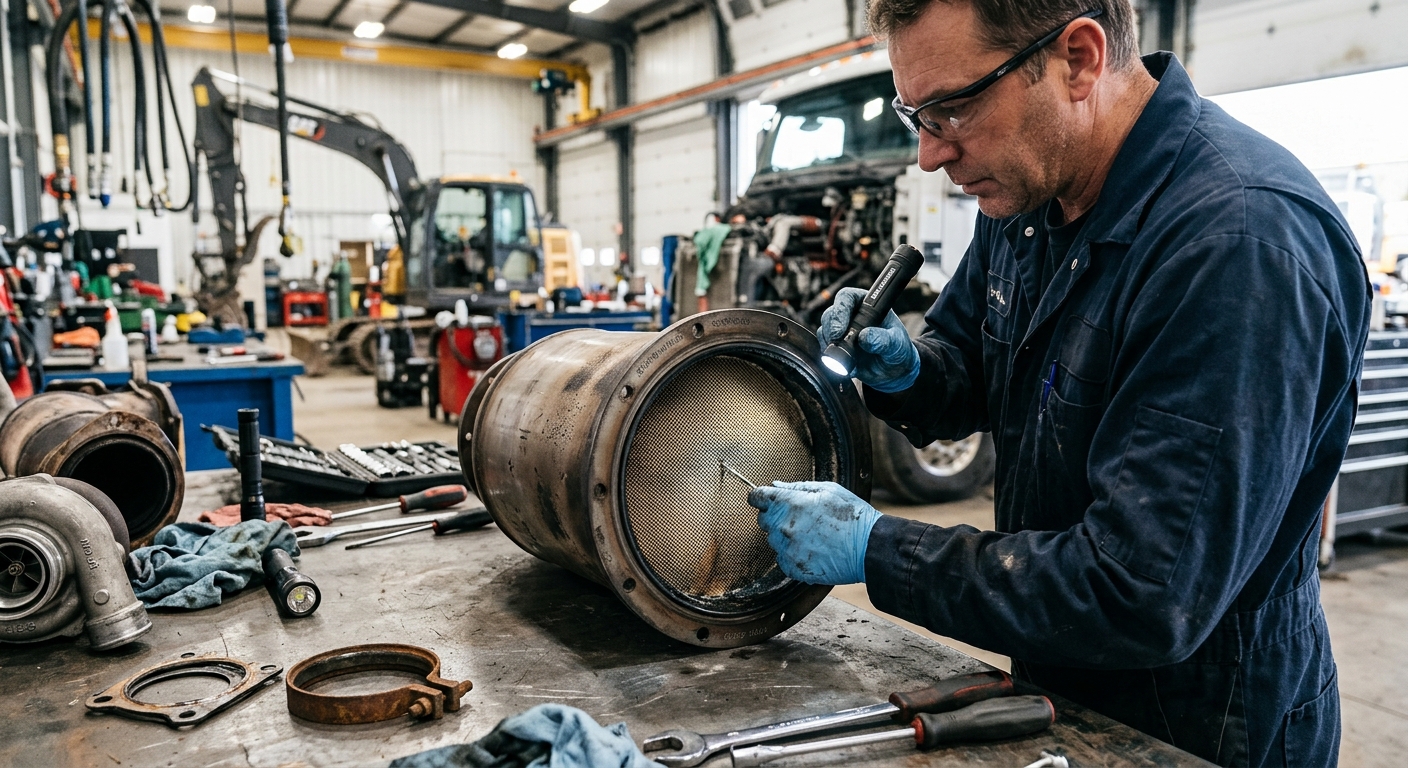
Heavy Equipment DPF Maintenance: The Complete Diesel Particulate Filter Guide
Learn how to maintain your DPF system, prevent costly regens, and avoid downtime. Complete guide to diesel particulate filter care for heavy equipment.
Key Takeaways
- DPF failures are the #1 cause of unplanned downtime on Tier 4 Final equipment, costing $3,000–$10,000+ per incident
- Passive regeneration happens automatically at highway speeds — but most heavy equipment never reaches those conditions
- Ash cleaning every 3,000–5,000 hours extends DPF life by 2–3x compared to neglected units
- Low-quality fuel and oil are the two biggest controllable factors in premature DPF failure
- FieldFix tracks DPF service intervals by hours and reminds you before service is due
What Is a DPF and Why Should You Care?
If you’re running any piece of heavy equipment built after 2014, you’ve got a Diesel Particulate Filter sitting in your exhaust system. It’s there to trap soot particles before they exit the tailpipe — part of EPA Tier 4 Final emissions requirements.
Here’s the thing most operators don’t realize: your DPF is essentially a ceramic honeycomb that catches particulate matter, and it needs to burn that soot off periodically. When that process fails, you’re looking at forced downtime, limp mode, and repair bills that make your accountant cry.
The DPF isn’t optional. You can’t delete it (legally). You can’t ignore it. But you can maintain it properly — and the difference between a well-maintained DPF and a neglected one is often the difference between 10,000+ hours of reliable service and a $7,000 replacement at 4,000 hours.
How DPF Regeneration Works
Regeneration — “regen” — is how the DPF cleans itself. The filter traps soot during normal operation, and regen burns that soot off at extremely high temperatures (1,000°F+). Think of it like a self-cleaning oven for your exhaust system.
There are three types of regen, and understanding them is the foundation of good DPF maintenance:
Passive Regeneration occurs continuously when exhaust gas temperatures are high enough — typically above 600°F. Highway trucks hit this naturally. Heavy equipment working at moderate-to-high loads often does too. This is the ideal scenario: the DPF cleans itself during normal operation with no operator intervention.
Active Regeneration kicks in when the ECM detects soot loading above a threshold (usually 40–60%). The system injects extra fuel into the exhaust stream to raise temperatures and burn off accumulated soot. You might notice slightly higher idle RPMs, a hotter exhaust, or a dashboard indicator. Most active regens take 20–40 minutes.
Parked (Stationary) Regeneration is the one nobody wants. When soot loading reaches critical levels (typically 80%+), the machine forces you to stop, park, and initiate a manual regen. This can take 30–60 minutes with the machine sitting idle, burning fuel, and producing zero revenue.
Warning: Repeatedly interrupting active regeneration cycles (by shutting down the machine mid-regen) is one of the fastest ways to kill a DPF. If the system is running an active regen, let it finish. The 30 minutes now saves you days of downtime later.
Signs Your DPF Needs Attention
Catch these early and you’ll save thousands:
-
Regen frequency increasing — If your machine used to go 8–10 hours between regens and now needs one every 3–4 hours, soot or ash is accumulating faster than the system can burn it off.
-
Regen duration getting longer — Active regens that used to take 25 minutes now taking 45+ minutes indicate the DPF is struggling to clean itself.
-
DPF warning light or soot load indicator climbing — Don’t ignore dashboard warnings. By the time the light comes on, you’re already behind.
-
Loss of power or “limp mode” — When the DPF reaches critical soot loading, the ECM will derate the engine to protect the filter. You’ll notice significant power loss.
-
Increased fuel consumption — A partially blocked DPF creates exhaust backpressure, forcing the engine to work harder. A 5–15% increase in fuel burn is common with a dirty DPF.
-
Exhaust backpressure readings above spec — If you’re monitoring backpressure (and you should be), readings consistently above the manufacturer’s threshold mean the DPF needs service.
-
White or blue exhaust smoke — This can indicate the DPF is no longer capturing particulates effectively, or that excess fuel is passing through during failed regen attempts.
Pro Tip: Keep a simple log of regen events — when they happen, how long they take, and whether they complete successfully. A pattern of increasing frequency or duration is your early warning system. FieldFix gives you a place to keep that log with each machine’s service history.
DPF Maintenance Schedule
| Interval | Task | Why It Matters |
|---|---|---|
| Every shift | Check dashboard for DPF warnings or soot load indicators | Catch issues before they become emergencies |
| Every 500 hours | Inspect exhaust system connections and clamps | Leaks reduce regen efficiency |
| Every 500 hours | Check DPF differential pressure sensor readings | Detects blockage trends early |
| Every 1,000 hours | Inspect DOC (Diesel Oxidation Catalyst) upstream of DPF | A failing DOC causes DPF overloading |
| Every 3,000–5,000 hours | Professional DPF ash cleaning | Removes non-combustible ash that regen can’t burn |
| Every 5,000–8,000 hours | Full DPF inspection with flow testing | Determines remaining filter life |
| As needed | Replace DPF substrate | When cleaning no longer restores acceptable flow |
The Real Cost of DPF Neglect
Let’s put real numbers to this. Consider a fleet of five compact track loaders running 1,500 hours per year each:
Case Study: Reactive vs. Proactive DPF Management
Reactive approach (no scheduled DPF maintenance):
- 2–3 unplanned DPF events per machine per year
- Average downtime: 10 hours per event (diagnosis + repair + parts sourcing)
- Revenue loss at $150/hour: $3,000–$4,500 per event
- Emergency DPF cleaning: $800–$1,200 per service
- One premature DPF replacement per year across fleet: $5,200
- Annual cost: $25,000–$35,000
Proactive approach (scheduled cleaning + monitoring):
- DPF ash cleaning every 4,000 hours: $500–$700 per service
- Monitoring system/logging: $50/month per machine
- Minimal unplanned downtime: 1–2 events per year across fleet
- Annual cost: $6,000–$9,000
Savings: $16,000–$26,000 per year for a 5-machine fleet.
The math isn’t even close. Proactive DPF maintenance pays for itself many times over — and that’s before you factor in the cascading effects of downtime on project schedules and customer satisfaction.
Fuel and Oil: Your DPF's Best Friends (or Worst Enemies)
Two consumables have an outsized impact on DPF longevity, and most operators underestimate both.
Fuel Quality
Ultra-Low Sulfur Diesel (ULSD) is mandatory for Tier 4 equipment, but not all ULSD is created equal. Contaminated fuel — water, particulates, or biodiesel blends above manufacturer recommendations — dramatically increases soot production.
- Always buy from reputable suppliers
- Use fuel-water separators and replace filters on schedule
- Drain water from fuel tanks and separators daily in humid conditions
- Store fuel properly — condensation in storage tanks is a top contamination source
- Avoid biodiesel blends above B5 unless your manufacturer specifically approves it
Engine Oil
Here’s what most people miss: engine oil ash is the #1 contributor to DPF clogging that regen can’t fix. When oil burns in the combustion chamber (which it always does, in tiny amounts), the metallic additives in the oil become ash that collects in the DPF. Unlike soot, ash cannot be burned off during regeneration. It accumulates until the filter is professionally cleaned.
Critical: Using non-CK-4 rated oil in Tier 4 equipment is one of the most expensive mistakes you can make. CK-4 oils are specifically formulated with lower ash content to protect DPF systems. The wrong oil can cut your DPF cleaning interval in half and shorten filter life by thousands of hours.
Oil rules for DPF longevity:
- Use only CK-4 (or CJ-4 minimum) rated engine oil
- Never exceed oil change intervals — degraded oil produces more ash
- Fix oil consumption issues immediately — a leaking turbo seal or worn rings dumps excess oil into the DPF
- Check oil level regularly — both overfilling and low oil cause problems
Active vs. Passive vs. Parked Regen: What Operators Need to Know
Passive Regen
Pros:
- Happens automatically — no operator action needed
- No downtime or fuel penalty
- Most efficient cleaning method
Cons:
- Requires sustained high exhaust temps (moderate-to-heavy load)
- Won’t happen during extended idling
- Not sufficient alone for high-soot-production applications
Active Regen
Pros:
- Automated by the ECM
- Can happen during operation (with some machines)
- More thorough than passive regen
Cons:
- Uses 0.5–1.0 gallons of extra fuel per cycle
- May require reduced load during regen
- Interrupted regens increase soot loading
Parked Regen
Pros:
- Most thorough soot burn
- Last resort before DPF damage
Cons:
- 30–60 minutes of complete downtime
- Burns 2–4 gallons of fuel
- Indicates the system is already stressed
The golden rule: Maximize passive regen opportunities by avoiding excessive idling. If a machine sits at low idle for hours, the DPF accumulates soot with no way to burn it off. Either shut the machine down or ensure it’s working at a load that generates sufficient exhaust temperature.
DPF Cleaning Methods
When ash accumulation reaches the point where regeneration alone can’t maintain flow, professional cleaning is necessary. There are several methods:
Pneumatic (Air Knife) Cleaning
Compressed air is used to blow ash out of the filter channels. This is the most common method for routine maintenance cleaning.
- Cost: $300–$500
- Time: 2–4 hours
- Effectiveness: Good for routine ash removal
- Best for: Scheduled maintenance intervals
Thermal (Bake) Cleaning
The DPF is placed in a specialized oven that heats it to regen temperatures for an extended period, burning off residual soot and some organic ash compounds.
- Cost: $400–$700
- Time: 8–12 hours (often overnight)
- Effectiveness: More thorough than pneumatic alone
- Best for: Heavily loaded filters or combined soot/ash buildup
Aqueous (Liquid) Cleaning
Water-based cleaning solutions are flushed through the filter to dissolve and remove ash deposits.
- Cost: $500–$800
- Time: 4–6 hours plus drying
- Effectiveness: Most thorough ash removal
- Best for: High-ash-loading situations, maximum filter life restoration
Best Practice: Many DPF service providers offer combination cleaning — pneumatic followed by thermal or aqueous. This provides the most complete cleaning and is recommended for filters past 5,000 hours. Always request a flow test after cleaning to verify the filter has been restored to acceptable specifications.
Common DPF Problems and Fixes
Problem: Frequent Forced Regens
Cause: Excessive idling, short duty cycles, or a failing DOC Fix: Reduce idle time, ensure the DOC is functioning, and check for upstream issues (injector problems, turbo leaks) that increase soot production
Problem: Regen Won’t Complete
Cause: Faulty exhaust temperature sensor, failed injector (7th injector or in-exhaust dosing valve), or software issue Fix: Check sensor readings with diagnostic software, inspect the dosing system, and update ECM software if available
Problem: Rapid Ash Accumulation
Cause: Wrong oil specification, excessive oil consumption, or oil leaks into exhaust Fix: Switch to proper CK-4 oil, perform a compression test and leak-down test, inspect turbo seals
Problem: Cracked DPF Substrate
Cause: Thermal shock (usually from interrupted regens or water ingestion), physical impact, or manufacturing defect Fix: Replacement is the only option — a cracked substrate cannot be repaired. Prevent by never shutting down during active regen and protecting the DPF from physical damage.
Problem: High Exhaust Backpressure After Cleaning
Cause: DPF substrate has reached end of life — pores are permanently glazed or damaged Fix: Replace the DPF. A filter that can’t be restored by cleaning has reached its service limit.
DPF Maintenance Checklist
Print this out and keep it in each machine’s service binder:
Daily:
- Check dashboard for DPF/emissions warning lights
- Note soot load percentage if displayed
- Allow active regens to complete before shutdown
- Minimize unnecessary idling
Weekly:
- Inspect exhaust system for leaks, loose clamps, or damage
- Check DEF level (DEF system supports DPF regen process)
- Review regen frequency — note any changes
Every 500 Hours:
- Record differential pressure sensor readings
- Inspect DOC inlet for oil contamination
- Check all exhaust connections and gaskets
- Verify exhaust temperature sensors are reading correctly
Every 3,000–5,000 Hours:
- Schedule professional DPF ash cleaning
- Request post-cleaning flow test
- Inspect DPF substrate for cracks or damage
- Review engine oil consumption records
Track It or Lose It
The single biggest factor separating fleets with chronic DPF problems from those that rarely deal with them? Tracking.
When you log regen events, monitor soot loading trends, and schedule ash cleanings based on actual hours rather than waiting for problems — DPF issues drop by 70% or more.
That’s exactly what FieldFix was built for. Set your DPF cleaning intervals by hours, get reminders before service is due, and keep a complete service history that helps you spot problems weeks before they strand a machine on a jobsite.
Stop Guessing, Start Tracking
FieldFix keeps your fleet’s maintenance intervals in one place, including DPF service, so you catch problems before they cost you thousands. Schedule ash cleanings by hours, note regen problems as they happen, and run an AI diagnosis when a DPF code shows up.
Free for your first machine. No credit card.
Related Articles
September 4, 2026
Heavy Equipment Fall Service Planning Guide: How to Prevent Winter Downtime
September 3, 2026
Horizontal Directional Drill Maintenance: The Complete HDD Service Guide for Contractors
September 2, 2026