Heavy Equipment Emergency Stop and Shutdown Inspection Guide
Learn how to inspect heavy equipment emergency stop buttons and shutdown circuits to prevent unsafe restarts, downtime, and failed jobsite inspections.
Key Takeaways
- Emergency stop buttons and shutdown circuits are safety-critical components, not decorative red hardware
- Most failures come from corrosion, damaged wiring, sticky actuators, loose mounts, or undocumented bypasses
- A short inspection routine can catch unsafe restart conditions before they turn into injuries or downtime
- Fleets should test the full shutdown sequence, not just whether the button physically moves
- Good records matter because intermittent shutdown faults often get dismissed until a serious event happens
Most maintenance programs are pretty good at covering filters, fluids, pins, and batteries. Safety shutdown hardware often gets less discipline, which is a problem because the entire point of an emergency stop system is to work on the worst day, not the easiest one.
If an emergency stop button sticks, a shutdown relay drops out intermittently, or a machine can restart without the system being properly reset, you do not just have a nuisance fault. You have an unsafe condition hiding in plain sight.
This guide covers how emergency stop and shutdown systems work on heavy equipment, what actually fails in the field, and how to inspect the system in a way that reduces both safety risk and wasted diagnostic time.
Why Emergency Stop Systems Deserve More Attention
Emergency stop systems exist to interrupt machine operation when something has already gone sideways. Depending on the machine, that can mean cutting power to controls, shutting down the engine, disabling hydraulics, or preventing restart until the circuit is reset.
That function matters on equipment used around workers, traffic, trench edges, suspended loads, service personnel, and busy jobsites where hesitation costs time and bad assumptions cost much more.
The expensive assumption
Many fleets assume an emergency stop system is fine because nobody has complained about it. That is weak logic. Operators do not press emergency stop buttons during normal production, so a hidden failure can sit there for months.
When shutdown circuits are ignored, fleets create three avoidable risks:
- Injury exposure if the machine cannot be stopped quickly during an incident
- Downtime when a faulty e-stop circuit causes no-start or control-enable complaints
- Liability if a machine fails a safety audit and there is no record showing the system was inspected
What Counts as an Emergency Stop or Shutdown System
Not every machine uses the same hardware, but most shutdown systems share the same goal: stop hazardous motion or power when normal controls are no longer enough.
Depending on the asset, the system may include:
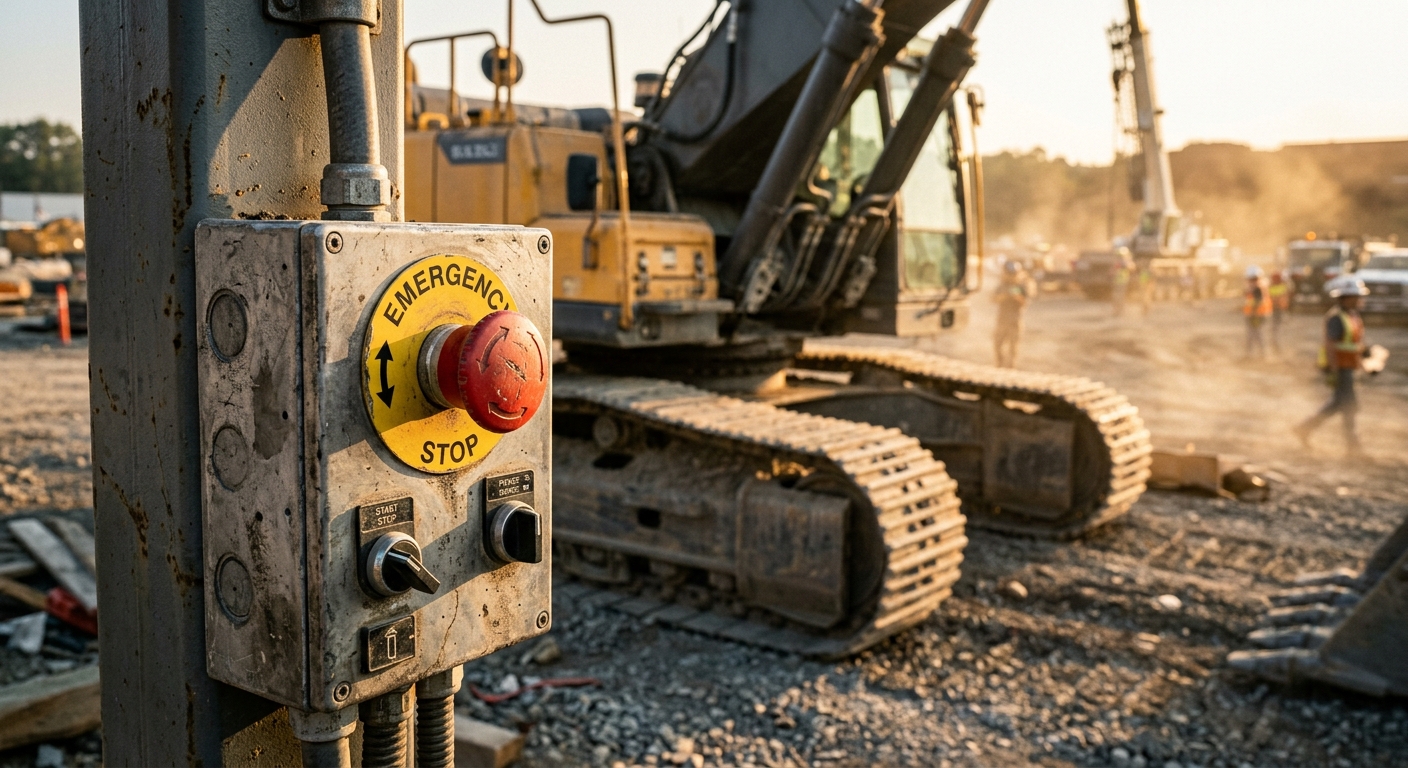
- Red mushroom-style emergency stop buttons
- Shutdown relays or contactors
- Safety control modules
- Hydraulic enable cutout circuits
- Fuel shutoff solenoids or engine stop logic
- Remote stop stations on crushers, conveyors, pumps, generators, and specialty equipment
- Restart inhibit logic that requires manual reset before operation resumes
On some machines, emergency stop hardware is obvious and external. On others, it is buried inside a more complex safety circuit that also watches door switches, access panels, seat bars, or service locks.
Important distinction
An emergency stop button is only one piece of the system. The full safety function includes the switch, wiring, relay logic, shutdown action, reset logic, and restart behavior afterward.
That distinction matters because plenty of machines have a button that looks fine while the actual shutdown circuit is compromised by corrosion, loose terminals, or a clever but dumb bypass.
The Most Common Failure Modes
Emergency stop systems usually fail in predictable ways. That is good news, because predictable problems can be prevented with a consistent inspection routine.
1. Sticky or damaged actuators
Buttons mounted in dusty, wet, or high-vibration environments can get stiff, bind, or fail to latch correctly. If the operator has to mash the button like they are mad at it, something is wrong.
2. Corroded contacts and connectors
Moisture intrusion, wash-down, fertilizer, salt, and time all attack low-voltage control circuits. Resistance climbs and signals become unreliable.
3. Loose mounting hardware
An e-stop that rotates in its panel or moves when pressed is not “fine for now.” Loose hardware changes switch travel, damages wiring, and encourages internal wear.
4. Harness damage
Shutdown circuits live in places where they can rub on metal edges, hinges, control consoles, and access doors. A rubbed wire can create intermittent shutdowns or, worse, prevent shutdown when needed.
5. Improvised bypasses
This is the classic dumb shortcut. Someone jumps the circuit because the machine needs to run today, then forgets to fix it tomorrow. That bypass can linger for months.
Mechanical Emergency Stop Devices
Pros:
- Easy to identify and test
- Fast to replace when physically damaged
- Straightforward for operators to understand
Cons:
- Can fill with dirt or moisture
- Mounting hardware loosens over time
- Wear can be hidden until the button is actually used
Relay or Module-Based Shutdown Logic
Pros:
- Better integration with alarms and restart inhibit logic
- Can support multiple stop stations
- Often provides cleaner system-level control
Cons:
- Easier to misdiagnose as a “software issue”
- Connector faults can mimic bigger electrical failures
- Bad documentation turns intermittent faults into time-wasting mysteries
Case Study: The Button Worked, the Circuit Didn’t
A contractor had a portable crusher with an emergency stop station that looked perfect during a walkaround. The button latched and reset normally. During a deeper inspection, the shutdown relay was found with a corroded terminal and heat damage from a loose connection. The button worked. The circuit did not. Catching it in the yard beat learning that lesson with a jammed conveyor and workers nearby.
A Practical Inspection Schedule
You do not need a giant teardown to manage this well. You need repetition, standards, and zero tolerance for vague sign-offs.
A simple rule
Any machine or attachment with an emergency stop function should have that function verified after electrical work, control-console work, wash-down, storage recommissioning, or any repair touching the shutdown circuit.
Use a schedule like this:
- Daily or pre-shift: Confirm visible stop stations are unobstructed, properly labeled, and not physically damaged
- Weekly: Perform a functional stop and reset test according to the OEM procedure
- Every 250 hours: Inspect connectors, mounting security, relay compartments, and wiring support
- Every 500 hours: Review the full shutdown and restart inhibit sequence, meter-test suspect devices, and inspect related control enclosures for moisture or heat damage
- After any fault complaint: Document the exact symptom, condition, and whether the problem happened during start, run, reverse, vibration, or after rain or wash-down
Inspection Rhythm That Actually Works
Fleets that stay ahead of shutdown-circuit failures usually do two things well: they add the check to an existing PM rhythm, and they force technicians to record pass or fail on the actual function. “Looked okay” is useless. “Pressed station A, engine shut down, restart blocked until reset” is useful.
Step-by-Step Emergency Stop Inspection Checklist
Here is a practical field process that works on most equipment when adjusted for the manufacturer procedure.
1. Start with a visual check
Look for missing labels, cracked housings, loose bezels, bent guards, packed-in dirt, cut boots, exposed terminals, or obvious signs of tampering. If the button is hard to reach because someone parked a bracket, tool tray, or lunchbox in front of it, that is a failure too.
2. Verify the button action
Press and reset the device. It should latch and release cleanly. Mushy travel, slow return, excessive force, or rotation in the panel all point to wear or poor mounting.
3. Test the shutdown function
Following the OEM procedure and site safety rules, confirm that pressing the stop station actually causes the intended action. That may be engine shutdown, hydraulic disable, conveyor stop, pump stop, travel inhibit, or control power loss.
4. Confirm restart inhibit behavior
This step gets skipped a lot. A good system should not allow casual restart if the e-stop is still latched or the reset sequence has not been completed. Verify that the machine stays down until properly reset.
5. Inspect the circuit path
Check the accessible wiring, connectors, relay panels, and mounting points associated with the stop station. Look for loose terminals, moisture, overheated wires, unsupported cable runs, and rubbed loom.
6. Document exactly what happened
Write down the button or station tested, the action observed, and whether reset and restart logic behaved correctly. If it failed once and passed once, treat it as failed until proven otherwise.
Do not fake a pass
If the shutdown function is intermittent, slow, or inconsistent, the machine is not safe enough to mark complete. Intermittent safety devices are failed safety devices.
Repair, Bypass, or Lock Out?
There is a correct answer here and it is not complicated: repair the system or lock the machine out until it is repaired.
Temporary bypasses during controlled diagnostics are one thing when done by qualified personnel and removed immediately. Sending equipment back into service with a defeated shutdown circuit is something else entirely. It is lazy, risky, and usually more expensive in the end.
What Bad Fleets Do
Pros:
- The machine gets back to work for a minute
Cons:
- Safety device is no longer trustworthy
- Liability exposure goes through the roof
- Future diagnostics get harder because the circuit no longer matches the schematic
- The next technician inherits a dangerous mystery
What Smart Fleets Do
Pros:
- Clear pass/fail standard
- Safer operators and technicians
- Better maintenance records and fewer repeat faults
- Faster troubleshooting because the circuit stays honest
Cons:
- Requires discipline when schedule pressure is high
If replacement parts are delayed, tag the asset out or create a formal restriction that removes it from hazardous use until the repair is complete. “We needed it today” is not a maintenance strategy. It is a confession.
How Documentation Protects Your Fleet
Emergency stop inspection records do more than satisfy paperwork people. They help technicians spot recurring faults, protect the business after incidents, and reduce the cost of intermittent electrical complaints.
The best records capture:
- Asset ID and hours
- Which stop station or device was tested
- The exact shutdown action observed
- Whether reset and restart inhibit logic worked
- Any wiring, corrosion, or mounting defects found
- Corrective action taken and who performed it
Why the details matter
If an operator reports that a machine shut off unexpectedly over rough terrain, a record showing prior shutdown-circuit faults near the control console saves a lot of guessing. Without that record, the complaint gets lumped into “electrical gremlins” and everyone wastes half a day chasing the wrong problem.
Good documentation also helps during resale, audits, and insurance conversations. A buyer or investigator who sees a real inspection trail is going to trust your fleet more than one who sees crossed fingers and verbal assurances.
Track Safety-Critical Inspections with FieldFix
Emergency stop systems are exactly the kind of maintenance item that slips through the cracks when records live in text messages, paper forms, or a tech’s memory.
Make safety-critical inspections impossible to lose
FieldFix helps fleets log shutdown-system inspections by asset, track repeat issues, attach photos of damaged buttons or wiring, and keep a clean service history your team can actually use. If an emergency stop station fails once, you should be able to see that pattern fast instead of rediscovering it on the next job.
The takeaway is simple: emergency stop hardware deserves the same routine discipline you already give fluids and filters. A button that only needs to work in an emergency still needs to work every single time.