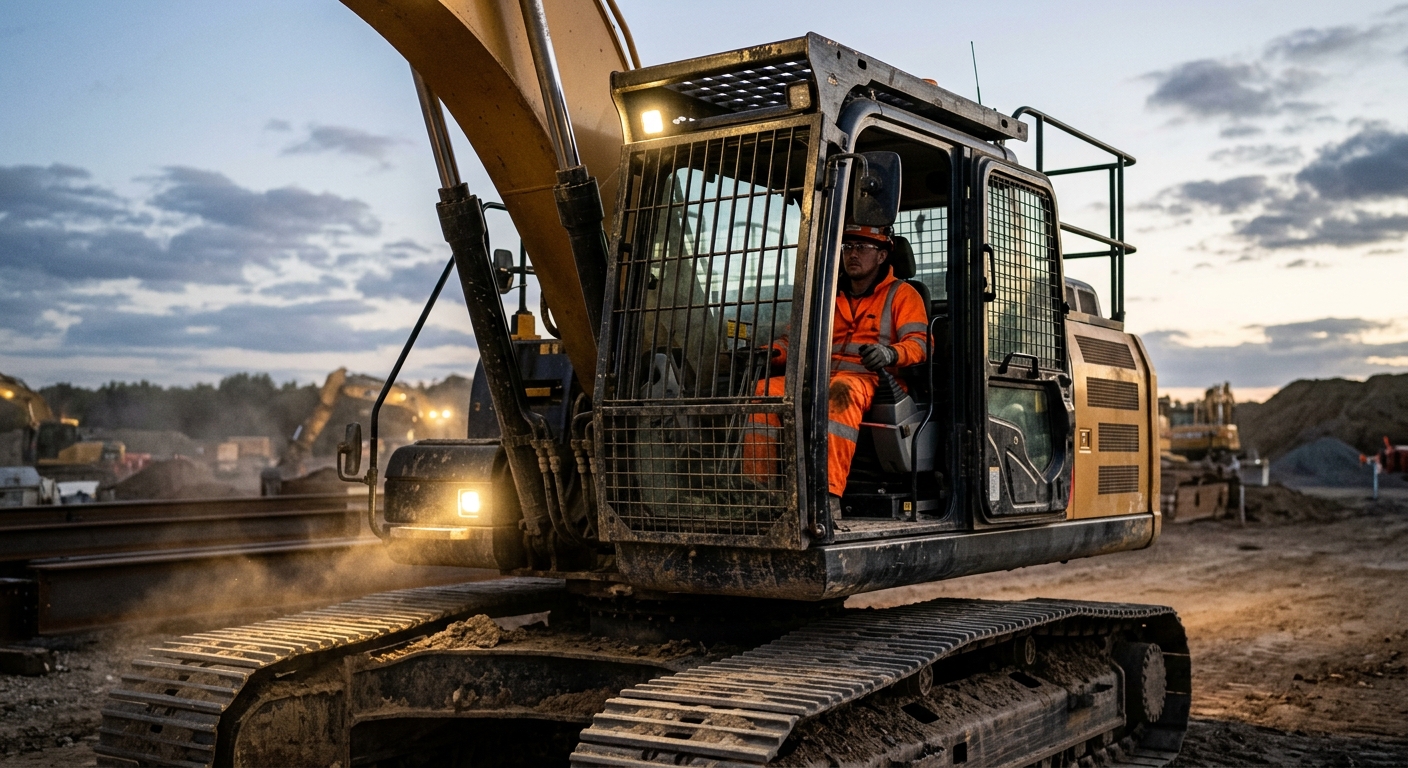
Heavy Equipment ROPS and FOPS Inspection Guide: How to Protect Operators and Stay Compliant
Learn how to inspect heavy equipment ROPS and FOPS structures, spot damage, document findings, and protect operators from rollover and falling-object risks.
Key Takeaways
- ROPS and FOPS are life-safety structures, not cosmetic metalwork and damage should never be brushed off.
- Welding, drilling, straightening, or modifying a certified protective structure can void protection and expose operators to catastrophic risk.
- Inspections should happen daily at the operator level and more thoroughly at scheduled service intervals with written documentation.
- Loose hardware, corrosion, cracked welds, bent uprights, and damaged mounting points are the most common red flags.
- A machine involved in a rollover or major strike event should be removed from service immediately until the structure is evaluated according to OEM guidance.
ROPS and FOPS do not matter right up until the exact second they matter more than anything else on the machine.
That is the ugly truth. A skid steer tips on a side slope. A compact track loader backs under unstable debris. A forestry machine takes a falling limb through the cab area. In those moments, the operator is betting his life on a protective structure that most fleets barely inspect beyond “looks fine from here.”
That is a terrible system.
This guide breaks down how to inspect rollover protective structures (ROPS) and falling object protective structures (FOPS), what damage is unacceptable, what documentation should look like, and how to keep operators out of machines that are no longer safe to run.
What ROPS and FOPS Actually Do
ROPS stands for Roll-Over Protective Structure. FOPS stands for Falling Object Protective Structure. They are engineered safety systems designed to preserve a survivable space around the operator during a rollover or falling-object event.
That last part matters: a protective structure is not just a roof, a guard, or a few pieces of steel tube. It is a tested assembly with specific material thickness, geometry, weld quality, mounting locations, and hardware requirements. Change one part of that system and you may change how the structure behaves under load.
Important distinction ROPS is designed primarily for rollover energy management. FOPS is designed primarily for impact from falling or flying material. Many cabs and canopies provide both forms of protection, but they are not automatically interchangeable just because they look heavy-duty.
Common equipment types that rely on ROPS and/or FOPS include:
- Skid steers and compact track loaders
- Mini excavators and excavators
- Dozers and wheel loaders
- Telehandlers and forklifts
- Forestry mulchers and land-clearing equipment
- Agricultural tractors and utility machines
If your fleet runs in demolition, tree work, quarry, recycling, land clearing, storm cleanup, or steep terrain, these structures should be treated as mission-critical safety assets.
Why These Structures Deserve Their Own Inspection Process
Many fleets bury ROPS/FOPS checks inside a generic walkaround form. That is better than nothing, but it is still weak. Life-safety systems deserve their own logic because failure here has a different consequence than a broken work light or bent step.
Here is why dedicated inspection discipline matters:
- Damage is often subtle before it becomes severe. Hairline cracks at weld toes, rust jacking around mounting plates, or slightly elongated bolt holes can be easy to miss.
- Bad repairs are common. A lot of shops still assume they can “burn it back together” after impact damage. On certified protective structures, that can be a dangerous shortcut.
- Operators normalize bent metal. If a machine still runs, teams often keep using it. ROPS/FOPS damage does not work like that.
- Legal exposure is brutal. After an injury, investigators will ask for inspection history, repair records, training records, and OEM guidance. If your answer is a shrug, that problem gets expensive fast.
Do not treat ROPS/FOPS like general fabrication A cracked bucket ear and a cracked ROPS upright are not in the same category. One affects productivity. The other can decide whether an operator goes home.
Common Damage That Should Stop You Cold
Some conditions call for immediate removal from service until the OEM or a qualified authorized repair path says otherwise.
- Visible cracks in tubes, plate sections, corners, welds, gussets, or mounting brackets
- Bent or buckled uprights even if the deformation seems minor
- Crushed roof members from impact with debris, transport incidents, or a rollover
- Missing, loose, stretched, or incorrect mounting bolts
- Corrosion loss that has reduced section thickness, especially around the base and hardware
- Unauthorized holes, tabs, brackets, or accessory mounts welded or drilled into the structure
- Repaired areas with poor weld profile, undercut, burn-through, or obvious heat distortion
- Damaged seat belt mounts when integrated with the protective zone strategy
Automatic red-line event If a machine has been in a rollover, side tip, overhead strike, or significant falling-object incident, remove it from service immediately. Even if the cab still “looks pretty good,” the structure may have already absorbed energy and lost its certified performance.
One of the biggest mistakes fleets make is focusing only on the visible upper cab structure while ignoring the mounting interface. A perfectly intact canopy mounted to cracked supports or wallowed-out bolt holes is not intact. The load path matters.
Daily Operator Inspection Checklist
The operator check is not a certification audit. It is a fast, disciplined scan to catch obvious danger before the key turns.
5-Minute Daily ROPS/FOPS Check
- Walk around the cab or canopy and look for fresh bends, impact marks, or new contact points.
- Inspect visible welds for cracks, flaking paint lines, or rust bleed that may indicate movement.
- Check all visible mounting bolts, washers, and brackets for looseness, shift marks, or missing hardware.
- Look for drilled holes, added tabs, radio mounts, light bars, chain hooks, or “custom” modifications.
- Inspect roof screens, guards, and overhead protection for distortion or broken attachment points.
- Confirm doors, windows, latches, and escape paths still open and close properly after any impact event.
- Verify the seat belt is present, functional, and anchored correctly.
This daily check works best when operators are trained on what “bad” actually looks like. Telling someone to inspect ROPS means nothing if they have never been shown photos of cracked weld toes, torn mounting tabs, or bent uprights.
Train with examples Keep a small reference sheet in the shop or inside your safety software with photo examples of acceptable condition, questionable condition, and automatic out-of-service condition. People catch more when their eyes know what to hunt for.
Scheduled Shop Inspection Process
The shop inspection is where you slow down and do it right. A good schedule is:
- Daily: operator visual check
- Every 250 hours or monthly: documented supervisor or lead-tech inspection
- Every 1,000 hours or annually: deeper structural inspection with hardware verification and record review
- After any incident: immediate event-driven inspection before the machine returns to work
During the scheduled inspection, the technician should:
- Clean the structure first. Mud, grease, bark, and packed dust hide cracks and corrosion.
- Inspect all welds closely. Focus on joints, corners, gussets, transitions, and prior repair areas.
- Check base plates and mounting pads. Look for cracking, deformation, rust trails, and hole elongation.
- Verify hardware. Confirm bolt grade, length, washers, torque marks, and retention condition match requirements.
- Inspect associated guards and screens. FOPS screens, side guards, mesh, and overhead panels still need secure mounting and straight load paths.
- Review machine history. Look for any rollover, transport strike, tree strike, or load incident that may not have been escalated properly.
- Document with photos. If there is any question at all, photograph it now instead of arguing about it later.
Visual-Only Checks vs Documented Structured Inspections
Visual-only checks
- Fast and easy to repeat
- Good for catching obvious impact damage
- Helpful for operators at startup
- Weak at spotting progressive issues or historical patterns
Documented structured inspections
- Create proof of due diligence
- Make recurring defects easier to identify
- Improve communication between operators and the shop
- Support warranty, compliance, and incident defense
If you want one habit that improves outcomes immediately, it is this: take photos every time a defect is suspected. The camera never forgets, and it shuts down a lot of lazy guesswork.
What Repairs Are Allowed and What Repairs Are Not
This is where people get into trouble.
Some attached components around a protective structure may be serviceable. Hardware may be replaceable. Bolt-on screens or guards may be replaceable. Trim, seals, glass, and latches may be replaceable. But the primary structure itself is a different conversation.
As a rule, if the load-bearing ROPS/FOPS structure is cracked, bent, buckled, cut, drilled, or previously modified, you should follow OEM instructions instead of improvising.
Never assume a field weld is acceptable Unless the manufacturer specifically provides an approved repair procedure, welding a cracked or deformed ROPS/FOPS structure is a gamble with someone else’s spine, skull, and livelihood.
Questions every fleet should ask before approving any repair:
- Is the damaged part structural or non-structural?
- Does the OEM allow repair, or only replacement?
- Is there a published procedure with materials, prep, weld process, inspection criteria, and torque specs?
- Does the event history suggest hidden damage beyond what is visible?
- Will the machine remain compliant after the proposed repair?
If the answer to any of those is fuzzy, stop. Fuzzy is not a safety strategy.
Documentation, Training, and Liability
ROPS/FOPS inspection is not complete when somebody says, “Yeah, we looked at it.” If it was not documented, it will be hard to prove later.
At minimum, your records should include:
- Machine ID, make, model, and serial number
- Date and hour meter reading
- Inspector name
- Pass/fail status
- Detailed notes on any damage found
- Photos of suspect areas
- Corrective action taken
- Return-to-service approval if the machine was tagged out
Good documentation helps in three ways.
First, it protects operators because defects get tracked instead of forgotten. Second, it protects managers because decisions are tied to evidence. Third, it protects the business if OSHA, insurance carriers, attorneys, or customers ask whether you run a serious operation.
Training matters as much as the checklist Even a perfect form is useless if operators have been taught to hide damage to avoid downtime. Build a culture where tagging out a questionable machine is treated as professional judgment, not disloyalty.
Real-World Failure Example
Case Study: “It Was Only a Small Bend”
A contractor had a compact track loader clip a low bridge beam while loading onto a trailer. The cab roof took the hit. The machine still operated, so the team kept it in service for another month. During that time, nobody documented the incident, and a light bar was later bolted to the already-deformed upper frame.
Two weeks later, the machine slipped off a muddy shoulder and tipped. The protective zone still prevented a fatal crush, but the damaged upper section and altered mounting arrangement complicated the load path and led to more severe cab deformation than expected. The post-incident review found:
- Prior overhead strike was never escalated
- Unauthorized accessory mounting altered the structure
- No inspection photos existed
- Operators had noticed the cab sat “a little off” but assumed it was fine
The lesson is brutal but simple: small structural events do not stay small when the next incident happens.
How FieldFix Helps Teams Track Safety-Critical Inspections
ROPS/FOPS checks are exactly the kind of safety-critical process that falls apart when it lives in memory, paper scraps, or a group text from three months ago.
FieldFix helps fleets standardize these inspections by giving teams a repeatable place to:
- Create machine-specific inspection checklists
- Log defects with timestamps and photos
- Tag machines out of service when structural issues are found
- Track corrective actions and return-to-service decisions
- Keep a full service history for every machine in the fleet
Protect the Operator, Not Just the Asset
If your ROPS and FOPS inspections still depend on memory, verbal handoffs, or whatever the last guy noticed, you are running too loose. FieldFix helps contractors document safety-critical checks, catch repeat issues faster, and keep every machine’s inspection history in one place.
The machine can be replaced. The operator cannot. Treat ROPS and FOPS like the life-support structures they are, because that is exactly what they become on the worst day of the year.
Related Articles
September 4, 2026
Heavy Equipment Fall Service Planning Guide: How to Prevent Winter Downtime
September 3, 2026
Horizontal Directional Drill Maintenance: The Complete HDD Service Guide for Contractors
September 2, 2026