Heavy Equipment Jobsite Safety: The Complete OSHA Compliance Checklist for 2026
Master heavy equipment jobsite safety with this OSHA compliance guide. Covers hazard zones, PPE requirements, communication protocols, and incident prevention.
Key Takeaways
- OSHA fines for heavy equipment violations averaged $16,550 per serious violation in 2025 — and they’re going up
- The “Fatal Four” causes of construction deaths include struck-by incidents involving heavy equipment
- A solid daily safety briefing takes 10 minutes but prevents 60% of jobsite incidents
- Proper swing radius marking and blind spot protocols eliminate the #1 cause of equipment-related fatalities
- Digital inspection and maintenance logs make it easier to show what was checked, fixed and when
Nobody starts a business thinking about OSHA fines and incident reports. You got into heavy equipment because you wanted to move dirt, clear land, or build something. But here’s the reality: one serious jobsite accident can end your business faster than any slow season ever will.
Between workers’ comp claims, OSHA penalties, equipment damage, and litigation costs, a single incident can easily exceed $100,000. And that’s before you factor in the human cost — which is the part that actually keeps you up at night.
The good news? Most heavy equipment jobsite accidents are completely preventable. This guide breaks down exactly what you need to know, what OSHA requires, and how to build safety protocols that your crew will actually follow.
Why Jobsite Safety Is a Business Decision
Let’s talk numbers before we talk protocols.
OSHA doesn’t just fine once and move on. Repeat violations carry penalties up to $165,514 each. If an inspector visits your jobsite and finds multiple issues — improper PPE, missing safety documentation, no competent person designated — those fines stack fast.
But the financial argument is actually the weakest reason to care about safety. The strongest reason? Your crew trusts you to bring them home in one piece. Everything else follows from that.
OSHA Standards Every Equipment Operator Must Know
OSHA’s heavy equipment regulations are scattered across multiple standards. Here are the ones that apply to almost every jobsite:
29 CFR 1926.600 — Equipment (General)
This is the baseline. Key requirements:
- All equipment must be inspected before each shift by a competent person
- Defective equipment must be tagged and removed from service until repaired
- Seat belts must be provided and worn on all equipment equipped with ROPS
- No modifications to equipment without manufacturer approval
29 CFR 1926.601 — Motor Vehicles
Covers any equipment that travels on public roads to reach jobsites:
- Working headlights, taillights, and brake lights
- Audible backup alarms (or a spotter requirement)
- Service brakes, parking brakes, and emergency stopping capability
29 CFR 1926.602 — Material Handling Equipment
This is where excavators, loaders, dozers, and similar machines fall:
- ROPS (Roll-Over Protective Structures) required on all applicable equipment
- Seat belts mandatory when ROPS is installed
- Bi-directional machines need audible alarms or spotters
Common Misconception: Many operators think backup alarms alone satisfy OSHA requirements. They don’t — in high-noise environments, OSHA may require a dedicated spotter in addition to audible alarms. If workers can’t hear the alarm over ambient noise, you need eyes on the ground.
29 CFR 1926.651 & .652 — Excavations
If you’re digging, these are non-negotiable:
- Call 811 before any excavation (utility locates)
- Trenches deeper than 5 feet require protective systems (sloping, shoring, or shielding)
- A competent person must inspect excavations daily and after any rain event
- Spoil piles must be kept at least 2 feet from trench edges
The Daily Safety Briefing That Actually Works
The most effective safety tool costs zero dollars and takes ten minutes. But most crews either skip it entirely or turn it into a checkbox exercise where nobody listens.
Here’s a format that actually works:
The 5-Point Morning Briefing
1. What are we doing today? (2 minutes) Outline the day’s tasks. Which machines are running, where, and what they’re doing. Everyone should know the full picture — not just their piece.
2. What’s different from yesterday? (2 minutes) New hazards, changed conditions, different crew members, weather changes. The brain locks onto change — use that.
3. Where are the danger zones? (2 minutes) Point them out physically. Walk to the swing radius boundary. Show where the overhead lines are. Make it visual, not verbal.
4. Who’s the spotter and what are the signals? (2 minutes) Assign specific names. Review hand signals. Don’t assume everyone remembers from last week.
5. Any concerns? (2 minutes) This is the most important part. Give your crew permission to speak up. The operator who noticed soft ground near the trench edge might save someone’s life — but only if they feel comfortable saying something.
Pro Tip: Rotate who leads the safety briefing each day. When operators have to think about hazards well enough to explain them to others, they internalize the awareness. It also builds ownership — safety becomes everyone’s job, not just the boss’s lecture.
Hazard Zones and Swing Radius Management
Struck-by incidents are the #1 killer in heavy equipment operations. Most of them happen in the swing radius of excavators and the blind spots of loaders and dozers.
The Swing Radius Problem
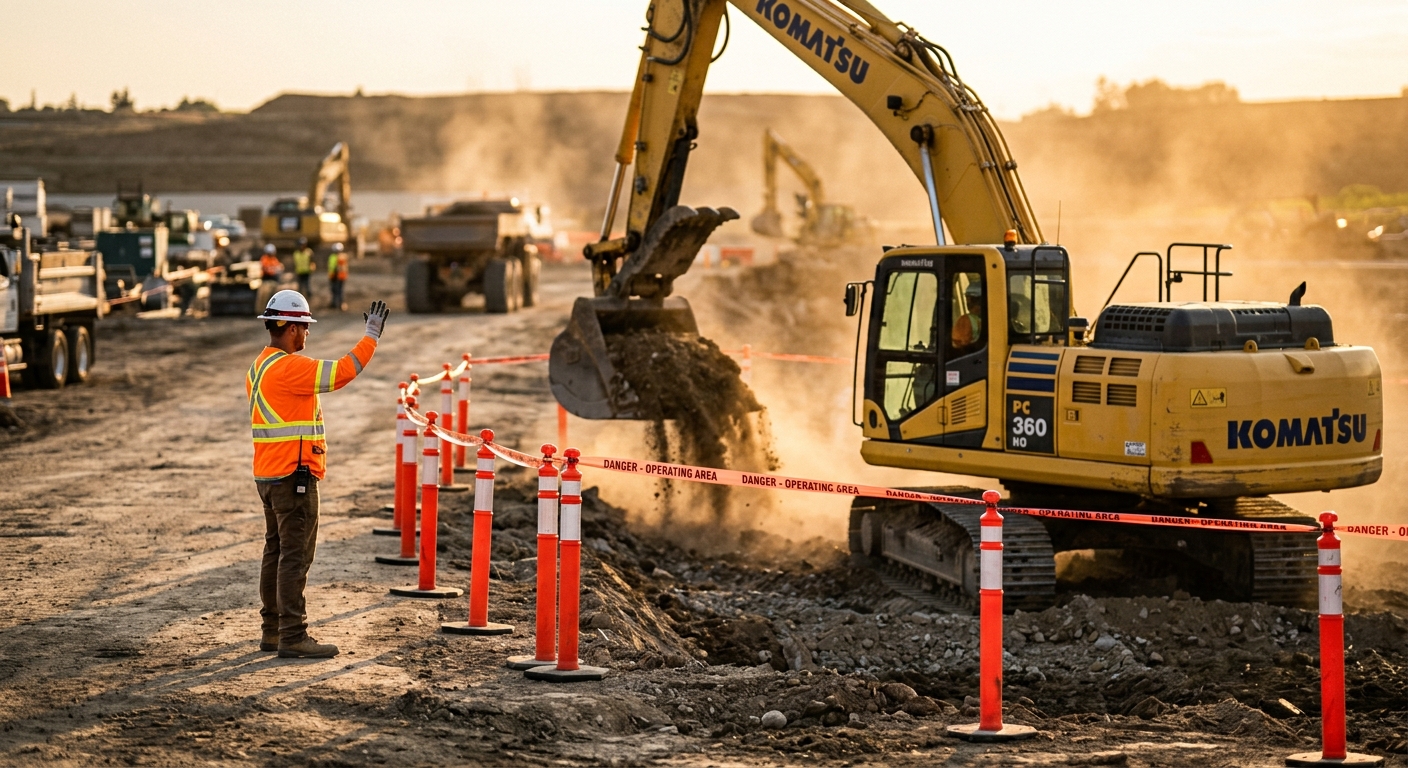
An excavator’s counterweight swings in an arc that’s invisible to the operator and often unmarked on the ground. A standard mid-size excavator has a tail swing of 8-10 feet from the center pin. At full swing speed, that counterweight delivers enough force to be fatal.
Required controls:
- Mark the swing radius with cones, caution tape, or painted lines
- No foot traffic inside the swing radius while the machine is running
- Operators must check blind spots before every swing — not just once at startup
- If ground workers must enter the radius, the machine shuts down completely
Blind Spot Protocol
Every piece of heavy equipment has blind spots. The larger the machine, the more area the operator simply cannot see.
Establish a clear rule: If you can’t see the operator’s mirrors, the operator can’t see you.
For loaders and dozers working in reverse:
- Audible backup alarm plus visual check before reversing
- Spotter assigned when backing toward any work area
- Designated safe zones where ground workers wait during machine movement
Critical: Never allow workers to walk between machines in a multi-equipment operation. Establish one-way traffic patterns and designated pedestrian paths. The 30 seconds saved by cutting between two loaders isn’t worth the risk.
PPE Requirements for Heavy Equipment Operations
OSHA mandates specific PPE based on jobsite hazards. For heavy equipment operations, the minimum typically includes:
Required PPE (Minimum)
Always Required:
- Hard hat (ANSI Z89.1 rated)
- High-visibility vest or clothing (Class 2 minimum, Class 3 near roadways)
- Steel-toe boots (ASTM F2413 rated)
- Safety glasses (ANSI Z87.1 rated)
- Hearing protection when noise exceeds 85 dB (most equipment operations)
Situational:
- Respiratory protection (dusty conditions, demolition)
- Fall protection (working at heights, steep slopes)
- Cut-resistant gloves (handling materials, chain work)
- Face shield (grinding, welding, chipping)
Operator PPE Inside the Cab
This is where it gets debated. Inside a modern enclosed cab, do operators need hard hats and hi-vis?
OSHA’s position: If the cab provides equivalent protection (enclosed ROPS, FOPS), operators may remove hard hats while inside. However — the moment they step out, full PPE goes back on. And seat belts are always required when ROPS is installed.
Most contractors require full PPE at all times on the jobsite because it’s simpler than managing the on/off transition. One rule, no exceptions, no confusion.
Communication Protocols on Active Jobsites
Miscommunication kills people on jobsites. Between engine noise, distance, and the assumption that “they probably saw me,” communication failures cause a huge percentage of incidents.
Hand Signals
OSHA requires standardized hand signals for crane and hoisting operations, but every equipment operation benefits from clear signals:
- Stop: One arm extended, palm open, facing the operator
- Move forward: Arm extended, palm up, beckoning motion
- Move back: Arm extended, palm down, pushing motion
- Swing left/right: Arm extended, pointing in the direction of travel
- Emergency stop: Both arms extended, crossing back and forth rapidly
The critical rule: Only one person directs each machine at a time. Multiple people giving signals creates confusion and danger. Designate your signal person and make sure the operator knows who to watch.
Radio Communication
Two-way radios are standard on larger jobsites. Basic protocol:
- Identify yourself and the machine: “Spotter to Excavator 1”
- Wait for acknowledgment before giving direction
- Use clear, specific language: “Stop swing” not “Hey, watch out”
- Confirm when action is complete: “Excavator 1, holding position”
Ground Conditions and Stability
Equipment rollovers are the second leading cause of heavy equipment fatalities. Most rollovers happen because of ground conditions — not operator error.
Before You Set Up
- Check ground bearing capacity. Saturated ground, recent fill, and clay soils can fail under equipment weight
- Identify slopes. Most equipment has maximum grade ratings — exceed them and physics wins
- Look for underground voids. Old septic tanks, abandoned wells, mine shafts, and storm drains create invisible collapse hazards
- Check weather forecast. Rain overnight can change stable ground into a rollover hazard by morning
Case Study: The Soft Shoulder
A contractor positioned a 30-ton excavator on what appeared to be solid ground near a retention pond. The ground had been backfilled two years prior but never properly compacted. Mid-swing with a full bucket, the right track broke through the surface and the machine rolled 90 degrees into the pond.
The operator survived because he was wearing his seat belt. The machine was recovered, but the repair bill exceeded $45,000. A simple ground assessment with a probe rod would have identified the soft fill in five minutes.
Slope Operations
- Never exceed the manufacturer’s maximum grade rating
- Always work up and down slopes, never across (when possible)
- Keep the bucket/attachment low and close to the machine when traveling on grades
- If the machine starts to slide, do not jump. Stay belted in the ROPS cab
Loading and Lifting Safety
Every time you lift a load — whether it’s a bucket of material, a pipe, or a concrete barrier — you’re performing a lift operation that requires planning.
Know Your Capacity
- Never exceed the machine’s rated lift capacity at any radius
- Capacity decreases as reach increases — check the load chart for your specific configuration
- Account for attachment weight in your capacity calculation
- Soft ground reduces effective capacity (outriggers may not hold full rated load)
Loading Trucks and Trailers
- Trucks must be stationary and braked before loading begins
- The truck driver stays in the cab or outside the swing radius — never between the machine and truck
- Load from the side, not over the cab
- Communicate clearly when loading is complete before the truck moves
Emergency Response Planning
Every jobsite needs an emergency action plan. OSHA requires it, but more importantly, when something goes wrong, panic fills any gap where a plan should be.
Minimum Emergency Plan Elements
- Emergency contacts posted visibly (911, nearest hospital address, company safety officer)
- First aid kit location known by all workers
- Assembly point designated and communicated
- Who calls 911 — assign a specific person (bystander effect is real)
- Equipment shutdown procedure — who shuts down what, in what order
- Utility emergency contacts (gas, electric, water) for underground strikes
First Aid and CPR
OSHA requires that someone trained in first aid and CPR be present on jobsites that aren’t in “near proximity” to a medical facility. In practice, this means most rural or suburban jobsites need at least one certified responder.
Investment Worth Making: A basic first aid and CPR certification costs about $75-$100 per person and takes one day. Having multiple certified responders on your crew isn’t just OSHA compliance — it’s the difference between effective response and helpless bystanders in a real emergency.
Digital Safety Documentation
OSHA inspectors love paper trails. Digital ones are even better because they’re timestamped, searchable, and harder to lose.
What to Document
- Daily pre-operation inspections (per machine, per shift)
- Safety briefing attendance (who was there, what was covered)
- Incident reports (including near-misses — these are gold for prevention)
- Training records (operator certifications, safety training dates)
- Equipment maintenance logs (safety-related repairs and inspections)
Fleet Management Tools for Safety
Fleet maintenance apps like FieldFix let you run a daily pre-start walkaround on each machine and keep service records, repairs and notes against it. When someone asks how your excavator has been maintained, the record is on your phone instead of in a filing cabinet. FieldFix isn’t a compliance program, so keep whatever inspection and training records your work requires.
Digital logs also help you spot patterns. If the same machine keeps flagging hydraulic issues during pre-op checks, that’s a safety signal — address it before it becomes an incident report.
Building a Safety Culture That Sticks
Rules don’t create safety. Culture does. And culture comes from the top.
What Actually Works
Lead visibly. If the owner skips PPE “just for a second,” the crew notices. Every time. You wear it, they wear it.
Reward reporting. When someone stops work because something felt wrong, that’s not a delay — it’s the system working. Thank them publicly.
Make near-miss reporting easy. Near-misses are free lessons. If reporting them is complicated or carries stigma, you’ll never hear about them — until the near-miss becomes an actual miss.
Train continuously. One annual safety meeting doesn’t cut it. Short, focused topics during daily briefings build awareness over time. Five minutes on swing radius Monday. Five minutes on ground conditions Tuesday. It compounds.
Investigate without blame. When incidents happen, the question is “what failed in our system?” not “whose fault was this?” Blame drives reporting underground. System thinking prevents recurrence.
The Safety Pays Calculation: OSHA’s own data shows that for every $1 invested in workplace safety, companies save $4-$6 in avoided costs. Lower insurance premiums, fewer workers’ comp claims, less equipment damage, and zero OSHA fines. Safety isn’t a cost center — it’s a profit center.
Track Safety and Maintenance in One Place
FieldFix helps equipment operators run a daily walkaround, track maintenance by hours, and keep a service history for every machine. Digital records, AI diagnostics, and cost tracking, all from your phone.
Related Articles
September 4, 2026
Heavy Equipment Fall Service Planning Guide: How to Prevent Winter Downtime
September 3, 2026
Horizontal Directional Drill Maintenance: The Complete HDD Service Guide for Contractors
September 2, 2026