Heavy Equipment Rigging Inspection Guide: Slings, Shackles, Hooks, and Safe Lifts
Learn how to inspect rigging gear for heavy equipment, catch lift hazards early, and build a safer lifting routine for slings, shackles, hooks, and hardware.
Heavy equipment owners spend plenty of time thinking about engines, hydraulics, and undercarriages. Fair enough. Those systems are expensive, and when they fail, they fail loudly.
Rigging gear is different. It usually fails quietly first.
A sling gets nicked. A hook throat opens up a little. A shackle pin gets swapped with the wrong size. A tag disappears, and suddenly nobody knows the working load limit. Then one day a “routine” lift turns into a dropped attachment, a damaged machine, or somebody getting badly hurt.
That’s why rigging inspection deserves its own system. If your crew lifts buckets, trench boxes, pipe, pallets, concrete forms, engines, or attachments, your slings and hardware are part of the machine’s reliability story. They are not just accessories.
Why rigging inspections matter
Rigging sits at the intersection of maintenance and safety. Bad rigging practices create three kinds of problems fast:
If you’re running a busy fleet, rigging often gets shared across trucks, machines, and crews. That makes it even easier for worn gear to stay in circulation longer than it should.
The best operators treat rigging like brake components or hydraulic hoses: inspect it often, document it, and retire it early when something looks off.
What to inspect before every lift
A pre-lift rigging check does not need to be complicated. It just needs to be consistent.
Before every lift, your operator or signal person should check:
- The correct sling type for the load
- Working load limit tags are present and readable
- No cuts, tears, kinks, broken wires, heat damage, or chemical damage
- Shackles, hooks, and links are the right size and type
- Latches work correctly on hooks where required
- Pins fully seat and match the body they belong to
- No visible stretching, twisting, or deformation
- Load path is clean, balanced, and free of pinch points
- Lift points on the attachment or load are rated and in good condition
This takes a couple of minutes. That’s a bargain compared to the cost of a failed lift.
How to inspect common rigging types
Different rigging materials fail in different ways. That means your inspection criteria should match the gear.
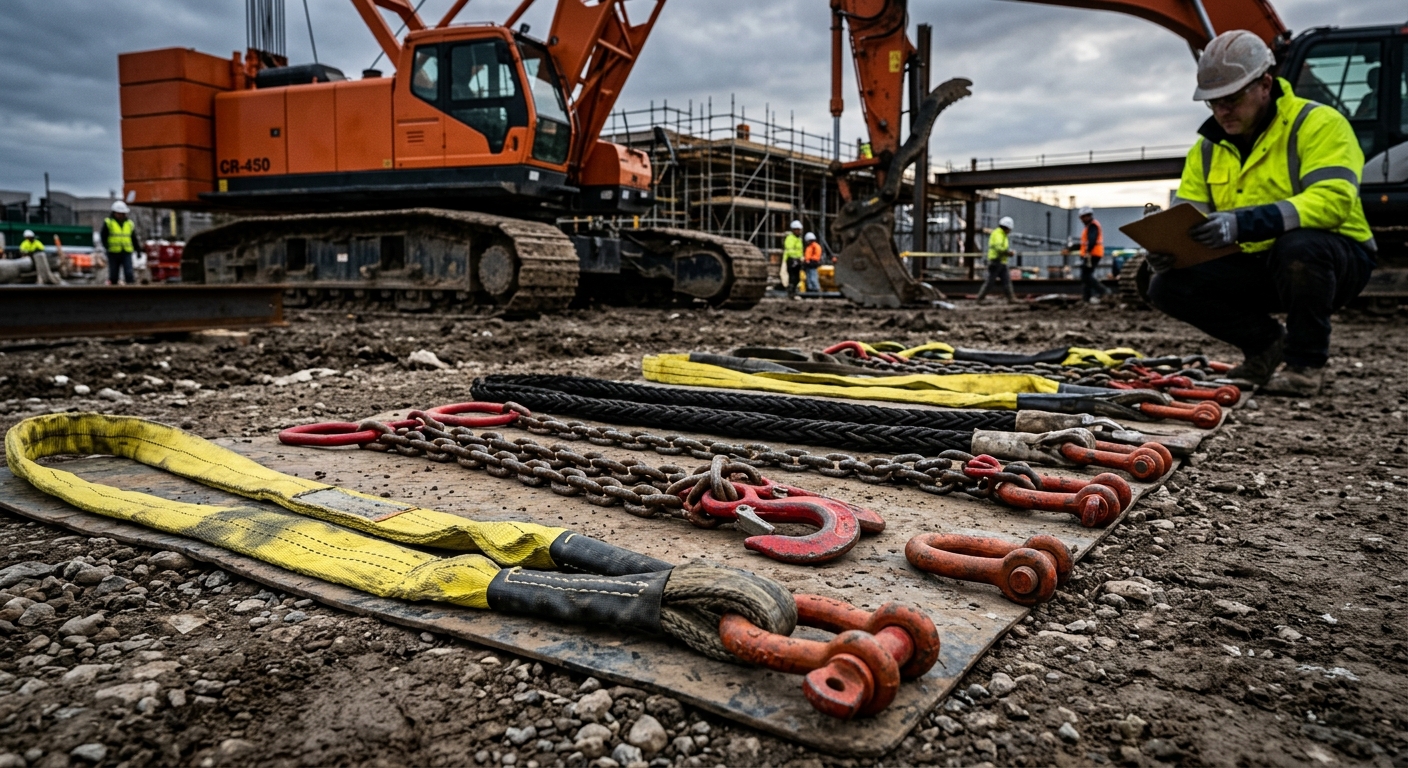
Synthetic web slings
Synthetic web slings are common because they’re light, flexible, and easy to use around finished surfaces. They’re also easy to abuse.
Look for:
- Cuts, punctures, and frayed edges
- Melted fibers or glazing from heat
- Stiff, brittle, or discolored sections from chemical exposure
- Broken stitching in load-bearing seams
- Crushed or stretched eyes
- Missing or unreadable identification tags
If the sling has been dragged across concrete, pinched under steel, or used around sharp edges without protection, inspect it hard. Synthetic damage tends to compound quickly.
Round slings
Round slings hide their load-bearing fibers inside a cover, which makes external inspection even more important.
Check for:
- Holes or tears in the outer cover
- Lumpy or flat spots that suggest internal yarn damage
- Burn marks, abrasions, or chemical staining
- Distortion near contact points
If the cover is compromised, don’t guess about the inside. Pull it from service.
Wire rope slings
Wire rope slings hold up well in rough environments, but they telegraph damage clearly if you know what to watch for.
Inspect for:
- Broken wires
- Bird-caging or strand separation
- Kinks and crushing
- Corrosion, especially at fittings
- Flattened sections from improper loading
- Damaged thimbles, ferrules, or eyes
Wire rope often survives long enough to tempt people into “one more job.” That’s dumb. Once structure changes, capacity confidence is gone.
Chain slings
Alloy chain slings are tough and repairable, but only if inspected by somebody who knows what they’re doing.
Watch for:
- Stretched links
- Gouges, nicks, and weld splatter
- Twisted or bent links
- Heat damage or discoloration
- Cracked master links or coupling links
- Worn hooks or latch failures
Measure questionable links against unworn sections. If dimensions have changed, the chain has been overloaded or damaged.
Shackles, hooks, and hardware
This is where a lot of crews get sloppy.
Inspect hardware for:
- Bent shackle bodies
- Pin thread damage or mismatch
- Hook throat opening beyond spec
- Point twist or side loading marks
- Cracks at high-stress corners
- Missing cotter pins, retaining clips, or safety latches
- Elongated holes in lift points
- Keep matched pins with their original shackles
- Store rigging off the ground and out of weather
- Use edge protection around sharp loads
- Tag damaged gear immediately
- Mixing random pins and bodies
- Dragging slings across gravel or steel decking
- Using unrated attachment points
- Keeping “maybe okay” gear in circulation
Red flags that mean remove from service
A lot of inspection problems come from indecision. The crew sees something questionable, but nobody wants to be the person who sidelines gear in the middle of the day.
So here’s the clean rule: if you cannot verify the gear’s identity, condition, or rating, it should not be used.
Immediate remove-from-service triggers include:
- Missing or illegible capacity tag
- Any crack in hardware or fittings
- Heat damage on synthetic or alloy components
- Severe abrasion, cuts, or broken stitching
- Bent, twisted, stretched, or deformed metal parts
- Evidence of shock loading or overload
- Corrosion that affects surface integrity
- Unauthorized field repairs or welded modifications
When in doubt, quarantine the gear, tag it, and have a qualified person inspect it.
Building a rigging inspection system
The companies that do this well don’t rely on memory. They build a repeatable process.
Here’s a simple system that works:
1. Assign ownership
Someone has to own rigging inventory. On a small crew, that may be the shop lead, foreman, or owner. On a larger fleet, it may be a safety or maintenance coordinator.
2. Create an inventory list
Track each sling set, chain assembly, shackle group, and specialty lifting device. Include:
- Type
- Size
- Rated capacity
- Serial or ID number if available
- Purchase date
- Storage location
- Inspection status
3. Separate daily checks from periodic inspections
Daily visual checks are fast. Periodic documented inspections should be more deliberate and performed by a qualified person at defined intervals.
4. Standardize storage
Rigging dies young when it lives in mud, UV, oil, and the bottom of a truck bed. Use racks, bins, hooks, and weather protection.
5. Document removals and replacements
If gear was retired, note why. Over time, those records show patterns: one crew dragging slings, one job type causing unusual wear, or one storage area wrecking synthetic gear.
Field example: cost of skipping inspections
That’s the real cost equation. Rigging inspection is not just about preventing catastrophic injury—though that alone should be enough. It also protects margins.
A $90 shackle, a $180 sling, or a 5-minute inspection is cheap. Trailer repairs, lost crew time, damaged attachments, insurance headaches, and job delays are not.
Final takeaway
Rigging gear is easy to ignore because it isn’t bolted to the machine. That’s a mistake.
If your operation lifts attachments, engines, pipe, structures, or materials, your slings and hardware are mission-critical equipment. Treat them that way.
Inspect before every lift. Document periodic checks. Remove questionable gear fast. Store it properly. And give your crews a dead-simple standard: if the rating is unknown or the condition is questionable, it doesn’t fly.
FieldFix helps contractors track maintenance, document field issues, and keep critical equipment information in one place—so fewer problems slip through the cracks.