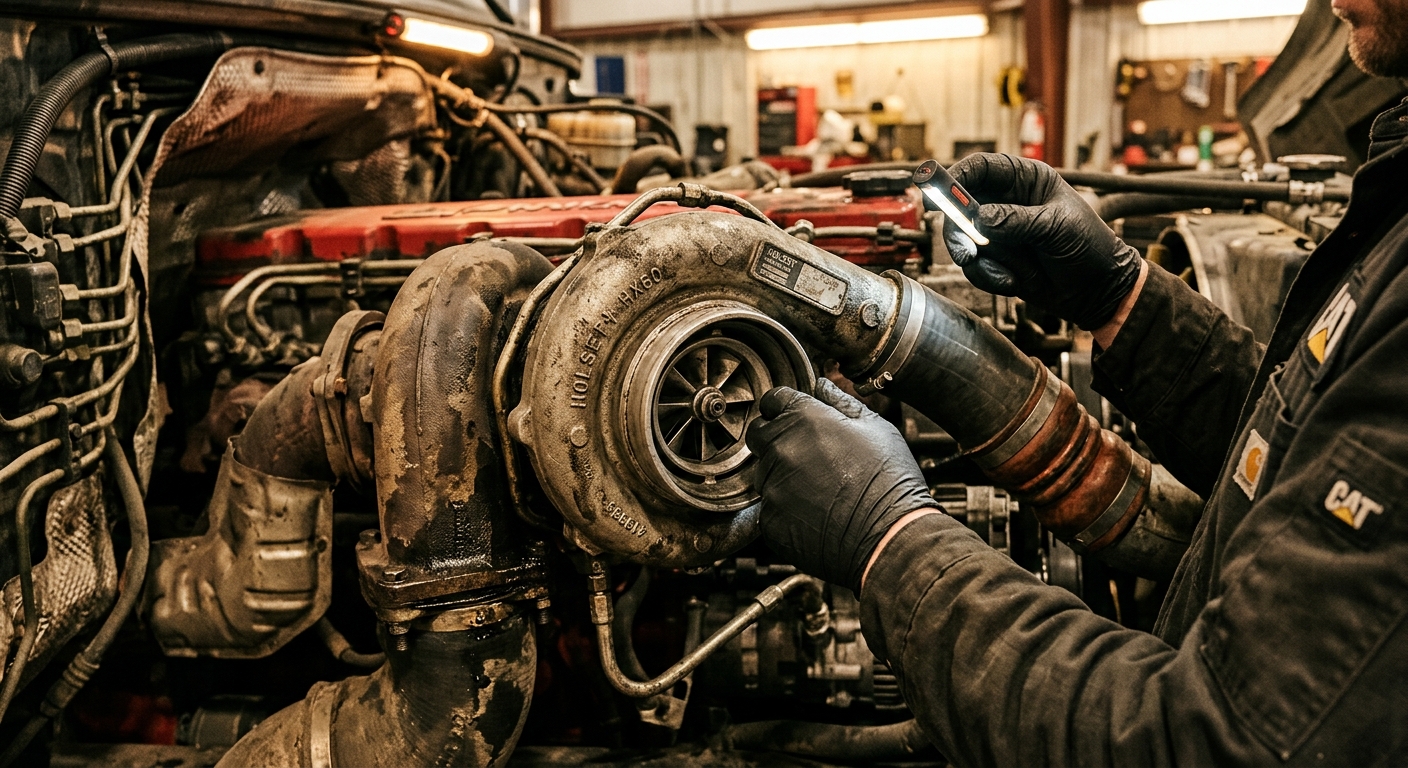
Heavy Equipment Turbocharger Maintenance: The Complete Guide to Preventing Costly Turbo Failures
Learn how to maintain and troubleshoot turbochargers on heavy equipment. Prevent costly failures with proper oil management, air filtration, and early warning signs.
Key Takeaways
- Turbo failures cost $3,000–$8,000+ per incident — most are preventable with basic maintenance
- Oil quality is the #1 factor — 90% of premature turbo failures trace back to oil-related issues
- Cool-down periods matter — shutting down under load can cut turbo life by 50%
- Air leaks kill turbos silently — a cracked intake boot can destroy a turbo in weeks
- Watch for the warning signs — excessive smoke, loss of power, and unusual whine all signal trouble
Your turbocharger spins at up to 150,000 RPM, handles exhaust temperatures exceeding 1,200°F, and forces compressed air into your engine thousands of times per minute. It’s one of the hardest-working components on your heavy equipment — and one of the most expensive to replace when it fails.
The good news? Most turbo failures are completely preventable. The bad news? Most operators don’t realize they’re killing their turbo until it’s too late.
Here’s everything you need to know to keep your turbochargers running strong and avoid those brutal repair bills.
How Turbochargers Work in Heavy Equipment
Understanding the basics helps you understand why certain maintenance practices matter so much.
A turbocharger uses exhaust gas energy to spin a turbine wheel. That turbine is connected by a shaft to a compressor wheel on the opposite side. As the compressor wheel spins, it draws in ambient air, compresses it, and forces it into the engine’s intake manifold.
More air means more fuel can be burned. More fuel burned means more power. That’s how a 6-liter diesel engine can produce the same power as a naturally aspirated engine twice its size.
The critical detail: the turbo shaft spins on a thin film of oil — not ball bearings (in most heavy equipment applications). That oil film is typically just 0.001 to 0.003 inches thick. If that film breaks down for even a moment, metal touches metal at 100,000+ RPM. The result is catastrophic and immediate.
Variable Geometry Turbos (VGT): Many modern Tier 4 and newer machines use variable geometry turbochargers with adjustable vanes. These provide better low-RPM response but add complexity — the vane mechanism can stick from soot buildup, creating additional maintenance considerations covered below.
Why Turbo Failures Are So Expensive
A turbo failure rarely stays contained. When a turbo lets go, the damage cascades.
When a turbo fails, broken pieces can enter the engine through the intake, scoring cylinders and damaging valves. Oil from the failed bearing seal can flood the intake, causing a diesel runaway scenario. Exhaust leaks from the turbine side can damage wiring harnesses and nearby components.
A $4,000 turbo replacement can easily become a $15,000+ repair when you factor in collateral damage and lost productivity.
The 5 Most Common Causes of Turbo Failure
1. Oil Starvation and Contamination
This is the big one. Roughly 90% of premature turbo failures are oil-related.
The turbo bearing relies on a continuous supply of clean, properly pressurized oil. Anything that disrupts that supply — low oil level, clogged oil feed line, degraded oil, or contaminated oil — starts the clock on a turbo failure.
Oil that’s been run past its change interval breaks down and loses its ability to maintain that critical bearing film. Contaminated oil introduces abrasive particles that erode bearing surfaces at microscopic levels, gradually increasing clearances until the shaft wobbles and contacts the housing.
Critical: After any engine work that drains the oil system — oil change, filter replacement, oil cooler service — always pre-prime the turbo before starting the engine. Crank the engine without starting (fuel shutoff or disconnect injectors) until oil pressure registers, then start normally. Running a dry turbo for even 5 seconds can cause measurable bearing damage.
2. Hot Shutdowns
When you shut down a diesel engine that’s been working hard, the turbo is still extremely hot. Under load, exhaust gas temperatures at the turbine can exceed 1,200°F. The turbo shaft is spinning at tens of thousands of RPM.
Kill the engine suddenly and two things happen: oil flow stops immediately, and residual heat “cokes” the remaining oil in the bearing housing. Coked oil forms hard carbon deposits that act like sandpaper on bearing surfaces the next time you start up.
3. Air System Leaks and Restrictions
The compressor side of your turbo is designed to work against specific pressure conditions. When intake restrictions increase (dirty air filter) or boost pressure leaks out (cracked charge air cooler boot, loose clamp), the turbo compensates by spinning faster.
Running a turbo beyond its designed speed range generates excessive heat, overloads bearings, and can cause compressor wheel fatigue cracking. A simple air leak that costs $15 to fix can destroy a $4,000 turbo.
4. Foreign Object Damage (FOD)
Anything that enters either side of the turbo — dust past a failed air filter, debris through a disconnected intake pipe, or exhaust-side material from a deteriorating manifold gasket — damages the precision-machined wheels.
Even small nicks on compressor or turbine blades create imbalance. At 100,000+ RPM, even microscopic imbalance generates destructive vibration that accelerates bearing wear.
5. Exhaust Restrictions
A clogged DPF (diesel particulate filter), damaged exhaust pipe, or restricted aftertreatment system creates backpressure that the turbo wasn’t designed to handle. Excessive backpressure overheats the turbine side, pushes hot exhaust gas past turbine seals, and can force oil out of the bearing housing.
Essential Turbocharger Maintenance Practices
Oil Management — Your Turbo’s Lifeline
Change oil on schedule. No exceptions. For turbocharged diesel engines in heavy equipment, this typically means every 250–500 hours depending on your machine’s specs and operating conditions. Dusty environments, high-load applications, and extreme temperatures all justify shorter intervals.
Use the correct oil specification. Turbocharged diesels need oils rated for high-temperature stability. Your engine manufacturer specifies the oil grade and API/ACEA rating for a reason — the turbo bearing is usually that reason. Running a cheaper oil that doesn’t meet spec is false economy.
Monitor oil pressure. Low oil pressure is the earliest indicator of future turbo problems. If your machine has an oil pressure gauge (not just an idiot light), note the normal readings at idle and operating RPM. Any drop from baseline warrants investigation before it becomes a turbo problem.
Pro Tip: Send oil samples for analysis every other change interval. Elevated aluminum or copper in the oil report can indicate turbo bearing wear months before you’d notice any performance change. This gives you time to plan a scheduled turbo service instead of dealing with an emergency failure in the field.
Air Filtration — Keep It Sealed
Inspect air filters at every pre-op check. You don’t need to pull the filter every day — just check the restriction indicator if your machine has one. But do visually inspect the intake system for loose clamps, cracked boots, and damaged piping.
Replace air filters before they reach maximum restriction. A clogged filter doesn’t just reduce power — it creates a vacuum on the compressor inlet that can pull oil past the compressor seal, contaminating the charge air cooler and intake manifold.
Check every connection between the air filter and the turbo inlet. The most dangerous air leaks are between the filter and the turbo — unfiltered air goes directly into the compressor. A loose clamp here does more damage than no air filter at all, because operators assume they’re protected when they’re not.
Boost System Integrity
Inspect charge air cooler (intercooler) boots and clamps monthly. Heat cycling causes rubber boots to crack and clamps to loosen over time. A boost leak here means your turbo works harder to maintain pressure, running hotter and faster than designed.
Check the charge air cooler for damage. Rocks, debris, and vibration can crack intercooler fins or tanks. An internal leak lets compressed air escape; an external leak lets oil contaminate the system. Either way, the turbo pays the price.
Turbo Cool-Down: The Habit That Saves Thousands
This is the single easiest thing you can do to extend turbo life, and most operators skip it.
Before shutting down, idle the engine for 3–5 minutes. That’s it. Just let it idle.
The idle cool-down allows:
- Turbo shaft speed to drop from 80,000+ RPM to under 20,000 RPM
- Exhaust temperatures to fall from 1,200°F+ to under 500°F
- Oil to circulate and carry heat away from the turbo bearing
- The bearing housing to cool gradually instead of soaking in residual heat
Some newer machines have turbo timers that keep the engine running after you turn the key off. If your machine has this feature, don’t override it. If it doesn’t, build the cool-down habit into your shutdown routine.
The exception: If the machine has been idling or running at light load for several minutes already, the turbo is already cool. You don’t need an additional cool-down period in that case.
Real-World Example: The $7,200 Shortcut
A contractor running a 200HP excavator had operators who routinely shut down immediately after heavy digging to move to the next task. Within 18 months, they’d replaced two turbochargers at $3,600 each. After implementing a mandatory 5-minute cool-down policy, the third turbo lasted over 6,000 hours — the full expected service life.
Total cost of cool-down habit: ~15 minutes per day × $0 = Free.
Cost of skipping it: $7,200 in turbo replacements + 8 days of downtime.
Warning Signs Your Turbo Is Failing
Catch these early and you might save the turbo — or at least prevent collateral engine damage.
Excessive Exhaust Smoke
- Black smoke under load: Could indicate a boost leak (turbo can’t maintain pressure) or failing compressor wheel
- Blue/gray smoke: Oil burning past turbo seals — the turbo bearing clearances have increased enough to let oil into the exhaust or intake stream
- White smoke at startup that clears: Minor oil seepage past seals during shutdown — early warning sign
Loss of Power
If the engine feels sluggish under load, the turbo may not be producing full boost. Check boost pressure with a gauge before assuming it’s a fueling problem. Low boost with a healthy fuel system points to turbo issues.
Unusual Sounds
- High-pitched whine or whistle: Could indicate compressor surge or a boost leak near the turbo
- Grinding or metallic scraping: Shaft bearing failure — shut down immediately
- Cyclical whooshing: Compressor surge from operating outside its efficiency range
Oil Consumption Increase
If oil consumption increases without visible external leaks, the turbo seals may be allowing oil to pass into the intake or exhaust. Check for oil residue in the intake piping downstream of the turbo and in the exhaust.
Troubleshooting Turbo Problems in the Field
When you suspect turbo trouble on site, here’s how to diagnose before calling for a tow.
Quick Field Checks
Visual Inspection:
- Remove intake piping at turbo inlet — spin compressor wheel by hand. It should spin freely with no contact or roughness
- Check for axial play (in-out movement) on the shaft — more than slight movement indicates bearing wear
- Look for oil in the intake piping between turbo and engine
- Inspect exhaust manifold and turbo housing for cracks or leaks
Boost Pressure Test:
- Connect a boost gauge to the intake manifold
- Run engine at full load — compare reading to spec
- Low boost + good air system = turbo issue
- Low boost + air leaks found = fix leaks first, retest
Oil Feed Check:
- Disconnect oil feed line at turbo (engine off)
- Crank engine briefly — oil should flow freely
- Restricted or no flow = clogged feed line or low oil pressure
Turbo Maintenance Schedule by Hours
| Interval | Action |
|---|---|
| Every 10 hours (daily) | Visual check of intake system integrity, listen for unusual sounds during warmup |
| Every 250 hours | Inspect all boost system connections and clamps, check air filter restriction |
| Every 500 hours | Oil sample analysis (check for turbo bearing metals), inspect charge air cooler boots |
| Every 1,000 hours | Full turbo inspection — check shaft play, spin test, inspect for oil leaks at seals |
| Every 2,000 hours | Professional turbo assessment — measure bearing clearances, inspect wheels for damage |
| 5,000–8,000 hours | Typical turbo service life in heavy equipment — plan for rebuild or replacement |
VGT-Specific Maintenance: If your machine uses a variable geometry turbo, add a vane actuation check at every 500-hour interval. The vanes should move freely through their full range. Sticky vanes are common on machines that idle extensively — occasional full-load operation helps keep vanes clean.
When to Rebuild vs. Replace
Rebuild
Pros:
- 40–60% less expensive than new ($1,200–$2,500 typical)
- Can be done with machine on-site by a mobile turbo shop
- OEM-quality parts available from reputable rebuilders
- Turnaround often faster with exchange programs
Cons:
- Quality varies widely between rebuild shops
- May not address housing wear or hard-to-detect cracks
- Warranty typically shorter than new (6–12 months vs. 2+ years)
- Not cost-effective if housing is damaged
Replace with New/Reman
Pros:
- Full manufacturer warranty (usually 2 years)
- Guaranteed clearances and balance
- Often includes updated components that address known failure modes
- Peace of mind on critical, high-value equipment
Cons:
- Higher upfront cost ($3,000–$5,000+)
- Lead time can be weeks for less common models
- Premium for OEM — aftermarket alternatives exist but quality varies
The general rule: If the turbo failed from oil starvation or FOD and the housing is scored or cracked, replace it. If it’s a wear-out failure with intact housing, a quality rebuild is usually the smart financial play.
How FieldFix Tracks Turbo Health
Turbo failures don’t happen overnight — they develop over hundreds of hours. The key to prevention is tracking the leading indicators consistently.
FieldFix helps you stay ahead of turbo problems by:
- Tracking service intervals for oil changes, filter replacements, and turbo inspections tied to actual operating hours
- Logging maintenance history so you can spot patterns (machines that eat turbos may have underlying oil system issues)
- AI diagnostics that take the symptoms you describe, like smoke color, power loss, and unusual sounds, research your make and model, and point you to the most likely turbo-related cause before it becomes a failure
- Cost tracking per machine (on Pro) so turbo repairs show up in what each machine costs you per hour
Stop Guessing, Start Tracking
Every turbo failure has a history of missed warning signs. FieldFix gives you the tools to catch problems early, track maintenance properly, and make data-driven decisions about when to service, rebuild, or replace.
The Bottom Line
Turbocharger maintenance isn’t complicated — it’s mostly about oil quality, air system integrity, and giving the turbo time to cool down before shutdown. These three habits alone prevent the vast majority of premature turbo failures.
The machines that get the most hours out of their turbos aren’t running anything special. They’re just running clean oil, sealed air systems, and operators who idle down before turning the key off. That’s it.
Your turbo is spinning at the speed of a dental drill while handling temperatures that would melt aluminum. Treat it with the respect that kind of engineering deserves, and it’ll reward you with thousands of hours of reliable boost.
Related Articles

September 4, 2026
Heavy Equipment Fall Service Planning Guide: How to Prevent Winter Downtime

September 3, 2026
Horizontal Directional Drill Maintenance: The Complete HDD Service Guide for Contractors

September 2, 2026