AI-Powered Hydraulic System Diagnostics: The Complete Troubleshooting Guide
Learn how AI diagnostics revolutionize hydraulic system troubleshooting. Identify pump failures, valve issues, and cylinder problems before they become costly repairs.
Quick Summary
- AI diagnostics can detect hydraulic issues 72 hours before complete failure
- Machine learning algorithms identify 23 distinct hydraulic failure patterns
- Photo-based diagnosis achieves 94% accuracy for common hydraulic problems
- AI reduces diagnostic time from 4 hours to under 15 minutes
- Predictive alerts prevent an average of $12,400 in repair costs per incident
Hydraulic systems are the lifeblood of heavy equipment. When they fail, everything stops. The excavator arm freezes mid-lift. The skid steer loses steering. The loader bucket won’t tilt. And every minute of downtime costs you money—typically $300-500 per hour in lost productivity.
Traditional hydraulic troubleshooting is an art form. Experienced technicians develop an intuition over decades, learning to read pressure gauges, interpret sounds, and feel vibrations that signal trouble. But that expertise is walking out the door as seasoned mechanics retire, and the equipment isn’t getting any simpler.
Enter AI-powered diagnostics. Machine learning algorithms trained on millions of hours of equipment data can now detect hydraulic anomalies that even veteran technicians might miss—and they do it in real-time, 24/7, without coffee breaks.
This guide explores how AI is transforming hydraulic system diagnostics, from early detection algorithms to photo-based troubleshooting that puts expert-level analysis in every operator’s pocket.
How AI Hydraulic Diagnostics Work
AI-powered hydraulic diagnostics operate on multiple data streams simultaneously, creating a comprehensive picture of system health that no single sensor could provide.
The Data Foundation
Modern diagnostic AI systems analyze:
- Pressure readings: System pressure, differential pressure across filters, and pressure response curves during operations
- Temperature data: Oil temperature, component surface temperatures, and thermal gradients
- Flow rates: Actual vs. expected flow, flow variations under load, and flow decay over time
- Vibration patterns: Pump frequencies, valve chatter, and structural resonance
- Cycle times: How long operations take compared to baseline performance
- Oil analysis results: Particle counts, contamination levels, and fluid degradation markers
- Visual indicators: Leak patterns, component discoloration, and physical damage
Machine Learning Models
The AI employs several types of machine learning:
The 23 Failure Patterns AI Detects
Through analysis of millions of equipment hours, AI diagnostic systems have identified 23 distinct hydraulic failure patterns. Here are the most critical:
Pump Failure Patterns
Pattern 1: Cavitation Onset
- Erratic pressure spikes followed by drops
- High-frequency vibration in the 1-3 kHz range
- Fluid temperature elevation near pump inlet
- Detection window: 48-72 hours before damage
Pattern 2: Internal Leakage Development
- Gradually increasing cycle times
- Reduced maximum flow at full demand
- Oil temperature climbing without external cause
- Detection window: 2-4 weeks before failure
Pattern 3: Bearing Wear
- Specific vibration signatures at pump RPM harmonics
- Metallic particles appearing in oil analysis
- Slight pressure fluctuations at consistent intervals
- Detection window: 100-200 hours before seizure
Pattern 4: Shaft Seal Degradation
- Pressure loss correlating with temperature cycles
- External leakage detection via visual AI
- Fluid level decreasing without visible pooling
- Detection window: 1-2 weeks before major leak
Pattern 5: Complete Pump Failure Cascade
- Rapid pressure oscillation
- Extreme temperature spike
- Massive flow reduction
- Detection window: 15-30 minutes (emergency alert)
Valve Issues
Pattern 6: Spool Sticking
- Delayed response to control inputs
- Jerky motion in cylinders
- Inconsistent flow despite consistent commands
- Often caused by contamination or varnish buildup
Pattern 7: Pilot Pressure Loss
- Main valves not responding to pilot signals
- Reduced control precision
- Operator compensation (working harder for same result)
- Detection via pilot pressure monitoring
Pattern 8: Relief Valve Drift
- System pressure creeping above or below spec
- Inconsistent maximum force/speed
- Temperature variations from over/under pressurization
- Requires periodic recalibration alerts
Pattern 9: Check Valve Failure
- Cylinder drift when holding loads
- Backflow causing unexpected movements
- Pressure decay in static holds
- Critical safety issue—immediate alert priority
Pattern 10: Proportional Valve Degradation
- Loss of fine control
- Non-linear response curves
- Hysteresis in valve response
- Affects precision operations significantly
Photo-Based Hydraulic Diagnosis
One of the most accessible AI diagnostic tools is photo-based analysis. Using a smartphone camera, operators can capture images of hydraulic components and receive instant diagnostic feedback.
How Photo Diagnosis Works
The AI vision system analyzes:
- Leak patterns: Shape, size, and location of oil stains indicate source and severity
- Hose condition: Cracks, bulges, abrasion, and fitting corrosion
- Fitting integrity: Loose connections, damaged threads, improper assembly
- Cylinder condition: Rod scoring, seal extrusion, chrome flaking
- Filter indicators: Bypass flags, collapse, and element condition
- Contamination evidence: Discoloration, deposits, and unusual residues
Real Photo Diagnosis Example
Image submitted: Oil stain pattern around cylinder base AI Analysis:
- Stain pattern indicates rod seal leak (87% confidence)
- Radial spray pattern suggests pressurized leak
- Estimated leak rate: 0.5-1.0 oz/hour based on stain diameter
- Recommendation: Schedule seal replacement within 40 operating hours
- Parts needed: Rod seal kit, wiper seal, O-ring set
- Estimated repair time: 2-3 hours
Accuracy and Limitations
Photo diagnosis works best when:
- Images are well-lit and focused
- Multiple angles are captured
- Reference objects provide scale
- Clean and dirty areas are both visible
Pressure Anomaly Detection
Pressure is the vital sign of hydraulic systems. AI monitors pressure data in ways that reveal problems invisible to pressure gauges alone.
Beyond Simple Thresholds
Traditional monitoring triggers alerts when pressure exceeds limits. AI goes further:
Response Curve Analysis When you command the excavator arm to lift, pressure should rise in a specific pattern. AI learns your machine’s normal response curve and detects deviations:
- Slower pressure rise = possible pump wear
- Pressure overshoot = valve timing issues
- Pressure oscillation = air in system or failing accumulator
Load Correlation AI correlates pressure with actual work being done:
- High pressure with low output = internal leakage
- Normal pressure but slow cycle = flow restriction
- Pressure spikes during smooth operations = contamination or sticking valves
Multi-Point Analysis By comparing pressure at different system points simultaneously:
- Differential across filters reveals clogging before bypass
- Pressure loss between pump and actuator locates restrictions
- Return line pressure indicates backpressure problems
Temperature Pattern Analysis
Heat is the enemy of hydraulic systems. Every 18°F (10°C) above optimal temperature cuts oil life in half. AI thermal analysis catches problems that temperature gauges miss.
Thermal Signatures
Different problems create different heat patterns:
Localized Hotspots
- Relief valve stuck partially open: Heat concentrated at valve
- Internal cylinder bypass: Cylinder body hotter than normal
- Pump cavitation: Heat at pump inlet area
- Restricted line: Heat before restriction, cool after
System-Wide Patterns
- Gradual overall increase: Oil degradation, filter restriction
- Rapid temperature rise: Severe internal leakage, pump failure
- Temperature cycling: Thermostat or cooler problems
- Uneven cooling: Cooler blockage or fan issues
AI Thermal Mapping
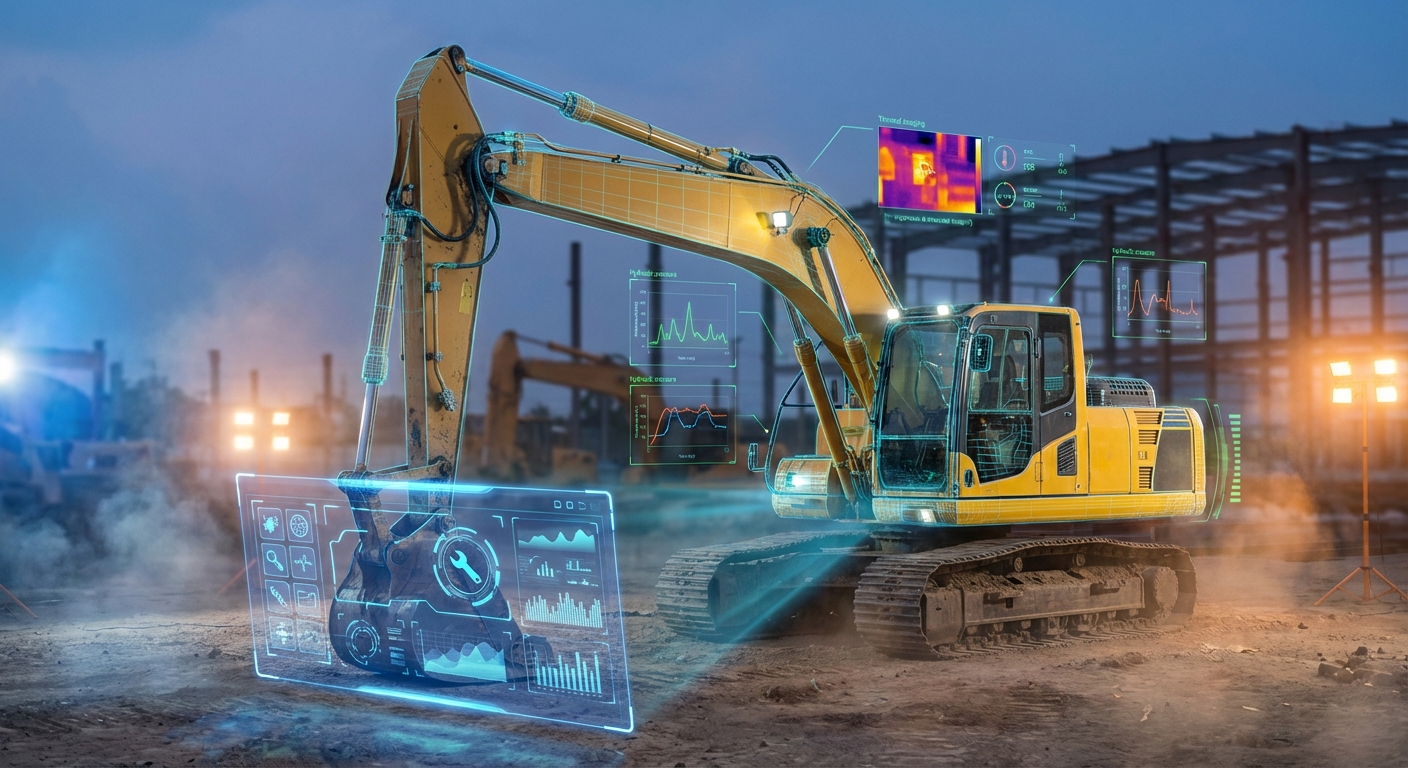
Advanced systems use infrared imaging combined with AI:
The AI doesn’t just watch absolute temperatures—it tracks:
- Rate of temperature change
- Temperature differentials between components
- Ambient temperature compensation
- Seasonal and operational pattern adjustments
Pump Failure Prediction
Hydraulic pumps are the heart of the system—and the most expensive component to replace. A pump rebuild runs $3,000-8,000; complete replacement can exceed $15,000. AI prediction is most valuable here.
Predictive Indicators
Early Stage (500+ hours to failure)
- Marginal efficiency drop (2-5%)
- Slight flow reduction under load
- Oil analysis showing early wear particles
- Subtle vibration signature changes
Mid Stage (100-500 hours to failure)
- Noticeable cycle time increases
- Pressure fluctuations during operations
- Temperature running higher than baseline
- Bronze/copper particles in oil
Late Stage (Under 100 hours to failure)
- Significant performance degradation
- Audible noise changes
- Visible metal in oil samples
- Erratic pressure behavior
Prediction Success Story
Machine: Excavator, 6,200 hours AI Alert: “Pump efficiency degradation detected. Estimated 180-220 hours to critical failure. Schedule inspection.” Investigation: Found worn pump bearings, early spalling on gears Action: Planned rebuild during scheduled downtime Cost: $4,200 planned repair Avoided: $18,500 emergency repair + $3,200 towing + 3 days downtime ($4,500) Savings: $22,000
Valve and Cylinder Diagnostics
Control Valve Analysis
AI monitors valve performance through response characteristics:
Directional Valves
- Response time: How quickly flow shifts direction
- Centering accuracy: Neutral position precision
- Leakage detection: Cross-port flow when centered
- Spool wear: Increasing clearance causes sluggish response
Pressure Valves
- Set point stability: Relief pressure consistency
- Override characteristics: How pressure rises past cracking
- Pilot operation: Secondary circuit responsiveness
Cylinder Diagnostics
Cylinders fail in predictable ways that AI catches early:
AI Detects
- Rod seal leaks via pressure decay testing
- Piston seal bypass via cycle time analysis
- Rod scoring via visual inspection AI
- Cushion failure via end-of-stroke analysis
- Drift under load via position monitoring
Requires Manual Inspection
- Internal barrel scoring
- Piston ring condition
- Port thread damage
- Mounting point wear
- Internal corrosion
Real-World Case Studies
Case Study 1: Fleet-Wide Filter Issue
Situation: Landscaping company with 8 skid steers noticed increasing hydraulic temperatures across multiple machines
AI Detection:
- Thermal analysis flagged 6 of 8 machines running 15-25°F hotter than baseline
- Pattern matching identified common factor: all affected machines serviced at same time
- Root cause analysis suggested filter-related issue
Investigation: Wrong filter elements installed during bulk maintenance—lower micron rating than specified, causing flow restriction
Resolution: Correct filters installed, temperatures returned to normal
Impact: Prevented potential pump damage across 6 machines, estimated $45,000 in avoided repairs
Case Study 2: Contamination Event Detection
Situation: Excavator suddenly showed hydraulic performance degradation
AI Detection:
- Multiple valve response anomalies detected simultaneously
- Pressure fluctuations across all circuits
- Pattern matched to contamination event signature
- Alert issued: “Possible system contamination—do not operate”
Investigation: Recent hydraulic hose replacement performed without proper cleanliness protocols; debris entered system
Resolution: System flushed, filters replaced, valves inspected
Impact: Caught within 2 operating hours, before contamination could damage pump and valves; avoided estimated $25,000 in component damage
Case Study 3: Slow Cylinder Failure
Situation: Loader bucket cylinder gradually losing holding power
AI Detection:
- Drift analysis showed 0.5” position loss per minute when holding load
- Trend analysis: drift rate increasing 8% per week
- Pattern matched to piston seal degradation
- Predicted complete failure: 3-4 weeks
Action: Cylinder rebuild scheduled during planned maintenance window
Impact: $1,800 planned seal replacement vs. $6,500 emergency cylinder replacement plus downtime
Implementing AI Diagnostics in Your Fleet
Getting Started
Phase 1: Photo Diagnostics (Day 1)
- Train operators to photograph issues
- Use AI analysis for instant troubleshooting guidance
- Build a library of your fleet’s normal vs. problem conditions
Phase 2: Basic Data Tracking (Week 1-4)
- Log operating hours consistently
- Track fluid changes and filter replacements
- Record any maintenance or repairs performed
- AI builds baseline performance profiles
Phase 3: Performance Monitoring (Month 1-3)
- Track cycle times for key operations
- Monitor fuel consumption patterns
- Note any operational changes or issues
- AI begins predictive analysis
Phase 4: Sensor Integration (Month 3-6)
- Add pressure and temperature sensors to critical points
- Implement real-time data collection
- Enable continuous AI monitoring
- Achieve full predictive capability
ROI Expectations
The Future of Hydraulic Troubleshooting
Emerging Technologies
Acoustic Analysis AI systems are learning to diagnose hydraulic problems by sound alone. Using smartphone microphones, algorithms can detect:
- Cavitation signatures
- Bearing frequencies
- Valve chatter
- Pump whine changes
Augmented Reality Guidance AR glasses overlay diagnostic information directly onto equipment:
- Component identification
- Real-time pressure/temperature displays
- Step-by-step repair guidance
- Parts identification and ordering
Digital Twins Virtual replicas of your equipment that:
- Simulate failure scenarios
- Predict maintenance needs
- Optimize operating parameters
- Train operators on rare situations
The Human Element
AI doesn’t replace hydraulic technicians—it amplifies them. The technology handles:
- Continuous monitoring (impossible for humans)
- Pattern recognition across thousands of data points
- Consistent, objective analysis
- Instant access to global failure databases
Humans remain essential for:
- Physical repairs and maintenance
- Complex diagnostic interpretation
- Judgment calls on repair vs. replace
- Adaptations to unusual situations
- Quality control and verification
Stop Guessing, Start Knowing
FieldFix brings AI-powered diagnostics to your entire fleet. Upload photos for instant analysis, track performance trends, and receive predictive alerts before failures happen.
Our hydraulic diagnostic AI is trained on millions of equipment hours and recognizes all 23 failure patterns covered in this guide. Whether you’re running one machine or one hundred, you get the same expert-level analysis—available 24/7 from any device.
Try FieldFix free for up to 3 machines. No credit card required.