Heavy Equipment Auction Buying Guide: How to Score Deals Without Getting Burned
Learn how to buy heavy equipment at auction confidently. Covers pre-auction inspection, bidding strategies, red flags, and post-purchase tips.
Key Takeaways:
- Equipment auctions can save 20–40% off dealer prices — but only if you know what to look for
- Always inspect machines in person before bidding (or hire a third-party inspector)
- Set a hard maximum bid before the auction starts and never exceed it
- Understand buyer’s premiums, fees, and transport costs before calculating your total investment
- Post-purchase inspection and immediate maintenance are critical to protecting your investment
Why Buy at Auction?
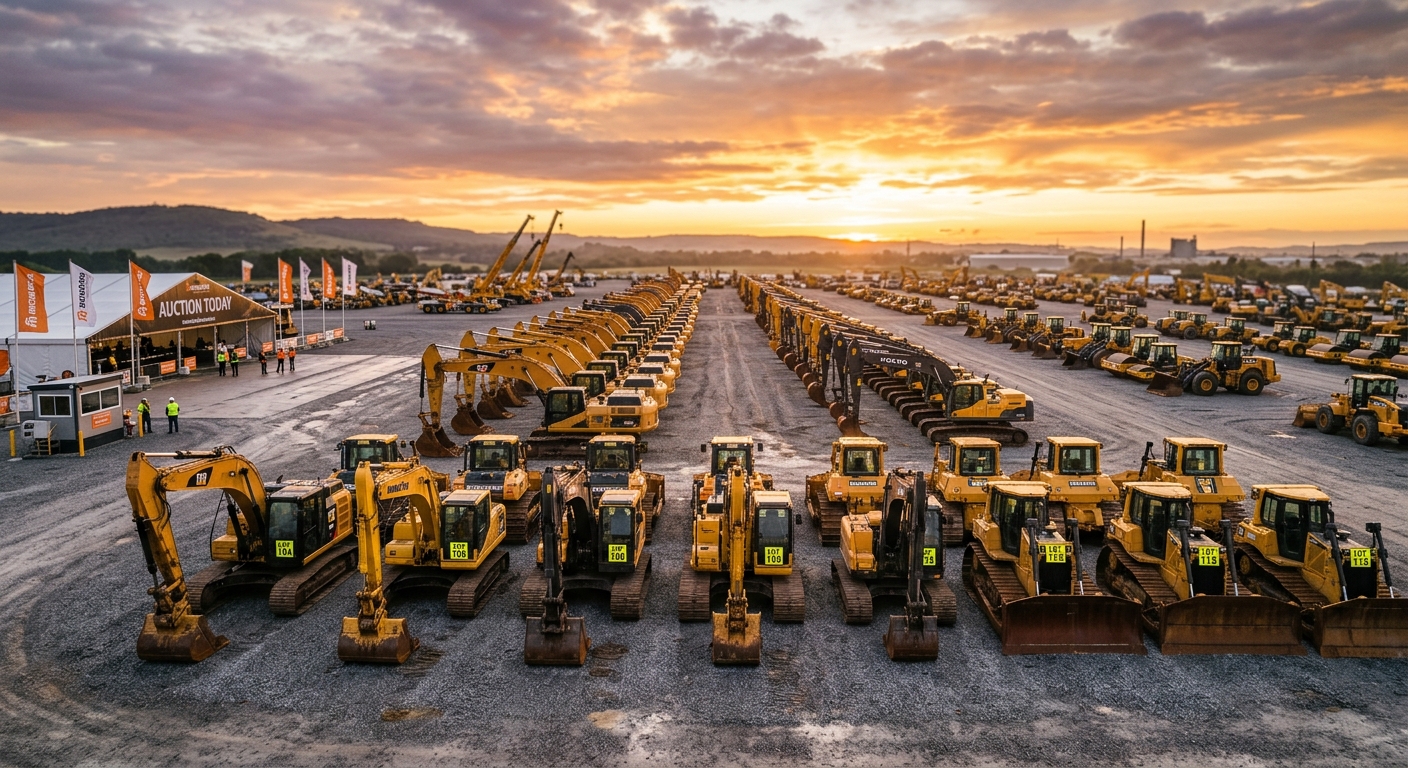
Equipment auctions are one of the best-kept secrets in the heavy equipment world — and also one of the fastest ways to lose money if you don’t know what you’re doing.
The upside is real. Contractors regularly pick up excavators, skid steers, dozers, and loaders at 20–40% below what a dealer would charge for comparable machines. Auctions move inventory fast, and sellers are often motivated — whether it’s a company liquidation, a fleet downsizing, or a bank repossession.
But auctions are “as-is” environments. There’s no warranty, limited recourse, and every machine has a story. The key is learning to read that story before you put your paddle up.
Types of Equipment Auctions
Not all auctions are created equal. Understanding the type of auction you’re walking into shapes your strategy entirely.
Unreserved Auctions
The machine sells to the highest bidder, period. No minimum price. This is where the real deals happen — and where the real chaos lives. Companies like Ritchie Bros. are known for unreserved sales. Sellers can’t pull a machine if bidding is low, which means buyers occasionally land incredible deals.
Reserve Auctions
The seller sets a minimum price. If bidding doesn’t reach it, the machine doesn’t sell. You’ll see more of these at smaller regional auction houses. Less risk of overpaying, but also less chance of a steal.
Government and Municipal Auctions
Cities, counties, and state agencies regularly auction surplus equipment. These machines are often well-maintained (government maintenance schedules tend to be thorough) but high-hour. GovPlanet and local government surplus sites are your go-to sources.
Bank and Liquidation Auctions
When a company goes under, their equipment has to go somewhere. These auctions can produce great deals because the bank just wants to recover capital. The catch: maintenance records are often incomplete or nonexistent.
Pre-Auction Research and Preparation
The auction itself is the easy part. The work happens in the days and weeks before.
Know What You Need
This sounds obvious, but auction fever is real. Define exactly what you need before you start browsing:
- Machine type and size class — Don’t show up looking for “something good.” Know the exact spec.
- Hour range — What’s acceptable for your budget and intended use?
- Must-have features — Cab, A/C, quick coupler, specific bucket width, thumb, etc.
- Maximum budget — Including buyer’s premium, taxes, and transport. Not just the hammer price.
Research Fair Market Value
Before bidding on anything, know what it’s worth. Check:
- Equipment Trader and Machinery Trader for dealer asking prices
- Ritchie Bros. past auction results (publicly available on their site)
- Iron Planet sold prices
- NADA or Equipment Watch guides if you have access
Your target price at auction should be 20–35% below average dealer retail for comparable machines.
Review the Auction Catalog Early
Most auction houses publish their catalog 1–4 weeks before the sale. Study it. Note the lot numbers you’re interested in, research each machine’s make/model/year, and check serial number ranges against known production issues.
Inspecting Equipment Before You Bid
This is the single most important step. Skip this and you’re gambling, not buying.
The Inspection Window
Most auctions offer an inspection period — usually 1–3 days before the sale. Use every minute of it.
What to Check (The Non-Negotiables)
Engine:
- Start it cold if possible — cold starts reveal problems warm engines hide
- Listen for knocking, excessive smoke (blue = oil burning, white = coolant leak, black = rich fuel)
- Check oil on the dipstick — milky oil means coolant contamination
- Look for fresh paint on the engine block (someone’s hiding something)
Hydraulics:
- Operate every function — boom, stick, bucket, swing, auxiliary
- Listen for whining, chattering, or delayed response
- Check all cylinder rods for scoring or pitting
- Look under the machine for active leaks (wet spots on the ground)
Undercarriage (for tracked machines):
- This is often 40–60% of a machine’s remaining value
- Check track pad condition, sprocket wear, idler condition, and roller integrity
- Measure track sag — excessive sag means worn pins and bushings
- A worn-out undercarriage can cost $15,000–$40,000+ to replace
Structural:
- Check the boom and stick for cracks, especially at weld points
- Look at pin bores for excessive wear (wobble = money)
- Inspect the frame for bending, cracking, or previous repair welds
- Check the cab for damage, leaks, and functioning controls
The Hour Meter Reality Check
Hour meters can be replaced, rolled back, or disconnected. Cross-reference the displayed hours with:
- Wear patterns on pedals, joysticks, and the operator seat
- General machine condition relative to claimed hours
- Service records (if available)
- ECM (engine control module) hours, which are much harder to alter
A machine showing 3,000 hours with a worn-out seat and smooth pedal rubber probably has a lot more than 3,000 hours.
Red Flags That Should Kill a Deal
Walk away from any machine that shows these signs — no matter how good the price looks.
🚩 Immediate Deal-Breakers:
- Frame cracks or major structural damage — Structural repairs are expensive and often incomplete
- Milky oil in any reservoir — Indicates internal contamination (head gasket, cracked block, cooler failure)
- Excessive blow-by — Pull the oil fill cap with the engine running. Heavy vapor = worn rings or worse
- Locked-out functions — If something “doesn’t work right now” it probably hasn’t worked in a long time
- Fresh paint everywhere — Someone spent money to make it look good instead of fixing what’s wrong
- No serial number plate — Could be stolen, salvage-titled, or rebuilt from multiple machines
Bidding Strategies That Actually Work
Set Your Max and Stick to It
Calculate your absolute maximum bid before the auction starts. This number should account for:
- Fair market value research
- Inspection findings (deduct estimated repair costs)
- Buyer’s premium (typically 10–15%)
- Sales tax
- Transport to your yard
- Immediate maintenance needs
Write this number down. When bidding hits it, stop. Period.
Timing Matters
Auctions have rhythms. Early lots often go cheap because bidders are still warming up. Late-day lots can go cheap because people have already spent their budget or left. Mid-auction prime equipment tends to draw the most competition.
Don’t Bid First
Let others establish the price. Jumping in early signals eagerness and can drive the price up. Wait until bidding slows, then enter with authority.
The “One More Bid” Trap
This is how auctions make their money. You’re at $42,000, your max was $40,000, and you think “one more bid won’t hurt.” It will. That extra $2,000 plus the 12% buyer’s premium plus tax plus transport means you just overpaid by $5,000+.
📋 Real-World Scenario:
A 2019 mid-size excavator with 4,200 hours comes up. Dealer retail for comparable machines is $95,000–$110,000. Your inspection found minor hydraulic leak (est. $1,500 repair) and 60% undercarriage life remaining.
Your calculation:
- Target price: $72,000 (30% below dealer avg of $102K)
- Deduct repair estimate: -$1,500
- Max bid: $70,500
- Total cost after 12% premium + 7% tax + $2,500 transport: ~$87,000
- Still saving roughly $15,000 vs. dealer, with known repair costs factored in
Understanding the True Cost
The hammer price is never the final price. Here’s what actually comes out of your account:
The Real Math
On a $50,000 hammer price:
- Buyer’s premium (12%): $6,000
- Sales tax (7%): $3,920
- Transport (300 miles): $2,500
- Immediate maintenance (fluids, filters, inspection): $1,200
- Actual cost: $63,620
That’s a 27% markup over the hammer price. Factor this into every bid.
Post-Purchase: What to Do After You Win
You won the bid. Now protect your investment.
Immediate Actions
- Complete fluid change — Every fluid in the machine: engine oil, hydraulic oil, coolant, final drive oil. You don’t know what’s in there or when it was last changed.
- Replace all filters — Air, oil, fuel, hydraulic. Start fresh.
- Full grease service — Hit every point.
- Document everything — Take photos of every component, note serial numbers, and record all fluid levels and conditions.
- Baseline hour reading — Log the exact hours at acquisition. This is hour zero for your ownership.
Set Up a Maintenance Tracking System
An auction machine comes with zero maintenance history. You’re building the book from scratch. This is where disciplined tracking becomes critical.
Log every service event, every fluid change, every repair. Track hours religiously. Calculate your cost-per-hour from day one so you know exactly what this machine is costing you to operate.
Online vs. In-Person Auctions
In-Person Auctions
Pros:
- Inspect machines yourself, hands-on
- Start machines cold, operate controls
- Read the room and other bidders
- No technology failures during bidding
Cons:
- Travel costs and time commitment
- Limited to geographic area
- Auction fever is stronger in person
- Weather and logistics challenges
Online Auctions
Pros:
- Access to nationwide (and global) inventory
- Bid from your office or couch
- Easier to stick to your max bid (less emotional)
- More time to research between lots
Cons:
- Can’t physically inspect (must rely on photos, reports, or third-party inspectors)
- Internet connectivity issues can cost you a bid
- Harder to gauge true machine condition from photos
- Potential for misrepresented equipment
Common Mistakes First-Time Auction Buyers Make
1. Not factoring in total cost. The hammer price is exciting. The invoice with premium, tax, and transport is sobering. Always calculate total landed cost before bidding.
2. Skipping the inspection. “It looks good in the photos” has cost contractors millions. Inspect or hire someone to inspect. No exceptions.
3. Chasing the deal instead of the machine. A great price on the wrong machine is still a bad purchase. Buy what you need, not what’s cheap.
4. Ignoring transport logistics. A screaming deal on a dozer in Texas doesn’t help your Connecticut operation if shipping costs $8,000 and takes three weeks.
5. No maintenance budget post-purchase. Budget 10–15% of the purchase price for immediate maintenance and repairs on any auction machine. If you spend less, great. If you don’t budget for it, you’ll be caught off guard.
6. Emotional bidding. You drove four hours, inspected the machine, and you want it. That emotional investment is the enemy of rational bidding. Set your max. Respect your max.
7. Not checking title and lien status. Make sure the machine has a clear title. Lien searches through services like Equipment Data Associates (EDA) can verify there are no outstanding loans against the equipment.
Track Your Investment with FieldFix
Start Tracking from Day One
Auction machines need more attention than dealer purchases — at least initially. FieldFix makes it easy to log your baseline inspection, schedule critical first-service intervals, and track your true cost-per-hour from the moment the machine hits your yard.
Add your new machine in under 2 minutes. Set up service reminders. Know exactly what your equipment is costing you.
Free for up to 3 machines. No credit card required.
Related Articles
September 4, 2026
Heavy Equipment Fall Service Planning Guide: How to Prevent Winter Downtime
September 3, 2026
Horizontal Directional Drill Maintenance: The Complete HDD Service Guide for Contractors
September 2, 2026