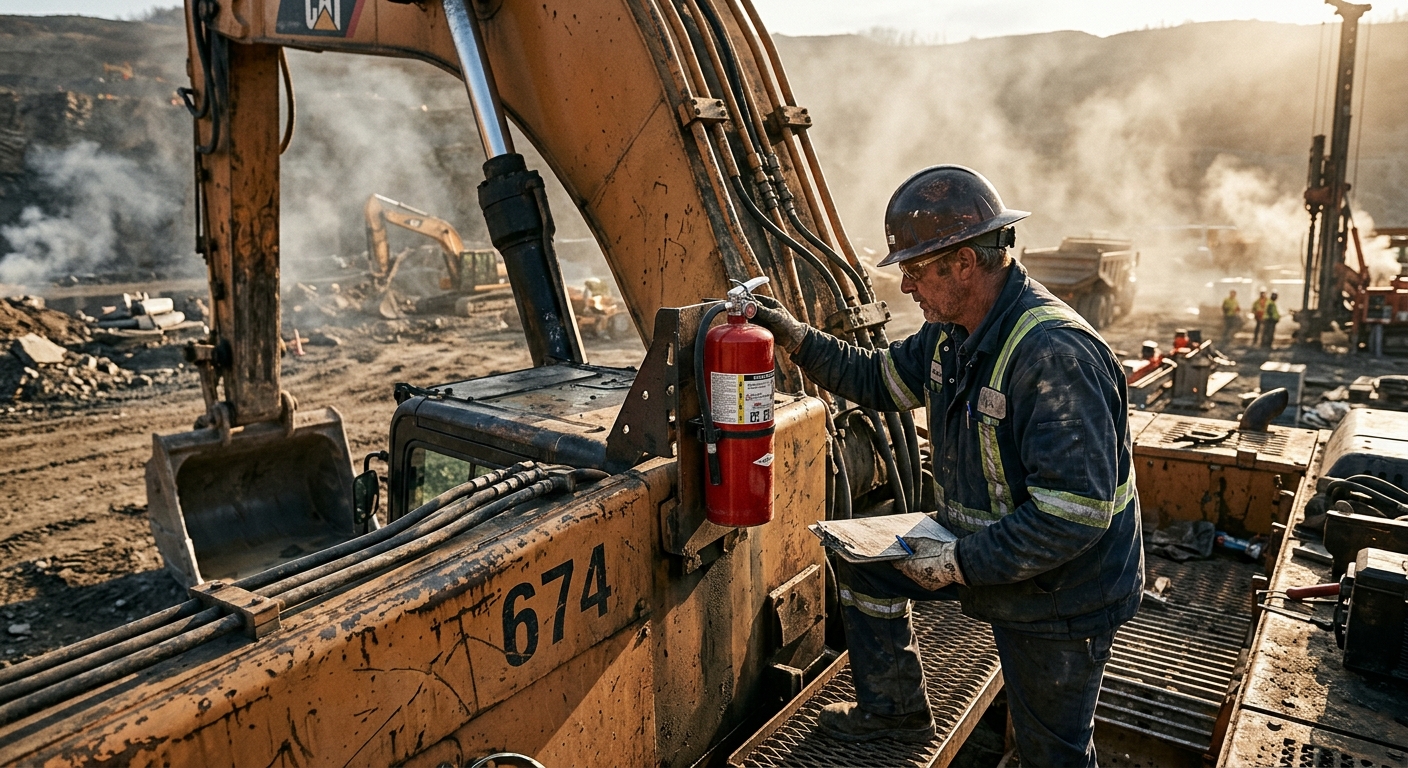
Heavy Equipment Fire Extinguisher Inspection Guide: What to Check Before a Small Fire Becomes a Total Loss
Learn how to inspect, mount, service, and document fire extinguishers on heavy equipment to reduce fire risk, downtime, and insurance headaches.
Key Takeaways
- A missing, discharged, or poorly mounted extinguisher can turn a minor engine-bay flare-up into a six-figure machine loss
- Monthly extinguisher checks take less than five minutes and should be part of every fleet safety routine
- Mounting location matters just as much as extinguisher size because operators need fast access during a real emergency
- Inspection records help with OSHA compliance, insurance claims, and internal accountability
- FieldFix makes it easier to assign extinguisher checks, log findings, and track replacements across your fleet
Heavy equipment fires usually start small. A rubbed-through wire, a leaking hydraulic hose misting onto a hot surface, a bird nest packed into an engine compartment, or a brake dragging just long enough to light off debris. In those first few seconds, the extinguisher on the machine is often the difference between a quick save and a total loss.
The problem is that many fleets treat extinguishers like permanent decorations. They get bolted to a fender, covered in dust, rattled loose, half-discharged, and forgotten until someone actually needs one. That is a brutal time to discover the gauge is in the red, the pin is missing, or the bracket broke three jobs ago.
This guide covers how to inspect fire extinguishers on heavy equipment, what defects matter, how often to check them, and how to build a process that actually holds up in the field.
Why Fire Extinguishers Get Overlooked
Extinguishers are easy to ignore because they do nothing right up until the exact moment everything depends on them. Operators naturally focus on fuel, coolant, hydraulic leaks, lights, tracks, tires, and visible wear. An extinguisher sits in the background until a fire turns it into the most important tool on the machine.
The expensive mistake Fleets often assume “we have extinguishers” means “we are protected.” It does not. A missing pin, dead gauge, broken bracket, or blocked access point can make an extinguisher useless when seconds count.
There are three reasons this gets missed so often:
- Ownership is vague. Operations thinks maintenance handles it. Maintenance thinks safety handles it. Safety assumes operators report problems.
- The equipment environment is punishing. Vibration, UV exposure, mud, washdowns, and constant shock destroy brackets, tags, hoses, and labels over time.
- Small defects seem harmless. A cracked bracket or faded tag does not feel urgent until the machine is smoking and the extinguisher is under the operator’s feet instead of in its mount.
That gap between a cheap save and a catastrophic loss is exactly why extinguisher readiness deserves a documented inspection standard.
What Type of Extinguisher Heavy Equipment Needs
Most heavy equipment fleets rely on ABC dry chemical extinguishers because they handle ordinary combustibles, flammable liquids, and energized electrical fires. That makes them a strong default for dozers, excavators, skid steers, loaders, service trucks, and trailers.
But default does not mean mindless. Extinguisher selection should match the machine, the environment, and the fire load.
ABC Dry Chemical Extinguishers
Pros:
- Versatile for diesel, oil, wiring, trash, and general jobsite fire risks
- Widely available and relatively inexpensive
- Familiar to most operators and technicians
Cons:
- Leaves corrosive residue that must be cleaned thoroughly after use
- Powder can reduce visibility in a cab or enclosed area
- Can compact over time if never inspected or serviced
Clean Agent Extinguishers
Pros:
- Cleaner discharge with less residue around electronics and controls
- Useful where post-fire contamination is a major concern
- Better fit for certain enclosed compartments or support vehicles
Cons:
- Higher cost
- Less common in mixed-contractor fleets
- May not be the best single standard for every machine
For many fleets, a 5-lb or 10-lb ABC extinguisher mounted on each machine is the practical baseline. Larger machines, remote forestry equipment, or units with elevated fire risk may justify multiple extinguishers or dedicated suppression systems in addition to handheld units.
Match the extinguisher to the machine An excavator working in dry brush, a milling machine around hot debris, and a service truck carrying fuel cans do not have the same fire profile. Standardize where you can, but not so hard that you ignore obvious risk differences.
Whatever you choose, the real rule is simple: the extinguisher must be correctly sized, accessible, charged, securely mounted, and documented.
The 5-Minute Inspection Checklist
Your monthly extinguisher inspection does not need to be complicated. It needs to be consistent. The goal is to confirm the extinguisher is present, usable, and instantly accessible.
Use this sequence:
1. Verify the extinguisher is in place
This sounds stupidly obvious, but it is the first failure point. Machines get washed, serviced, traded between crews, or sent to paint and come back without the extinguisher reinstalled.
2. Check the pressure gauge
The needle should be in the operable range. If it is low, overcharged, or unreadable, remove the extinguisher from service.
3. Confirm the safety pin and tamper seal are intact
Missing pins are a red flag. Sometimes that means the extinguisher was partially used. Sometimes vibration worked something loose. Either way, do not assume it is ready.
4. Inspect the hose, nozzle, and body
Look for cracks, corrosion, dents, oil contamination, blocked nozzles, or abrasion. On dirty machines, wipe it down enough to actually see the condition.
5. Inspect the bracket and mounting hardware
Grab the extinguisher and bracket firmly. If the assembly shifts, rattles excessively, or looks one hard bump away from breaking off, it needs attention now.
6. Confirm labels are readable
Operating instructions matter when an operator is stressed, panicking, or handing the extinguisher to someone else.
7. Check the service tag or inspection record
Make sure the unit has been inspected on schedule and has not blown past required maintenance or hydrostatic test dates.
Monthly Machine Fire Extinguisher Checklist
- Extinguisher present and assigned to the machine
- Gauge in operable range
- Pin installed and tamper seal intact
- No dents, rust, leakage, or powder buildup at the nozzle
- Hose and nozzle unobstructed
- Bracket secure, not cracked, not bent
- Mounting location accessible from ground or operator exit path
- Instructions readable
- Service tag current
- Defects logged and replacement assigned immediately
Make the inspection physical Do not inspect extinguishers from six feet away while walking past. Put a hand on the unit, tug the bracket, read the gauge, and verify access. Visual-only checks miss half the real problems.
Where to Mount an Extinguisher on Equipment
The best extinguisher in the world is useless if the operator cannot reach it safely. Mounting location matters more than a lot of fleets realize.
Good mounting locations usually share four traits:
- Easy to reach during exit
- Protected from direct impact and debris
- Visible enough to locate fast
- Secure enough to survive vibration and washdowns
On some machines, the right answer is near the cab entry point on the exterior. On others, it may be in the cab plus a secondary unit outside. The exact location depends on machine layout, but the logic stays the same: make the extinguisher accessible without forcing the operator to move toward the fire.
Do not mount the extinguisher where the fire will trap access If the likely fire source is the engine compartment or rear deck, avoid mounting the only extinguisher behind or above that hazard zone. Operators should be able to grab it while moving away from the threat, not toward it.
Common bad mounting decisions include:
- Bolting the bracket to flimsy panels that crack under vibration
- Mounting where mud and debris bury the release strap
- Placing the unit behind tools, chains, or grease guns
- Putting it so high or low that operators skip using the bracket correctly
- Letting the extinguisher ride loose in the cab because the original mount failed
If a machine repeatedly breaks brackets, stop replacing them with the same weak hardware. Upgrade the mount, add isolation, or change the location.
Common Problems Fleets Miss
Some extinguisher failures are obvious. Others hide in plain sight for months.
Here are the defects that show up constantly in the field:
- Bracket fatigue from vibration on compactors, skid steers, and rough-riding haul equipment
- Powder compaction in extinguishers that sit for long periods without inspection or service
- UV damage that fades labels and weakens plastic components on exterior mounts
- Corrosion on extinguishers exposed to fertilizer, salt, wash chemicals, or coastal environments
- Access blockage from added toolboxes, guards, aftermarket lighting, or spare parts storage
- Unauthorized use where extinguishers get cracked open for non-emergency cleanup or “just to test it”
A green gauge is not a full pass An extinguisher can show pressure and still fail because the nozzle is blocked, the powder is compromised, the bracket is broken, or the unit is unreachable. Treat the gauge as one checkpoint, not the whole inspection.
This is also where documentation starts paying off. If the same crew keeps turning up with broken mounts or missing units, that is not random bad luck. That is a process problem you can finally see.
Replacement, Recharge, and Service Rules
Every fleet needs a simple rule set for when to recharge, service, or replace an extinguisher. If the standard lives only in one supervisor’s head, it will fail the moment work gets busy.
At a minimum:
- Replace or service immediately after any discharge, even partial discharge
- Remove from service if the gauge is out of range, the pin is missing, the body is damaged, or the tag is not current
- Follow required annual maintenance and hydrostatic test intervals based on extinguisher type and applicable standards
- Standardize approved replacement sizes and models so crews are not improvising with whatever was cheapest at the farm store
Good Fleet Rule
If an extinguisher fails inspection on Friday, the machine does not start Monday without a compliant replacement installed or the deficiency formally flagged and corrected before dispatch.
That rule sounds strict because it should be. A machine without a usable extinguisher is not fully job-ready.
Building an Equipment Fire Response Standard
Inspection alone is not enough. Operators need to know what to do when smoke or flame shows up.
Your fleet fire standard should cover:
- When to shut down immediately
- When to evacuate instead of fighting the fire
- How to approach the fire safely
- Who gets called after the incident
- What gets photographed and documented
- How the machine is quarantined for follow-up inspection
The smartest version of this standard is brutally practical. If a fire is growing, threatening the cab, or involving pressurized fuel or hydraulics, the operator’s job is not heroics. It is exit, distance, and emergency response.
Train for judgment, not bravado Operators should know how to use an extinguisher, but they should also know when not to. A handheld unit is for early-stage fire control, not for gambling against a machine that is already fully involved.
Short toolbox talks, new-hire orientation, and annual refresher training go a long way here. So does reviewing real incidents from your own fleet.
How to Track Extinguisher Readiness in FieldFix
Fire extinguisher readiness is exactly the kind of small, easy-to-skip item that gets better when it is tracked inside a real system instead of a clipboard nobody reads.
With FieldFix, fleets can:
- Assign extinguisher inspections to specific machines and intervals
- Log failed checks with photos and notes
- Track repeated bracket failures or missing units by machine
- Record service dates, recharges, and replacements
- Build a cleaner maintenance history for safety reviews and insurance conversations
Keep Small Safety Failures From Becoming Big Equipment Losses
FieldFix helps you track the maintenance details crews usually forget until they become expensive. Schedule recurring extinguisher checks, document defects in the field, and keep every machine fire-ready with a maintenance record you can actually trust.
Related Articles

August 23, 2026
Heavy Equipment Grease Gun Maintenance Guide: Clean Tools, Longer Pin Life
August 22, 2026
Portable Pressure Washer Maintenance Guide for Contractors: Pumps, Hoses, Nozzles, and Winter Protection
August 21, 2026