Heavy Equipment GPS Tracking & Theft Prevention: The Complete Guide
Protect your fleet with GPS tracking, anti-theft devices, and smart security strategies. Learn how to prevent heavy equipment theft and recover stolen machines.
Key Takeaways:
- Heavy equipment theft costs the U.S. construction industry over $1 billion annually, with recovery rates under 25%
- GPS trackers cost $15–50/month per machine but can save you from a six-figure loss overnight
- A layered security approach — GPS + physical deterrents + operational procedures — is far more effective than any single measure
- Most equipment theft happens on weekends and holidays from unsecured jobsites
- Insurance alone won’t make you whole — deductibles, depreciation, and downtime costs add up fast
The Reality of Heavy Equipment Theft
Here’s a number that should keep every fleet owner up at night: the National Equipment Register estimates that $300 million to $1 billion worth of heavy equipment is stolen in the United States every year. And the recovery rate? A dismal 21–23%.
That means if your excavator gets stolen tonight, there’s roughly a 4-in-5 chance you’ll never see it again.
Unlike a stolen car — which has a VIN, title history, and license plate — heavy equipment is notoriously easy to move and resell. Serial numbers can be ground off. Machines can be repainted. And a stolen skid steer crossing state lines on a flatbed trailer doesn’t draw a second glance.
The financial hit goes way beyond the machine’s value. You’re also looking at:
- Project delays while you scramble for a replacement
- Rental costs to keep jobs running
- Insurance premium increases after a claim
- Lost revenue from downtime
- Emotional toll — that machine represented years of payments
How Thieves Target Heavy Equipment
Understanding how equipment theft works is the first step to preventing it. Most thieves aren’t criminal masterminds — they’re opportunists who exploit predictable weaknesses.
The Typical Theft Profile
When it happens: Over 60% of equipment thefts occur on weekends, holidays, and overnight. Friday evening through Monday morning is the prime window. Thieves know that nobody’s checking the jobsite on a Saturday night.
Where it happens: Unsecured jobsites are the #1 target. Rural locations with poor visibility and minimal traffic are especially vulnerable. But urban sites aren’t safe either — a busy street can actually provide cover for a thief who looks like they belong.
How it happens: Most equipment theft is shockingly low-tech:
- Drive on, drive off — Many machines are left with keys in the ignition or use universal keys. The thief simply starts it up and drives it onto a waiting trailer.
- Trailer and tow — Smaller equipment like skid steers, mini excavators, and attachments get loaded onto trailers in minutes.
- Insider knowledge — Former employees or subcontractors who know the site layout, equipment locations, and security gaps.
- Organized rings — Professional operations that target specific machines, often for export or resale across state lines.
The Universal Key Problem: Many heavy equipment manufacturers use a limited number of key patterns. Some older machines from the same brand all use the same key. A thief with a $10 set of common equipment keys can start a shocking number of machines. Always rekey your equipment or install secondary ignition locks.
GPS Tracking Systems Explained
GPS tracking is the single most effective theft recovery tool available. It won’t physically stop someone from taking your machine, but it dramatically increases the odds of getting it back — and fast.
How Equipment GPS Trackers Work
A GPS tracker installed on your machine uses satellite signals to determine its location, then transmits that data to a server via cellular networks. You access the location data through a web dashboard or mobile app.
Modern equipment trackers offer far more than just a dot on a map:
- Real-time location — See exactly where every machine is, updated every few minutes (or seconds in some modes)
- Geofencing — Set virtual boundaries around jobsites. Get alerted instantly if a machine moves outside the fence.
- Movement alerts — Get notified when a machine moves during off-hours
- Ignition detection — Know when someone starts the engine
- Speed alerts — Unusual speeds (like a machine on a trailer doing 60mph) trigger notifications
- Location history — Full breadcrumb trail of everywhere the machine has been
Types of GPS Trackers
Hardwired trackers connect to the machine’s electrical system. They’re powered continuously, harder to find and remove, and offer the most features. Best for high-value machines you own long-term.
Battery-powered trackers are self-contained units you can attach magnetically or hide in a compartment. Batteries last anywhere from a few weeks to several years depending on reporting frequency. Great for attachments, trailers, or rental equipment.
OBD/CAN-connected trackers plug into the machine’s diagnostic port. They can pull engine data alongside location — hours, fault codes, idle time. More useful for fleet management than pure theft prevention, since they’re easy to unplug.
Pro Tip: Install TWO trackers on high-value equipment — one obvious hardwired unit and one hidden battery-powered backup. If a savvy thief finds and disables the first tracker, the second one keeps broadcasting.
Choosing the Right GPS Tracker
Not all GPS trackers are created equal. Here’s what to evaluate:
What to Look For
Must-haves:
- ✅ Geofencing with instant push notifications
- ✅ Real-time tracking (updates at least every 2-5 minutes)
- ✅ Tamper alerts if the device is disconnected
- ✅ Long battery life (for battery-powered units)
- ✅ Waterproof/dustproof rating (IP67 minimum)
- ✅ Cellular coverage on major networks (check your jobsite areas)
Nice-to-haves:
- ✅ Engine hour tracking
- ✅ Ignition on/off alerts
- ✅ Historical location playback
- ✅ Multiple geofence zones
- ✅ API access for integration with fleet software
Red flags:
- ❌ Monthly fees over $50/unit with no added value
- ❌ Proprietary hardware that locks you into one provider
- ❌ No mobile app (dashboard-only)
- ❌ Poor cellular coverage in rural areas
- ❌ Long-term contracts with no flexibility
Cost Breakdown
Expect to pay $100–$400 for the hardware and $15–$50/month per device for the cellular service and platform access. Some providers offer volume discounts for fleets of 10+ machines.
That $15–50/month might feel like a cost you’d rather skip — until you realize it’s insuring a machine worth $50,000 to $500,000. The math isn’t even close.
Real-World Example: The Weekend Recovery
A contractor in Tennessee noticed a geofence alert on his phone at 2:47 AM on a Saturday. His mini excavator had just left the jobsite. He called the police immediately and shared the real-time GPS location. Officers intercepted the thief — who had the machine on a flatbed trailer — within 40 minutes, less than 30 miles away. Total cost of the GPS tracker over 2 years: about $850. Value of the recovered excavator: $62,000.
Physical Anti-Theft Devices
GPS tracking helps you recover stolen equipment. Physical deterrents help prevent the theft from happening in the first place. Use both.
Ignition and Fuel System Locks
- Kill switches — Hidden switches that cut power to the ignition or fuel system. A thief who can’t start the machine has a much harder time stealing it.
- Fuel shut-off valves — Lockable valves that prevent fuel flow to the engine. The machine cranks but won’t run.
- Ignition lock replacements — Replace universal-key ignitions with unique-key or keypad systems.
Physical Barriers
- Wheel/track locks — Similar to a car boot, these clamp onto wheels or tracks to prevent movement. Visible deterrent that also physically stops the machine.
- Coupler locks — Lock the quick coupler so attachments can’t be stolen. Buckets, breakers, and grapples are common targets.
- Trailer hitch locks — If your equipment sits on a trailer, lock the hitch. A good hitch lock and coupler lock combo makes it very difficult to hook up and tow away.
Marking and Identification
- PIN stamping — Stamp your company’s unique identifier into multiple locations on the frame, boom, and major components. Unlike serial numbers, PIN stamps are hard to find and remove.
- Microdot technology — Thousands of tiny coded dots applied to the machine’s surfaces. Even if repainted, these dots can be detected with UV light and tied back to the owner.
- UV paint markings — Invisible under normal light but glow under UV. Mark hidden areas that a thief is unlikely to repaint.
Registration Matters: Register your equipment with the National Equipment Register (NER) and keep detailed records including serial numbers, photos, and identifying marks. This dramatically improves recovery chances if a machine is found by law enforcement.
Jobsite Security Best Practices
The most effective theft prevention happens at the jobsite level. These operational practices cost little but make a massive difference.
Site Layout and Access Control
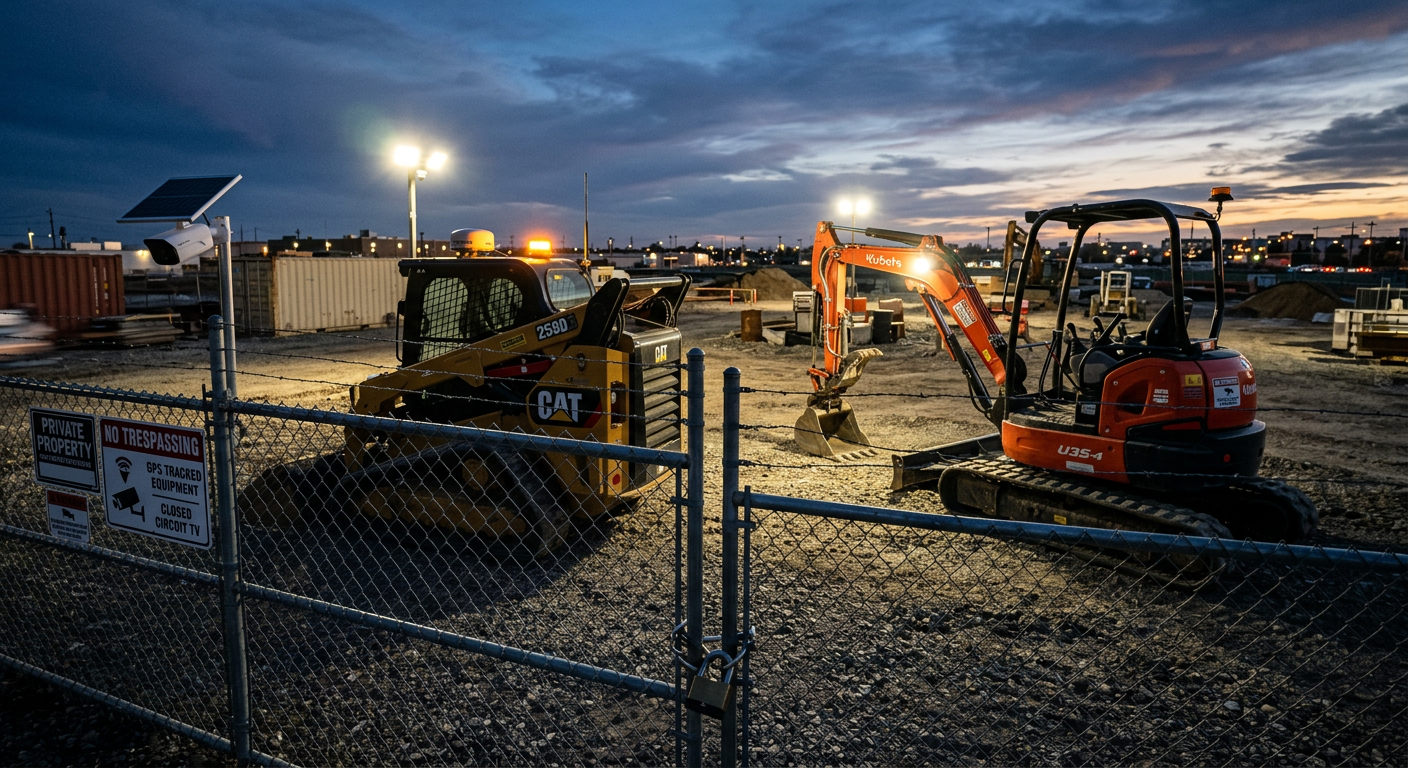
- Control entry points — Limit the number of ways vehicles can enter and exit the site. Chain and lock gates after hours.
- Park strategically — Position larger equipment to block smaller machines. Put the most valuable or portable equipment in the center, surrounded by bigger machines.
- Face machines inward — Park equipment facing toward the center of the site. It takes longer to maneuver out, and headlights pointing inward don’t alert a thief to the layout.
- Remove keys — This sounds obvious. It’s still the #1 mistake. Never leave keys in machines overnight. Period.
Surveillance and Lighting
- Trail cameras — Battery-powered game cameras are cheap ($30–$80), weatherproof, and capture motion-triggered photos with timestamps. Put them at entry points.
- Solar-powered security cameras — No wiring needed. Many offer cellular connectivity so you can view feeds remotely.
- Motion-activated lights — Thieves don’t want to be seen. Bright lights that snap on with motion are a cheap, effective deterrent.
- Signage — “Site Under Video Surveillance” signs cost $10 and deter casual opportunists, even if you don’t actually have cameras (though you should).
Operational Procedures
- End-of-day checklists — Before leaving the site: keys removed, fuel valves locked, kill switches engaged, gates chained, cameras positioned.
- Equipment logs — Record which machines are on which sites. If you can’t account for a machine, you can’t report it missing promptly.
- Employee awareness — Make sure everyone on the team knows the security procedures and understands why they matter.
- Vary your routine — If you always leave the site at 5 PM and don’t return until 7 AM, a thief watching the site knows exactly how much time they have.
What to Do When Equipment Is Stolen
Despite your best efforts, theft can still happen. Having a response plan saves critical time.
Immediate Steps
- Call the police immediately. File a report with every detail: make, model, serial number, PIN, color, distinguishing marks, last known location, GPS data if available.
- Share GPS data with law enforcement. If you have a tracker, provide real-time access or live coordinates. Every minute matters — stolen equipment can be on a truck heading across the country within hours.
- Contact your insurance company. Start the claims process right away. Delays can complicate your claim.
- Notify the National Equipment Register (NER). They maintain a database used by law enforcement and dealers to identify stolen equipment.
- Alert local dealers and auction houses. Provide photos and serial numbers. Thieves often try to sell stolen equipment through legitimate channels.
- Post on social media. Industry groups and local contractor forums can be powerful. Many stolen machines have been recovered because another contractor spotted the listing or the machine on a jobsite.
Do NOT attempt to recover the equipment yourself. If you have GPS showing the machine’s location, give that information to police. Confronting thieves is dangerous and can have legal consequences even if the equipment is yours.
Insurance and Theft Coverage
Insurance is your financial safety net, but it’s not a replacement for prevention. Here’s what most contractors get wrong about theft coverage.
What’s Typically Covered
- Inland marine insurance (also called contractor’s equipment insurance) covers heavy equipment against theft, vandalism, and damage. This is the most common policy type for mobile equipment.
- Commercial property insurance may cover equipment at a fixed location but often excludes machines on jobsites.
What Catches Contractors Off Guard
- Deductibles are high. Equipment policies often carry $5,000–$30,000 deductibles. A stolen attachment worth $8,000 with a $5,000 deductible nets you just $3,000.
- Depreciation hits hard. Most policies pay actual cash value (ACV), not replacement cost. Your 5-year-old skid steer might be insured for $35,000, but replacing it with a comparable used machine costs $50,000 in today’s market.
- Downtime isn’t covered. Insurance replaces the machine. It doesn’t compensate for the 4–8 weeks you spent without it, the jobs you couldn’t do, or the rental costs in the meantime.
- Premiums go up. A theft claim can increase your premiums 15–30% at renewal. Multiple claims? You might struggle to find coverage at all.
Policy Tip: Ask your broker about agreed value policies instead of ACV. With agreed value, you and the insurer set the machine’s value upfront — that’s what gets paid out, with no depreciation surprise. It costs more in premium, but you know exactly what you’re getting.
Building a Complete Security Strategy
The best protection is layered. No single measure stops every thief, but stacking multiple deterrents makes your equipment far less attractive as a target.
The Security Pyramid
Layer 1 — Visibility: GPS tracking on every machine. You can’t protect what you can’t find.
Layer 2 — Deterrence: Visible locks, cameras, lighting, and signage. Most thieves move on to easier targets.
Layer 3 — Prevention: Kill switches, fuel locks, removed keys, strategic parking. Even if a thief tries, they can’t easily move the machine.
Layer 4 — Response: Geofence alerts, response plan, law enforcement relationships, NER registration. If prevention fails, you respond fast.
Monthly Security Checklist
- Verify all GPS trackers are reporting and batteries are charged
- Test geofence alerts on every active jobsite
- Confirm kill switches and fuel locks are functional
- Review camera footage and replace trail camera batteries/SD cards
- Update equipment inventory with current locations
- Check that all serial numbers and photos are on file
- Remind crew about end-of-day lockdown procedures
Track Your Fleet with FieldFix
Knowing where your equipment is and what condition it’s in — that’s the foundation of both good fleet management and theft prevention.
Start Protecting Your Fleet Today
FieldFix gives you complete visibility into your equipment fleet — maintenance history, service logs, cost tracking, and AI-powered diagnostics. When every machine is documented with photos, service records, and identifying details, you’re not just managing better — you’re building the documentation that makes theft recovery possible.
A well-maintained, well-documented fleet is a protected fleet.
Start Free → fieldfix.ai Free for up to 3 machines. No credit card required.