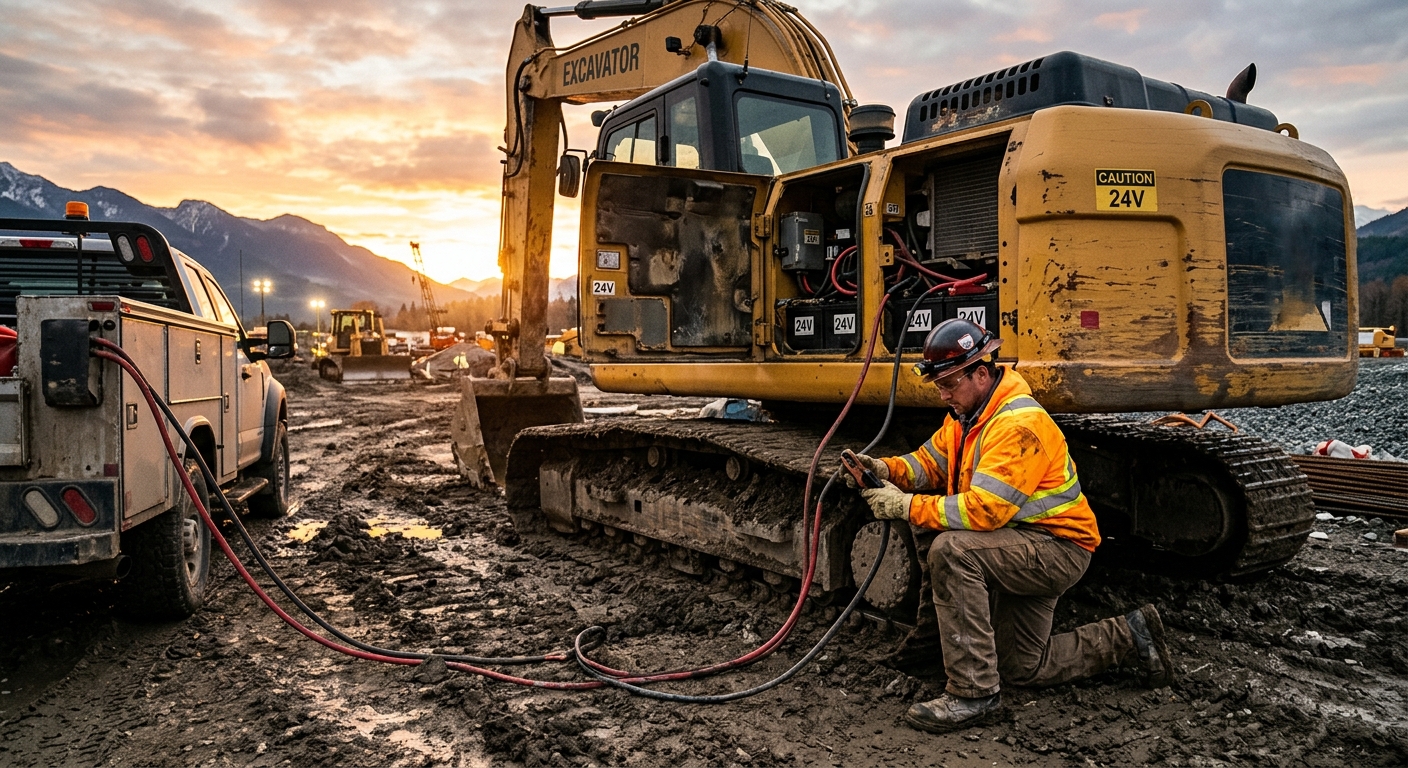
How to Jump Start Heavy Equipment Safely Without Damaging Electronics
Learn the safe way to jump start heavy equipment, protect sensitive electronics, avoid battery damage, and reduce downtime in the field.
A dead machine at 6:30 in the morning has a special talent for making people impatient. Production is waiting. The operator wants moving iron, not a lecture. So somebody grabs a set of cables, another machine, and a little too much confidence.
That is usually where the expensive part begins.
Modern heavy equipment is full of sensitive electronics, control modules, sensors, displays, and charging components that do not appreciate sloppy jump-start habits. Even older machines can suffer from battery explosions, cable melt, damaged alternators, or ruined terminals when the basics get ignored. A dead battery is annoying. A fried controller, harness damage, or an injured operator is worse.
The point is not to make jump starting feel complicated. It is to make it boring, repeatable, and safe.
can turn a simple no-start into an electrical repair with real downtime.
beats guessing at voltage, polarity, or battery condition in the field.
a jump start fixes the symptom, not why the battery went dead.
Why jump starts go wrong
Most jump-start failures are not bad luck. They come from rushing.
Crews skip voltage checks. They use light automotive cables on equipment that needs serious current. They connect directly to a damaged battery. They ignore corrosion, frozen cases, loose grounds, or obvious acid leaks. Then they act surprised when the machine still will not start or something electrical starts acting weird afterward.
Heavy equipment batteries deal with vibration, weather, dirt, long idle periods, and high cranking demand. Add cold weather or a parasitic drain, and a no-start becomes pretty easy to create. The jump start itself is only one part of the issue.
Common reasons jump starts go sideways include:
- Mismatched system voltage
- Reversed polarity
- Weak or undersized cables
- Corroded terminals or bad grounds
- Attempting to jump a damaged battery
- Cranking too long and overheating components
- Ignoring the actual charging-system problem after startup
When crews treat jump starts like a last-second hack instead of a controlled procedure, they stack risk fast.
Before you connect anything
This is the part people love skipping, which is exactly why it matters.
1. Confirm system voltage
Is the machine 12-volt or 24-volt? Do not assume. Check the battery labels, service information, or the machine documentation. Jumping a 24-volt system incorrectly or mixing voltage sources is a great way to cook electronics.
2. Inspect the battery and cables
Look for cracked cases, swelling, low electrolyte signs, loose hold-downs, green corrosion, rubbed-through cables, and burnt connections. If the battery is physically compromised, the answer is not “more amps.”
3. Check for obvious reasons the battery died
Were the lights left on? Has the machine been sitting for weeks? Is there a known charging issue? Did a disconnect switch get left in the wrong position? You want the story before the restart, not after the next breakdown.
4. Use the right tools
You need heavy-duty cables sized for equipment use or a proper commercial booster pack. Flimsy passenger-car jumper cables are mostly decoration in this context.
- Verify voltage first
- Inspect battery condition
- Clean or tighten terminals if needed
- Use equipment-grade cables or booster pack
- Keep sparks away from battery gases
- Guessing the voltage
- Hooking up to a leaking battery
- Using cheap, undersized cables
- Connecting in a rush without checking polarity
- Cranking over and over with no diagnosis
Safe jump start procedure
The exact procedure can vary by manufacturer, so machine-specific guidance always wins. But this is the practical field-safe process that fits most equipment when approved for the machine.
Step 1: Position safely
Place the donor machine or booster pack close enough for the cables to reach without stretching across moving parts, mud, or sharp edges. Put both machines in park or neutral, set parking brakes, and shut down accessories.
Step 2: Turn off both machines
You want a controlled connection, not live chaos.
Step 3: Identify positive and negative clearly
Clean the terminals if needed so there is zero doubt. If you cannot read the markings, stop and verify before connecting anything.
Step 4: Connect positive to positive
Attach the positive cable to the dead machine’s positive terminal first, then to the donor source positive terminal.
Step 5: Connect negative carefully
Attach the negative cable to the donor source negative terminal. For the final connection, use the recommended ground point on the disabled machine if the manufacturer specifies one. That helps reduce sparking near the battery.
Step 6: Let the dead battery stabilize briefly
If using another machine or a booster source, give the weak battery a little time to accept charge before cranking. No need for drama. Just do not connect and instantly hammer the starter.
Step 7: Crank in short attempts
Try short, controlled crank cycles. If the machine does not start after a reasonable attempt, stop and reassess. Endless cranking is not grit. It is abuse.
Step 8: Disconnect in reverse order
Once running, remove the final ground connection first, then donor negative, then donor positive, then the disabled machine positive. Keep cables clear of fans, belts, and hot components.
A crew tries to start a loader with light jumper cables from a pickup truck. The cables heat up, the loader barely turns over, and the operator keeps cranking. The real issue turns out to be a corroded ground plus a weak battery. Ten minutes spent cleaning the ground and using a proper booster pack would have saved the truck, the cables, and the swearing.
Mistakes that damage equipment
This is where a lot of avoidable repair bills are born.
Reversed polarity
Yes, it still happens. And yes, it is still catastrophic. Reverse polarity can blow fuses, damage alternators, fry modules, and create sparks where you absolutely do not want them.
Jumping a frozen battery
A battery can look normal enough and still be frozen internally in cold conditions. Applying current to a frozen battery is a terrible idea.
Using a 12-volt source on a 24-volt system incorrectly
Some crews get creative here. Creative is not the goal. Correct is the goal.
Clamping onto dirty or loose terminals
Poor contact creates heat, resistance, voltage drop, and frustration. Clean metal matters.
Cranking too long
Long crank events overheat starters, cables, and connections. If it will not fire, stop guessing and diagnose.
There is also a subtler mistake: treating every dead battery like a battery problem. Sometimes the battery is fine and the issue is a bad alternator, failed disconnect, parasitic draw, loose ground, or corroded cable end hidden under insulation.
Booster pack vs another machine
For a lot of fleets, a professional-grade booster pack is the better answer.
It is faster, more controlled, and avoids tying up another machine or service truck. It also reduces the temptation to improvise with whatever vehicle happens to be closest.
- Portable and fast
- No donor machine needed
- Often safer and more controlled
- Good for service trucks and field response
- Useful when a booster pack is unavailable
- Can support repeated starts in the field
- Practical on remote jobs if voltage matches
The downside of using another machine is that people get sloppy. They park poorly, stretch cables too far, connect under pressure, and skip inspection because “we just need it running.” That mindset is how a dead machine becomes two dead machines.
Use a commercial booster pack approved for your fleet voltage.
Use a matched-voltage donor machine with a clean procedure.
Use whatever is nearby and hope the smoke stays inside the wires.
What to do after it starts
If the machine started, good. You solved exactly one problem: it is running right now.
Now do not waste the opportunity.
Check charging voltage and system behavior
Watch for battery warning lights, weak restart behavior, dim displays, or electrical faults. A machine that starts once but dies again after shutdown is telling you something.
Inspect the battery hold-down and terminals
Vibration kills batteries and cables over time. If the hardware is loose, fix that before the next job beats the battery to death again.
Log the event
A jump-start event belongs in the maintenance record. One event might be random. Three events in two months is a pattern.
Identify the root cause
Dead batteries usually trace back to one of these buckets:
- Battery age or failure
- Alternator or charging fault
- Cable or ground issue
- Parasitic drain
- Long-term storage without maintenance charging
- Cold-weather capacity loss
A compact excavator needs two jump starts in one week. Instead of just replacing the battery and moving on, the fleet checks charging voltage and finds a loose alternator connection causing intermittent undercharging. The fix is cheap. Ignoring it would have burned through another battery and more lost mornings.
Build a better battery program
The best jump start is the one you never need.
If dead batteries keep interrupting your week, the issue is not bad luck. It is usually a weak battery-management process. Fleets that stay ahead of this build a simple system around inspection, charging, storage, and documentation.
That system should include:
- Battery condition checks during PM service
- Terminal cleaning and corrosion control
- Verified hold-down security
- Off-season charging or maintainer use
- Scheduled testing for older batteries
- Documentation of no-start and jump-start events
- Clear replacement criteria before total failure
This is exactly where good recordkeeping matters. When operators, mechanics, and owners can see recurring no-starts, repeated battery swaps, or seasonal failure trends, they stop treating every dead battery like an isolated annoyance.
FieldFix helps crews log repairs, track recurring issues, and spot patterns across the fleet before “just jump it” becomes the standard operating procedure.
Stop treating repeat jump starts like normal
If the same machine keeps needing a boost, you do not have a battery problem. You have a tracking problem. FieldFix helps you log no-start events, maintenance history, and repair trends so battery issues get fixed at the root instead of showing up at the worst possible time.
Related Articles

June 23, 2026
Heavy Equipment Axle and Differential Maintenance Guide: Stop Heat, Noise, and Metal Before Failure

June 22, 2026
Portable Generator Maintenance Guide for Contractors: Prevent Expensive No-Start Mornings

June 21, 2026