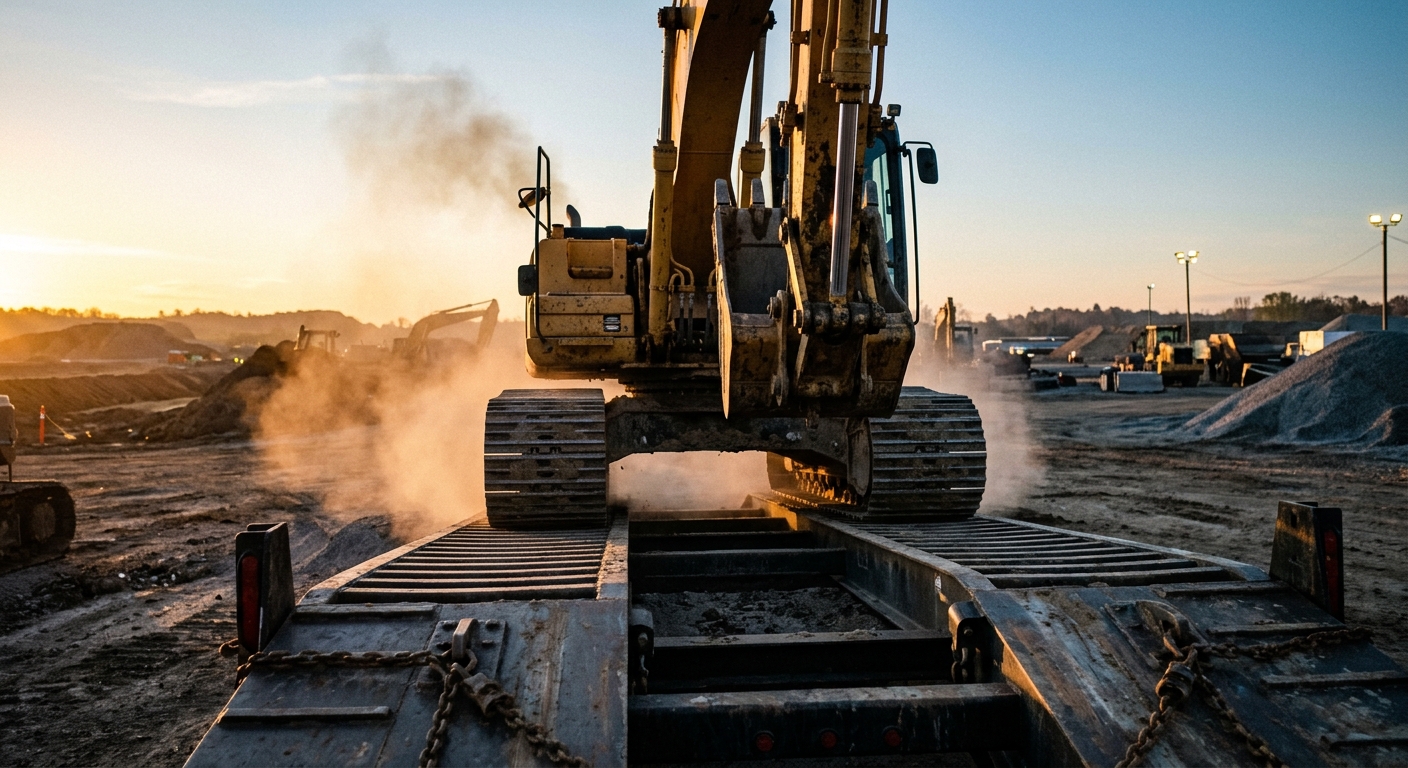
Heavy Equipment Lowboy Loading Ramp Maintenance Guide
Learn how to inspect and maintain lowboy trailer loading ramps to prevent cracked hinges, bent supports, unsafe loading angles, and costly transport downtime.
Lowboy trailers do not fail all at once. They fail one ignored stress point at a time.
That is especially true for loading ramps. They get slammed onto gravel, dragged through mud, shock-loaded by steel tracks, clipped by buckets, backed over by hurried operators, and left outside in every season. Then crews expect them to work perfectly when it is time to load a machine worth six figures.
That is a ridiculous expectation unless somebody is actually maintaining them.
Most fleets have at least one trailer with ramps that “still work if you know how to lift them” or “need a little extra persuasion.” That sentence should make any equipment manager twitch. A ramp that binds, sags, kicks sideways, or loses traction is not just annoying. It is a direct loading risk that can damage the trailer, damage the machine, or put an operator on the ground.
Why ramp maintenance gets overlooked
Trailer maintenance usually gravitates toward the obvious legal and roadside items. Brakes, lights, tires, couplers, safety chains, breakaway systems, and tie-down points all get attention because they are visible, regulated, or impossible to ignore once they fail.
Ramps sit in the gray zone.
They are not always part of a formal inspection checklist. They may not belong to any one operator. And because they often keep functioning while already damaged, people get comfortable with bad conditions. A slightly twisted ramp becomes normal. A cracked weld becomes “we’ll hit it later.” A missing traction cleat becomes something operators work around by feathering the tracks and hoping for the best.
That is how transport damage breeds.
Ramps also suffer from repeated impact loading. Unlike many trailer parts that carry steady weight, ramps get hit dynamically. Machines crawl up them, bounce on them, spin on them, and occasionally drop onto them harder than anyone wants to admit. Repeated shock loading around hinge tubes, pivot pins, gussets, and support members slowly rewrites the structure.
If your inspection process only happens when a ramp visibly folds or stops moving, you are not doing maintenance. You are waiting for public embarrassment.
What fails on loading ramps first
The first things to fail are usually the places that take concentrated stress.
Hinge areas are high on the list. Hinge barrels can wear oval, pins can loosen or seize, and weld toes around the hinge mount can start cracking. Once that geometry starts moving around, the ramp no longer loads evenly. One side starts carrying more punishment than the other, which speeds up deformation.
Support members are another weak spot. Box tubing, angle reinforcement, spring mounts, and ramp braces can bend from repeated overloaded entries or off-center loading. The scary part is that a ramp can still appear usable while its internal straightness is already gone.
Traction surfaces wear out too. Expanded metal tears. Cleats flatten. Serrated bar loses bite. Wood inserts rot or loosen. Smooth steel packed with mud is basically an invitation to slip, especially for rubber-tire equipment or steel tracks with wet clay packed in the grousers.
Then there are the support systems. Spring-assist ramps lose balance when springs stretch, anchors crack, or hardware wears. Hydraulic ramps create their own trouble with leaking cylinders, contaminated pins, hose damage, latch problems, and uneven extension.
- Even alignment side to side
- Clean hinge movement without binding
- Intact traction bars or expanded metal
- No fresh rust trails around welds or pins
- One ramp sits lower than the other
- Ramp has to be kicked into place
- Visible twist near the outer corners
- Hydraulic ramp drifts, jerks, or settles unevenly
Pre-load inspection checklist
Good ramp maintenance starts before the machine climbs. The inspection does not need to be complicated, but it does need to happen every time the trailer is used.
Start with a visual alignment check. Are both ramps sitting evenly? Are they parallel? Does one appear twisted, lower, or farther back than the other? Uneven stance often points to hinge wear, bent structure, or damaged support components.
Next inspect the hinge and pivot areas closely. Look for cracked welds, elongated pin holes, missing retainers, rust bleed, seized grease points, or metal polishing that suggests movement where there should not be movement. Fresh shiny contact marks around the hinge usually mean parts are shifting under load.
Then inspect the ramp face itself. Check traction bars, cleats, expanded metal, wood inserts, or grating for tearing, excessive wear, or missing fasteners. If the loading surface is slick, bent, or partially detached, loading should stop until it is fixed.
Do not forget the landing area. Mud built up under the ramp foot, uneven gravel, broken asphalt edges, and soft shoulder conditions change how the ramp carries weight. A good ramp placed on bad footing still creates a bad loading setup.
Finally, check locks, spring assists, and hydraulic controls. Ramps should deploy, latch, and stow without drama. A component that only works smoothly on level pavement and dry days is already asking for trouble.
Structural wear and deck traction problems
Structural ramp damage usually starts small and gets rationalized for too long. A hairline crack at a gusset is easy to shrug off. So is a slightly bent corner or a support member that only shows a little bow. But ramps do not enjoy the luxury of harmless cosmetic damage. They are either carrying load correctly or they are storing up a future failure.
Pay close attention to:
- outer edges that curl or hook upward
- crossmembers with visible sag
- gussets separating from the main rail
- ramp feet worn thin or mushroomed from repeated ground contact
- traction cleats flattened enough to lose bite
- torn expanded metal that can catch a tire, track shoe, or operator boot
Traction matters more than many fleets realize. Safe loading is not just about structure. It is about the interface between ramp and machine. Worn traction surfaces increase wheel spin, track slip, and bouncing. That bouncing drives even more impact into the hinge and support structure, which means poor traction does not stay a traction problem for long. It turns into a structural problem too.
Spring-assist and hydraulic ramp systems
Spring-assist ramps often get ignored because they look mechanically simple. That is exactly why people miss the danger.
Inspect springs for deformation, corrosion, uneven stretch, broken mounts, and worn attachment hardware. If a ramp suddenly feels much heavier than normal or does not balance evenly, do not just call it “stiff.” That balance changed for a reason. Springs and mounting brackets are carrying stored energy, and a failure there can hurt somebody in a hurry.
Hydraulic ramps deserve the same seriousness you would give any hydraulic circuit. Check cylinder rods for scoring, pins for looseness, hoses for chafing, fittings for seepage, and latches for full engagement. Watch both ramps deploy together. If one side hesitates, drifts, or lands harder, alignment or hydraulic imbalance may already be in play.
Hydraulic issues also hide inside contamination and neglect. Dry pins, packed dirt around pivots, and damaged hose routing create side loads that the cylinder was never designed to absorb.
Loading angle and operator habits
Not every ramp problem begins with the trailer. Some begin with how crews use it.
Loading too fast, approaching crooked, slamming steel tracks onto the first third of the ramp, or loading from uneven shoulders all increase impact. So does using a trailer that is too steep for the machine configuration. Long-wheelbase equipment, low-clearance attachments, and machines with unusual weight distribution can punish a ramp even when the ramp itself is in decent shape.
Operators also create trouble when they turn on the ramp, brake hard while halfway up, or keep loading after noticing bounce, slip, or misalignment. Those habits do not just increase incident risk in the moment. They shorten the life of the ramp assembly every single time.
The fix is not complicated:
- Load straight whenever possible.
- Keep the trailer footing stable and level.
- Clean mud and debris off traction surfaces.
- Match trailer and ramp setup to the machine being hauled.
- Stop immediately when the ramp behavior changes.
Repair vs replacement decisions
Some ramp issues are repairable. Some are not worth gambling on.
Replacing traction bars, pins, bushings, retainers, hydraulic hoses, latch hardware, and properly evaluated localized weld repairs can make sense when the main structure is still straight and sound. But once the ramp rail is badly twisted, the hinge geometry is distorted, the support members are repeatedly cracking, or the deck surface is deteriorated across the full assembly, replacement becomes the smarter move.
This is where fleets lie to themselves. They compare the price of a new ramp or a proper fabrication repair to the cost of one more patch. What they fail to compare is the cost of:
- loading delays at the yard
- machine damage during a slip or drop
- operator injury exposure
- roadside downtime because a trailer cannot be used
- repeated labor hours chasing the same bent hardware
How FieldFix helps
Ramp maintenance is exactly the kind of task that disappears in busy fleets because it lives between trailer maintenance, hauling operations, and operator habit.
FieldFix helps by giving crews a consistent place to log ramp inspections, attach repeatable photo evidence, document cracks or surface wear, assign repairs, and track which trailer keeps developing the same problem. That is useful because pattern recognition matters. If one ramp assembly keeps cracking, the issue may be loading technique, machine mismatch, or a trailer setup problem, not just bad luck.
Use FieldFix to store:
- trailer-specific ramp checklists
- inspection photos by date
- repair history for hinges, pins, welds, springs, or cylinders
- notes on operator-reported loading behavior
- recurring defect trends across the fleet
FieldFix helps fleets document trailer ramp condition, standardize pre-load inspections, assign repairs fast, and keep transport-critical equipment from slipping through the cracks.
Lowboy ramps do not need attention because they are complicated. They need attention because they are easy to take for granted.
Inspect them before every load. Track how they change. Fix them before operators start inventing workarounds. That is how you keep a trailer useful instead of one hard load away from a bad day.
Related Articles

August 23, 2026
Heavy Equipment Grease Gun Maintenance Guide: Clean Tools, Longer Pin Life
August 22, 2026
Portable Pressure Washer Maintenance Guide for Contractors: Pumps, Hoses, Nozzles, and Winter Protection
August 21, 2026