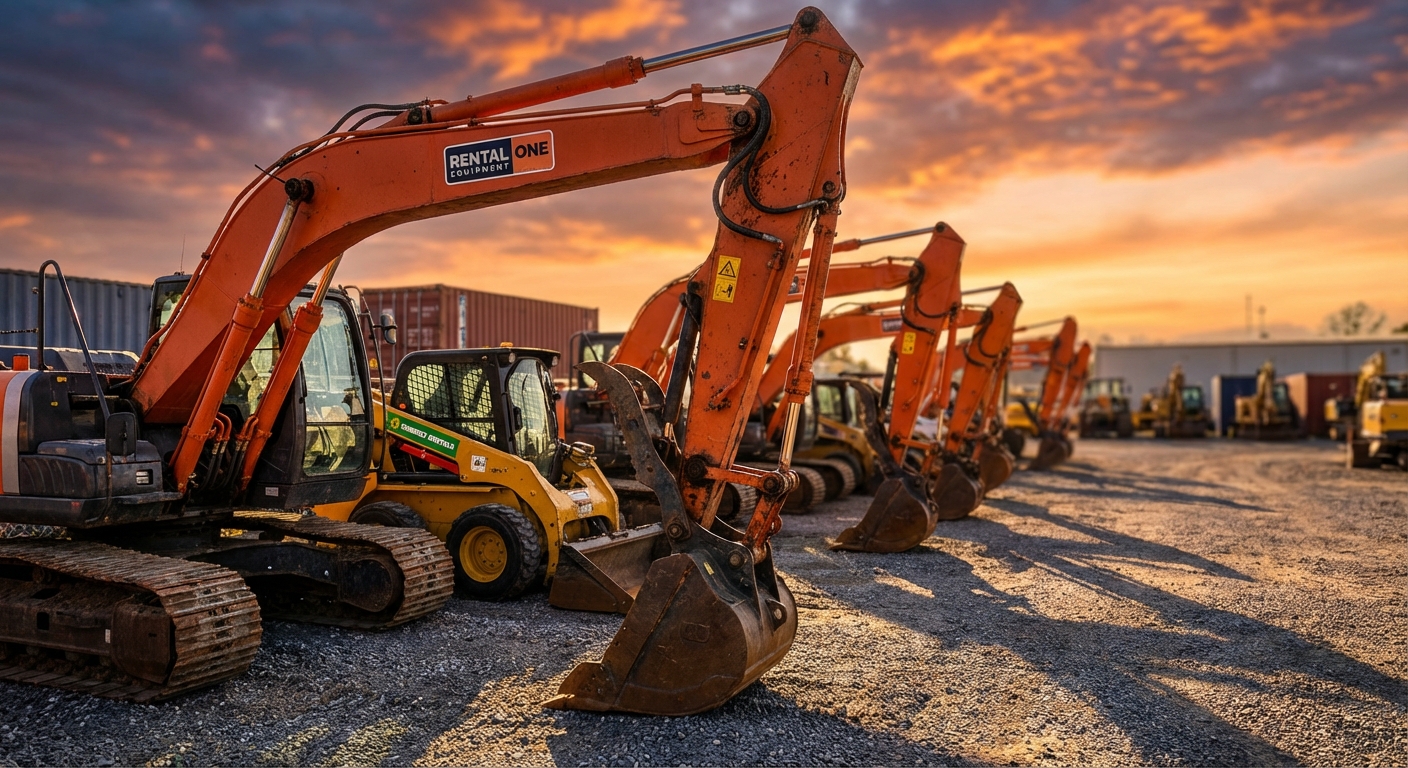
Heavy Equipment Rental vs. Buying: Complete Cost Analysis for 2026
Should you rent or buy heavy equipment? Compare total costs, break-even points, tax implications, and fleet strategy to make the right decision for your business.
Key Takeaways:
- Renting makes sense for under 60% annual utilization or specialty work
- Buying wins when you’ll use equipment more than 800 hours/year consistently
- The real break-even isn’t just purchase price — factor in maintenance, insurance, storage, and depreciation
- A hybrid fleet strategy (own core machines, rent specialty) often delivers the best ROI
- Tax implications differ significantly — Section 179 deductions can tip the scales toward buying
The Real Question Nobody Asks
Every contractor faces this decision eventually: do you keep writing rental checks, or do you pull the trigger on a purchase? Most people frame it as a simple monthly payment comparison. That’s the wrong way to think about it.
The real question is: what does each hour of machine time actually cost you, and how does that number change over the life of the equipment?
A $350/day rental sounds expensive until you realize your $85,000 skid steer costs you $47/hour when you factor in everything — and you’re only running it 600 hours a year. Conversely, that rental gets painful fast when you’re booking 1,200+ hours annually.
Let’s break down the actual math so you can make this decision with real numbers instead of gut feelings.
True Cost of Ownership: More Than the Sticker Price
When you buy a piece of equipment, the purchase price is just the beginning. Here’s what ownership actually costs:
The Full Ownership Cost Breakdown
Let’s use a real example — a mid-size excavator purchased at $120,000:
Year 1-5 Annual Costs:
- Loan payment: $2,350/month ($28,200/year at 6.5% over 5 years)
- Insurance: $2,800/year
- Maintenance (preventive): $6,000-$12,000/year (increases with age)
- Major repairs reserve: $3,000-$8,000/year
- Storage: $4,800/year
- Registration/permits: $500/year
- Depreciation opportunity cost: $12,000-$18,000/year (first 3 years)
The Depreciation Trap: Heavy equipment typically loses 20-30% of its value in the first year and 10-15% annually after that. A $120,000 excavator might be worth $72,000 after three years. That’s $48,000 in depreciation — real money that disappears whether you use the machine or not.
Total annual cost of ownership (Year 1): approximately $52,000-$60,000
If you run that excavator 1,000 hours in Year 1, your true cost per hour is $52-$60/hour. At 1,500 hours, it drops to $35-$40/hour. At just 500 hours? You’re looking at $104-$120/hour — and that rental doesn’t sound so bad anymore.
True Cost of Renting: Not Just the Day Rate
Rental pricing seems straightforward, but there are layers most contractors don’t calculate:
Typical 2026 Rental Rates
| Equipment Class | Daily Rate | Weekly Rate | Monthly Rate |
|---|---|---|---|
| Mini Excavator (3-6 ton) | $250-$450 | $800-$1,500 | $2,500-$4,500 |
| Mid-Size Excavator (12-20 ton) | $500-$900 | $1,600-$3,000 | $5,000-$9,000 |
| Skid Steer / CTL | $250-$450 | $750-$1,400 | $2,200-$4,000 |
| Dozer (small-mid) | $500-$1,000 | $1,500-$3,200 | $4,500-$10,000 |
| Wheel Loader | $400-$800 | $1,200-$2,800 | $3,800-$8,000 |
Hidden Rental Costs
- Delivery/pickup: $200-$800 per round trip
- Damage waiver: 10-15% added to the base rate
- Fuel: You’re filling someone else’s tank
- Cleaning fees: $50-$200 if returned dirty
- Overtime charges: Rates based on 8-hour days; exceeding that costs extra
- Attachment rentals: Often billed separately
- Mobilization time: Hours spent picking up and returning equipment aren’t billable to your client
The Weekly Rate Hack: Most rental companies price weekly rates at 3-4x the daily rate, and monthly rates at 3x the weekly. If you need equipment for 5+ days, always go weekly. For 3+ weeks, go monthly. This can save you 30-40% compared to daily billing.
Real Rental Cost Example
That same mid-size excavator at $700/day for a 2-week job:
- 10 working days × $700 = $7,000 (or ~$2,400 weekly × 2 = $4,800)
- Delivery/pickup: $600
- Damage waiver (12%): $576
- Total: $5,976 for two weeks (using weekly rate)
Break-Even Analysis by Equipment Type
Here’s where the math gets interesting. The break-even point is where owning costs the same as renting over a year.
That's 5-6 months of steady use
About 4-5 months of regular use
Roughly 6-7 months of use
Often 200+ days — renting usually wins
Quick Rule of Thumb: If you’ll use equipment more than 60% of available working days (roughly 150 days/year), buying starts to make financial sense. Below that threshold, renting is usually cheaper when you account for all ownership costs.
The Utilization Rate Decision Framework
Your utilization rate is the single most important number in this decision. Here’s how to calculate it:
Utilization Rate = (Actual Hours Used ÷ Available Hours) × 100
Available hours in a year: roughly 2,080 (260 working days × 8 hours)
| Utilization Rate | Hours/Year | Recommendation |
|---|---|---|
| Under 25% | < 520 | Rent. Not even close. |
| 25-40% | 520-832 | Rent, unless you have seasonal peaks that make scheduling rentals difficult |
| 40-60% | 832-1,248 | Gray zone — run the full cost analysis for your specific situation |
| 60-80% | 1,248-1,664 | Buying likely wins, especially with tax advantages |
| Over 80% | 1,664+ | Buy. You’re leaving money on the table renting. |
How to Estimate Your Utilization
Look at your last 12 months of work:
- Count the days you used (or would have used) that equipment type
- Estimate daily hours — most contractors average 5-7 productive machine hours per field day
- Multiply: days × average hours = projected annual hours
- Be honest: Don’t count hours you hope to use — count what your backlog actually supports
Tax Implications: Section 179 and Depreciation
Tax treatment can dramatically shift the rent-vs-buy equation.
Buying: Tax Advantages
- Section 179 Deduction: In 2026, you can deduct the full purchase price (up to $1,220,000) in the year of purchase. An $85,000 skid steer could save you $20,000+ in taxes that first year depending on your bracket.
- Bonus Depreciation: Still available at 60% for 2026 on anything Section 179 doesn’t cover.
- Interest Deduction: Loan interest on business equipment is tax-deductible.
- Maintenance Deductions: All repair and maintenance costs are deductible operating expenses.
Renting: Tax Treatment
- Full Deduction: Rental payments are 100% deductible as a business expense in the year paid.
- Simpler Accounting: No depreciation schedules to track.
- Predictable: Easier to forecast tax impact.
The Section 179 Swing: For a contractor in the 24% federal tax bracket, buying an $85,000 machine and taking Section 179 saves roughly $20,400 in Year 1 taxes. That’s like getting a $20,400 discount on the equipment. Factor this into your break-even calculation — it can move the break-even point by 30-50 rental days.
Hidden Factors That Change the Math
Beyond the raw numbers, several factors can tip the decision:
Factors Favoring Buying
- Availability risk: In busy seasons, rental fleets run dry. If you can’t get a machine, you can’t work. Owning eliminates that risk entirely.
- Operator familiarity: Your crew learns the quirks of your specific machine — where the controls are stiff, how the hydraulics respond. This improves productivity 10-15% versus a different rental unit every time.
- Customization: You can add aftermarket guards, upgrade buckets, install your preferred tech stack.
- Revenue generation when idle: You can rent your own equipment out when you’re not using it — turning a cost center into a profit center.
Factors Favoring Renting
- Technology churn: Equipment technology is advancing rapidly. Renting lets you always use the latest machines without being stuck with aging iron.
- Cash flow preservation: Down payments tie up cash that could fund marketing, hire employees, or cover seasonal gaps.
- No disposal headache: Selling used equipment takes time, effort, and you often get less than expected.
- Risk transfer: Major breakdowns are the rental company’s problem, not yours.
Case Study: Regional Excavation Contractor
A mid-size excavation company in the Midwest ran the numbers on their fleet of three excavators:
- Machine A (owned, 1,400 hrs/year): Cost per hour $38 — clear buy winner
- Machine B (owned, 650 hrs/year): Cost per hour $71 — would be cheaper to rent
- Machine C (rented as needed, ~400 hrs/year): Cost per hour $82 — correct decision to rent
By selling Machine B and renting when needed, they freed up $45,000 in capital and saved $8,200 annually. They reinvested that into marketing, which generated enough new work to push Machine A to 1,600 hours — dropping its cost per hour even further.
The Hybrid Fleet Strategy
Most successful contractors don’t go all-in on buying or renting. They use a hybrid approach:
Own Your Core Fleet:
- ✅ Equipment you use 60%+ of the time
- ✅ Your primary revenue-generating machines
- ✅ Equipment that’s hard to rent locally
- ✅ Machines your operators are trained on
Rent the Rest:
- ✅ Specialty equipment for one-off jobs
- ✅ Extra capacity for peak season overflow
- ✅ Equipment you’re evaluating before buying
- ✅ Machines needed for geographic expansion into new markets
Building Your Hybrid Strategy
- Audit your fleet utilization — track every machine’s hours for 3-6 months
- Identify your core machines — the ones running daily
- Flag underperformers — machines sitting more than they work
- Model the swap — what would it cost to rent those underperformers only when needed?
- Reinvest the freed capital — into marketing, operators, or higher-utilization equipment
When Renting Always Wins
Some situations are clear-cut in favor of renting:
- New business (first 1-2 years): You don’t have enough data to predict utilization. Rent until you can prove consistent demand.
- Specialty equipment: Concrete pumps, piling rigs, large cranes — unless that’s your core business, rent these.
- Geographic expansion: Testing a new market? Rent locally instead of hauling your fleet.
- Short-term contracts: A 3-month project doesn’t justify a 5-year loan.
- Rapidly evolving technology categories: If a machine class is seeing major innovation year-over-year, renting keeps you current.
When Buying Always Wins
And some situations clearly favor ownership:
- High utilization (1,000+ hours/year): The math is overwhelmingly in your favor.
- Equipment scarcity in your area: If rental availability is unreliable, owning is an operational necessity.
- Strong resale market: Some equipment holds value exceptionally well — buying and selling after 3-4 years can be nearly cost-neutral.
- Revenue-generating idle time: If you can rent out your equipment when you’re not using it, ownership becomes a profit center.
- Long-term contracts: Multi-year projects make ownership economics very favorable.
Making Your Decision: A Step-by-Step Process
Here’s a practical framework to run through for each piece of equipment:
- Calculate projected annual hours based on your actual backlog and historical data
- Get rental quotes for your area — daily, weekly, and monthly rates
- Calculate total rental cost at your projected usage level (don’t forget delivery, waivers, and fuel)
- Calculate total ownership cost including financing, insurance, maintenance, storage, and depreciation
- Compare cost per hour for both scenarios
- Factor in tax benefits — run the Section 179 numbers with your accountant
- Add qualitative factors — availability risk, operator familiarity, cash flow needs
- Decide and review annually — your utilization might change as your business grows
Pro Tip: Many rental companies offer rent-to-own programs where a percentage of your rental payments apply toward purchase. This can be the best of both worlds — you rent while building data on utilization, then convert to ownership once you’ve proven the demand. Ask about these programs before committing to either option.
Track Your Equipment Costs with FieldFix
Making the rent-vs-buy decision requires accurate data on utilization, maintenance costs, and cost per hour. FieldFix tracks all of this automatically — giving you the real numbers you need to make confident fleet decisions.
Start tracking your fleet for free →
Stop guessing. Start knowing exactly what your equipment costs you per hour.
Related Articles
September 4, 2026
Heavy Equipment Fall Service Planning Guide: How to Prevent Winter Downtime
September 3, 2026
Horizontal Directional Drill Maintenance: The Complete HDD Service Guide for Contractors
September 2, 2026