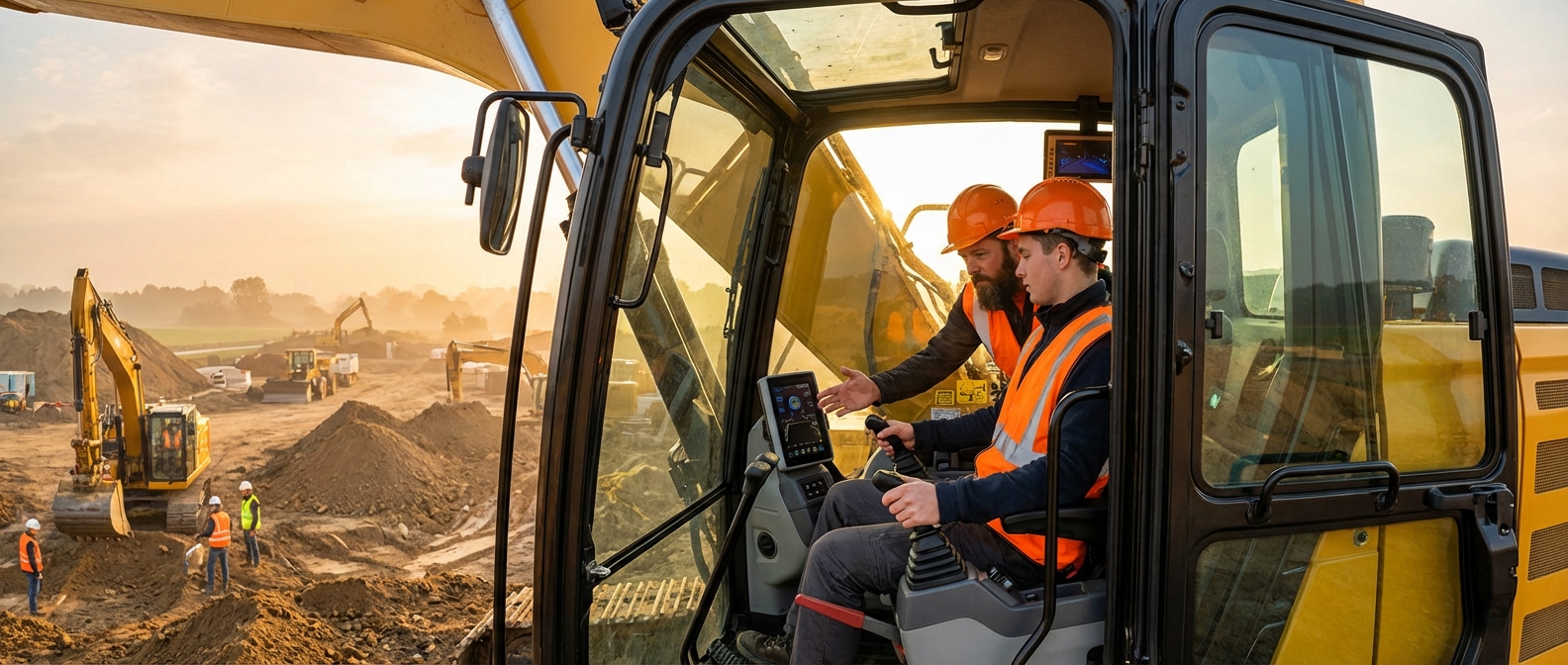
Heavy Equipment Operator Training & Certification: The Complete 2026 Guide
Everything you need to know about heavy equipment operator training, certification programs, OSHA requirements, and how proper training reduces downtime and repair costs.
Key Takeaways:
- Untrained operators cause up to 70% of avoidable equipment damage in small fleets
- OSHA requires documented training for most heavy equipment — fines start at $16,131 per violation
- Proper operator training can reduce maintenance costs by 25-40% and extend machine life by years
- Certification programs range from 2-week intensives ($5,000-$15,000) to multi-year apprenticeships
- Even experienced operators benefit from annual refresher training on new equipment and technology
You bought a $200,000 excavator. You’d never hand the keys to someone who’s never sat in one, right?
And yet — it happens constantly. Operators get a 10-minute walkaround, a “don’t hit anything,” and they’re off to the jobsite. The machine comes back with a cracked track frame and a hydraulic leak. Nobody knows how it happened.
Here’s the uncomfortable truth: your equipment is only as good as the person running it. And if you’re not investing in operator training, you’re burning money on repairs that never needed to happen.
Why Operator Training Matters More Than You Think
Most fleet owners obsess over maintenance schedules, fluid changes, and parts costs. All important. But the single biggest variable in how long your equipment lasts — and how much it costs to maintain — is the operator sitting in the cab.
A skilled operator doesn’t just “run” a machine. They:
- Listen to the engine and hydraulics for early warning signs
- Feel when something isn’t right through the controls
- Understand load limits and don’t push beyond them
- Know how to work efficiently without over-stressing components
- Report issues before they become catastrophic failures
An untrained operator does none of this. They run the machine until something breaks, then tell you about it after the fact.
The 70% Rule: Industry studies consistently show that 60-70% of avoidable equipment damage in fleets under 20 machines traces back to operator error — not mechanical failure, not manufacturer defects. Operator error. That’s your biggest maintenance cost hiding in plain sight.
The Real Cost of Untrained Operators
Let’s put real numbers on this.
The math is simple. If you’re running a 5-machine fleet with untrained operators, you’re looking at $60,000-$90,000 in annual repairs. Train those operators properly and you could cut that to $30,000-$45,000. That’s $30,000+ back in your pocket every year.
And that doesn’t account for:
- Lost revenue from unplanned downtime (easily $2,000-$5,000 per day)
- Insurance premium increases from accident claims
- Worker’s comp costs from injuries
- Replacement operator costs when someone gets hurt and can’t work
Case Study: A 3-Machine Land Clearing Operation
A small land clearing company in the Southeast was spending $42,000/year on equipment repairs across three machines. After sending their two operators through a 40-hour training program ($3,200 total), their repair costs dropped to $22,000 the following year. ROI: 525% in the first year alone.
The biggest change? Operators started doing proper pre-operation inspections and reporting minor issues early, before they became major failures.
OSHA Requirements You Can't Ignore
This isn’t optional. OSHA has specific training requirements for heavy equipment operators, and the penalties for non-compliance are steep.
Key OSHA standards for heavy equipment:
- 29 CFR 1926.1427 — Operator certification for cranes (mandatory)
- 29 CFR 1926.602 — Material handling equipment training
- 29 CFR 1926.21 — General safety training requirements
- 29 CFR 1910.178 — Powered industrial truck (forklift) operator training
Penalty Alert: As of 2026, OSHA fines start at $16,131 per serious violation and up to $161,323 per willful violation. If an untrained operator causes an accident and OSHA investigates, you’re looking at potential fines that could sink a small operation. Plus the liability exposure in civil court.
What OSHA requires at minimum:
- Formal instruction — Lectures, videos, written materials, or computer-based training
- Practical training — Hands-on operation under supervision
- Evaluation — Documented demonstration that the operator can safely operate the equipment
- Equipment-specific training — Each type of machine requires its own training
- Refresher training — When unsafe operation is observed, after an accident, or when conditions change
The key word is documented. Verbal instructions don’t count. You need records showing who was trained, when, on what equipment, and who evaluated them.
Types of Training Programs
Formal Certification Programs (Schools/Institutions)
Pros:
- Comprehensive curriculum covering multiple machine types
- Industry-recognized certifications
- Professional instructors with decades of experience
- Often include simulator time before live equipment
- Strong for new/inexperienced operators
Cons:
- Expensive ($5,000-$15,000+ for multi-week programs)
- Operators are off-site during training (lost productivity)
- Generic curriculum may not cover your specific equipment
- Wait times for enrollment can be months
Manufacturer Training Programs
Pros:
- Equipment-specific — covers exact machines your operators run
- Often included with new equipment purchases
- Taught by factory-trained technicians
- Covers machine-specific maintenance and diagnostics
Cons:
- Only covers one manufacturer’s equipment
- Limited availability (may require travel)
- Shorter duration — focuses on operation, not broad skills
- May push proprietary parts/service
In-House Training Programs
Pros:
- Tailored to your exact fleet and operations
- Flexible scheduling around job demands
- Experienced operators can train new hires
- Lowest per-operator cost over time
- Builds team knowledge and culture
Cons:
- Requires significant upfront setup time
- Your “trainers” may not know best practices themselves
- No external certification credential
- Risk of passing down bad habits
- Documentation burden falls on you
Union Apprenticeship Programs
Pros:
- Multi-year comprehensive training (3-4 years typical)
- Earn while you learn — apprentices work and get paid
- Produces highly skilled, versatile operators
- Strong safety culture built in
- Nationally recognized credentials
Cons:
- Long timeline — not a quick solution
- Union membership requirements
- Geographic availability varies significantly
- May not align with small fleet needs
Certification Options Breakdown
Here are the most recognized certifications in the industry:
NCCER (National Center for Construction Education and Research)
- What: The gold standard for construction trades training
- Duration: 2-4 levels, each taking several months
- Cost: Varies by training provider ($2,000-$8,000)
- Recognized by: Most major contractors and government agencies
- Best for: Operators who want a career credential
NCCCO (National Commission for the Certification of Crane Operators)
- What: Required for crane operators in most states
- Duration: Written + practical exam (prep courses are 1-2 weeks)
- Cost: $600-$1,200 for exams, plus prep course fees
- Recognized by: OSHA-compliant, legally required in many jurisdictions
- Best for: Anyone operating cranes or hoisting equipment
Equipment-Specific Manufacturer Certifications
- What: Brand-specific operation and maintenance credentials
- Duration: 1-5 days typically
- Cost: Often free with equipment purchase, otherwise $500-$2,000
- Best for: Operators running specific machines daily
OSHA 10-Hour and 30-Hour Cards
- What: General construction safety awareness (not operator-specific)
- Duration: 10 or 30 hours of instruction
- Cost: $25-$200 (often available online)
- Best for: Baseline safety knowledge for everyone on-site
Pro Tip: For small fleet owners, the best bang for your buck is usually a combination of manufacturer-specific training for your exact machines plus OSHA 10-Hour for general safety. This covers your legal bases and gives operators the specific knowledge they need — without the cost of a full certification program.
Building an In-House Training Program
If you’re running a small fleet (under 10 machines), building your own training program makes the most sense long-term. Here’s how:
Step 1: Document Your Equipment
Create a training checklist for each machine type in your fleet. Cover:
- Pre-operation inspection procedure
- Startup and shutdown sequences
- Basic operation controls and their functions
- Load capacity limits and charts
- Common error codes and what they mean
- Emergency shutdown procedures
- Daily maintenance tasks (grease points, fluid checks)
Step 2: Designate Trainers
Pick your most experienced, safest operators. Not just the fastest — the ones who bring machines back in good condition and have clean safety records. Give them:
- A structured checklist to follow during training
- Authority to sign off (or not) on new operators
- Time in the schedule dedicated to training — not “squeeze it in between jobs”
Step 3: Create a Training Timeline
For a new operator on a single machine type:
| Phase | Duration | Activities |
|---|---|---|
| Classroom | 4-8 hours | Manual review, safety rules, controls overview |
| Observed operation | 16-24 hours | Run machine with trainer present |
| Supervised solo | 40 hours | Operate independently, trainer checks in regularly |
| Signed off | After evaluation | Documented competency assessment |
Step 4: Document Everything
Create a simple training record for each operator:
- Date trained
- Equipment type
- Trainer name
- Topics covered
- Evaluation results (pass/fail with notes)
- Operator and trainer signatures
This is your OSHA documentation. Keep it forever.
What Good Training Actually Covers
Bad training: “Here’s the joystick, here’s the throttle, don’t flip it over.”
Good training covers seven core areas:
1. Machine Familiarization
Understanding the machine inside and out. Not just the controls — the systems. How the hydraulics work. What the engine gauges mean. Where the grease points are and why they matter.
2. Pre-Operation Inspection
The single most valuable habit any operator can develop. A proper walkaround takes 10-15 minutes and catches problems before they become failures. Fluid levels, track condition, hydraulic hoses, bucket teeth, structural damage — all of it, every day.
3. Proper Operating Technique
This is where the real money is saved. Smooth inputs instead of jerky movements. Proper digging technique that doesn’t overload the hydraulic system. Understanding how to work with the machine’s design rather than fighting against it.
4. Load Management
Every machine has limits. Understanding swing radius loads, lifting capacities at different boom extensions, grade limitations, and tipping points. This knowledge prevents rollovers and structural damage.
5. Site Awareness
Reading terrain. Identifying underground utilities. Understanding soil conditions. Knowing where other workers and machines are. Spatial awareness prevents the most serious accidents.
6. Basic Troubleshooting
Operators should know how to identify common issues: unusual sounds, warning lights, performance changes. They don’t need to fix everything — but they need to know when to stop and call for help vs. when something is normal.
7. Emergency Procedures
What to do if the machine catches fire. How to perform an emergency shutdown. Rollover survival techniques. Who to call and what to report. These scenarios are rare but catastrophic when operators aren’t prepared.
How Training Impacts Equipment Longevity
Let’s connect the dots between training and your maintenance budget:
Trained operators reduce wear in three key ways:
-
Smoother operation — Fewer shock loads on pins, bushings, and hydraulic components. A jerky operator can wear out a set of bucket pins in half the normal lifespan.
-
Early problem detection — Trained operators notice when a track is loose, a cylinder is leaking, or the engine sounds different. Early detection means a $200 fix instead of a $5,000 repair.
-
Proper startup/shutdown — Cold-starting an engine and immediately putting it under full load damages bearings and seals. Proper warm-up and cool-down procedures alone can add thousands of hours to engine life.
The pattern is consistent: machines operated by trained operators show lower maintenance costs over the life of the machine compared to identical machines run by untrained operators. The difference is most dramatic in hydraulic system repairs and undercarriage wear — exactly the areas most affected by operator technique.
Technology's Role in Operator Development
Training doesn’t stop after the initial certification. Modern fleet management tools are changing how operators improve over time:
Digital Service Logs
When operators log their daily inspections digitally instead of on paper (or not at all), patterns emerge. You can see which operators are thorough and which are cutting corners. Fleet management platforms make this data visible and actionable.
Machine Telematics
Modern equipment reports operating data — idle time, fuel consumption, working hours, fault codes. Compare this data across operators running the same machine and you’ll quickly identify who’s efficient and who’s burning fuel and wearing parts unnecessarily.
AI-Powered Diagnostics
When an operator encounters an issue they’re not sure about, AI diagnostic tools can help them identify the problem from a photo or description. This bridges the gap between “I don’t know what’s wrong” and “I can describe the issue accurately to the mechanic” — saving diagnostic time and preventing operators from running a machine with an unidentified problem.
Simulator Training
Increasingly affordable simulators let operators practice on virtual machines before touching real equipment. Mistakes in a simulator cost nothing. Mistakes on a $300,000 excavator cost a lot.
Getting Started: A Practical Roadmap
Here’s your action plan, whether you’re running 2 machines or 20:
This Week:
- Audit your current training documentation (most fleet owners discover they have none)
- List every operator and what equipment they’re authorized to run
- Check your insurance policy’s training requirements
This Month:
- Create pre-operation inspection checklists for each machine type
- Designate lead operators as trainers
- Schedule OSHA 10-Hour for anyone who doesn’t have it
- Set up a digital system for logging training records and inspections
This Quarter:
- Develop written training procedures for your top 3 most-used machine types
- Run every operator through a formal evaluation on their primary machine
- Contact your equipment dealers about available manufacturer training
- Begin tracking maintenance costs per operator (this data is gold)
Ongoing:
- Annual refresher training for all operators
- New-hire training before anyone touches equipment unsupervised
- Review maintenance data quarterly to identify training gaps
- Update procedures when new equipment enters the fleet
Track Training Impact on Your Fleet
Want to see exactly how operator skill affects your maintenance costs? FieldFix tracks maintenance expenses, service history, and cost-per-hour across your entire fleet — giving you the data you need to prove training ROI and catch problems before they get expensive.
Related Articles
September 4, 2026
Heavy Equipment Fall Service Planning Guide: How to Prevent Winter Downtime
September 3, 2026
Horizontal Directional Drill Maintenance: The Complete HDD Service Guide for Contractors
September 2, 2026