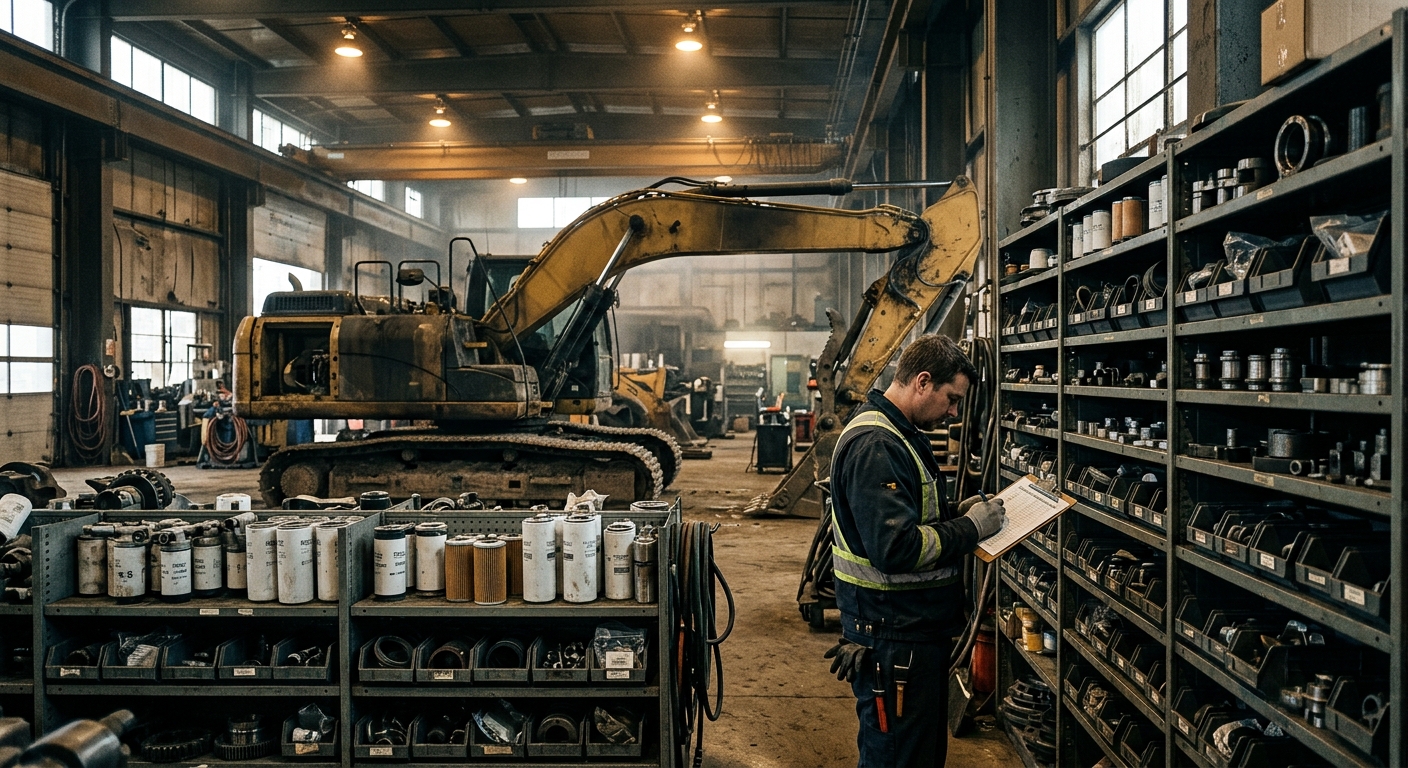
Heavy Equipment Spare Parts Inventory Guide: What to Stock and What to Order
Learn how to build a heavy equipment spare parts inventory system that cuts downtime, avoids overbuying, and keeps your fleet working when parts fail fast.
Key Takeaways
- The right spare parts shelf saves far more money than it costs.
- Stock fast-fail, low-cost parts that can shut down a machine instantly.
- Do not tie up cash in slow-moving, high-dollar parts without a real failure history.
- Your parts list should be based on fleet mix, lead times, and downtime cost.
- A simple digital log beats guessing what is “probably somewhere in the shop.”
A machine can be ready to work, the crew can be ready to work, the job can be ready to start — and then everything stops because nobody has a $24 filter, a $60 belt, or the hydraulic fitting that always seems to fail at the worst possible time.
That is stupid downtime. Expensive downtime too.
Most contractors do one of two bad things with spare parts. They either stock almost nothing and pray the dealer has it, or they stock a random graveyard of parts that tie up cash and still somehow never include the thing they actually need.
The smarter move is simple: stock the parts that fail often, cost little, and shut you down fast. Order the rest with intention.
This guide breaks down how to build a spare parts inventory system for heavy equipment without turning your shop into a warehouse.
Why parts inventory matters
Spare parts inventory is not about being a parts dealer. It is about protecting uptime.
If you run excavators, skid steers, track loaders, wheel loaders, dozers, or support trucks, you already know the ugly truth: the part itself is often the cheap part of the failure. The real cost is the lost production, the idle operator, the delayed subcontractors, the rescheduled hauling, and the phone call where you tell a customer the job is slipping.
A simple rule: if a part is cheap, fails predictably, and can park a machine, you should strongly consider stocking it.
A good inventory system does four things:
- Reduces avoidable downtime
- Prevents rush shipping and dealer markup surprises
- Keeps preventive maintenance on schedule
- Gives you cleaner data on what your fleet actually consumes
That last point matters more than people think. If you do not know which parts you burn through, you do not really know which machines are costing you money.
The real cost of not having the part
Owners often hesitate to stock parts because they do not want money sitting on a shelf. Fair. But they usually compare the shelf cost to zero instead of comparing it to downtime.
Imagine a compact track loader goes down because of a failed serpentine belt. The belt costs less than lunch for two people. But now the operator is standing around, the trailer trip was wasted, and the whole day gets weird. That tiny missing part can wreck margin on the job.
Real-world example
A contractor keeps one spare fuel filter, one engine air filter, one serpentine belt, and two common hydraulic hose sizes for each core machine class. Total shelf value: roughly $1,200.
That same contractor avoids just two one-day delays over a season because the parts are already in the shop. The inventory paid for itself and then some.
What parts you should always stock
This is where most fleets should start.
1. PM consumables
These are non-negotiable.
- Engine oil filters
- Fuel filters
- Air filters
- Cab filters
- Hydraulic return filters
- Drain plug washers and common seals
If your maintenance intervals are predictable, there is no excuse to get caught without these.
2. Belts and common wear items
Belts are cheap. Downtime is not.
- Serpentine belts
- Alternator belts
- A/C belts where applicable
- Wiper blades
- Common work lights
- Fuses and relays
3. Hydraulic repair basics
Not every hose should be prebuilt and shelved, but some hydraulic support stock makes sense.
- Common hydraulic fittings
- O-rings and seal kits
- Hose clamps
- Quick couplers
- A few high-failure hose assemblies for your most used machine
Best practice: track which hose lengths and fitting combinations fail most often, then stock those exact assemblies instead of guessing.
4. Electrical quick-fix parts
Electrical issues love wasting entire mornings.
- Blade fuses
- Maxi fuses
- Standard relays
- Battery terminals
- Ground straps
- Common sensors with known failure history
5. Undercarriage and attachment wear items for your most-used machines
Not everything. Just the repeat offenders.
- Bucket teeth and pins
- Cutting edges if you replace them regularly
- Attachment hoses and couplers
- Track hardware or roller hardware with known wear patterns
What parts you usually should not stock
This is where people get carried away.
Worth Stocking
Pros:
- Cheap compared to downtime
- Predictable usage
- Easy to store
- Often machine-stopping when unavailable
Usually Better to Order
Cons:
- High-dollar components tie up cash
- Failure is rare or unpredictable
- Warranty or serial-number matching may matter
- Storage conditions can damage the part over time
In most fleets, you usually should not stock:
- Turbochargers
- Injection pumps
- Full alternators or starters for every unit
- Large hydraulic cylinders
- ECMs and major electronics
- Rarely used glass and body panels
- Expensive OEM-only components with long shelf time
There are exceptions. If one machine is a bottleneck for your whole operation and a certain expensive part has already failed twice, stocking it may be smart. But that should be a deliberate decision, not fear-based hoarding.
Watch the trap: a shelf full of old, dusty, slow-moving parts feels prepared. It is usually just cash turned into clutter.
How to build a smart parts system
A smart inventory system is built on three inputs: failure frequency, lead time, and consequence of downtime.
Ask these questions for every part category:
- How often does this part fail or get replaced?
- How long does it take to get one from the dealer or supplier?
- Does the machine become unusable without it?
- Is there a safe workaround, or are you dead in the water?
- Is this part shared across multiple machines in the fleet?
That gives you your stocking logic.
Use an A-B-C method
A parts: cheap, common, machine-stopping, or PM-critical
Stock these aggressively.
B parts: moderate cost, moderate usage, moderate urgency
Keep limited quantities and reorder deliberately.
C parts: expensive, rare, specialty, or serial-specific
Do not stock unless history proves you should.
Example A-B-C classification for a 6-machine fleet
- A parts: filters, belts, fittings, fuses, relays, couplers, bucket teeth
- B parts: starter, alternator, common seat switch, common hoses, wheel seals
- C parts: ECM, turbo, pump, injector set, final drive assembly
Recommended min/max levels
Once you know what belongs on the shelf, stop relying on memory.
Use a min/max system:
- Minimum: the reorder trigger
- Maximum: the amount you want on hand after replenishment
For example:
- Fuel filter for your main skid steer: min 2, max 6
- Serpentine belt for your excavator class: min 1, max 3
- Common hydraulic fitting: min 4, max 12
- Bucket teeth pins: min 10, max 30
This is not glamorous. It works anyway.
Do not run inventory by memory. The sentence “I thought we had one” has cost contractors a ridiculous amount of money.
How to organize your parts room
A messy parts shelf is almost as bad as having no parts at all.
Your shop inventory should be:
- Labeled by machine class or part family
- Stored in bins, not loose piles
- Tagged with part number and reorder point
- Protected from moisture, dust, and sunlight
- Counted on a simple recurring schedule
If you want this to stick, make it stupidly easy for the crew.
- Put used-part checkouts on a whiteboard or tablet
- Keep QR labels or simple bin labels
- Require every PM service to log what parts were used
- Assign one person ownership, even if the whole team has access
The best inventory systems are boring. That is a compliment.
A sample inventory strategy by fleet size
Small fleet: 1 to 3 machines
Keep it lean.
Focus on PM kits, belts, filters, fuses, lights, common couplers, and one emergency hose strategy. You do not need a warehouse. You need the basics that keep one breakdown from killing the week.
Growing fleet: 4 to 10 machines
This is where inventory discipline starts to matter a lot.
Standardize machines where possible, consolidate part numbers, and build min/max levels across shared components. If two loaders can use the same filters or belts, that is a win.
Larger mixed fleet: 10+ machines
Now you need process, not vibes.
At this stage, use digital tracking, dedicated storage locations, recurring counts, supplier relationships, and reporting on consumption trends. Otherwise theft, overordering, and chaos creep in fast.
Common mistakes that waste money
The worst mistakes are predictable.
- Buying random parts after a failure and never organizing them
- Stocking based on fear instead of failure history
- Keeping no reorder levels
- Letting one machine type dominate storage with low-value junk
- Failing to remove obsolete parts after selling equipment
- Not standardizing across similar machines
- Treating dealer availability as a permanent guarantee
Strong opinion: obsolete inventory is a tax on sloppy management. If you sold the machine two years ago, stop storing its ghosts.
A quarterly review fixes most of this. Pull obsolete parts. Count fast movers. Check what caused delays. Tighten the list. Repeat.
How FieldFix helps track parts readiness
FieldFix is built for the reality that maintenance is not just about repairs. It is about readiness.
When you log services, failures, and recurring issues, patterns start showing up fast:
- Which machine classes chew through filters or hoses
- Which failures repeat often enough to justify shelf stock
- Which PM jobs are getting delayed because parts were not ready
- Which assets are quietly driving emergency orders
That gives you a much smarter stocking plan than gut instinct.
Stop letting cheap parts create expensive downtime
If your fleet is still tracking maintenance and parts usage from memory, text threads, or random receipts, you are leaving uptime to chance.
FieldFix helps you track maintenance history, spot repeat failures, and build a tighter parts strategy before downtime hits.
Start using FieldFix to turn parts inventory from shop clutter into an actual uptime advantage.
A good spare parts inventory is not about owning more stuff. It is about owning the right stuff.
That is the whole game. Keep the cheap machine-stoppers on hand. Stop hoarding slow movers. Track what gets used. Tighten the system every quarter.
Do that, and your shop gets calmer, your fleet gets more reliable, and your jobs stop getting held hostage by parts that should have been sitting on a shelf the whole time.
Related Articles
May 1, 2026
Heavy Equipment Transmission Maintenance: The Complete Guide to Preventing Drivetrain Failure

April 30, 2026
Heavy Equipment Cooling Pack Cleaning Guide: Stop Overheating Before It Starts
April 29, 2026