Heavy Equipment Transport & Hauling: Complete Safety Guide for 2026
Learn how to safely transport heavy equipment with proper trailer selection, tie-down methods, permitting, and loading procedures to avoid costly damage.
Key Takeaways
- Improper loading and securement cause over 500 heavy equipment transport incidents per year in the U.S.
- Trailer selection depends on machine weight, dimensions, and ground clearance — not just rated capacity
- Chain and binder ratings must exceed the total weight of the machine by at least 50% using the aggregate working load limit
- Permits and regulations vary by state — an overweight or over-dimensional load without proper permits can mean $10,000+ in fines
- Pre-transport inspection of both the machine and trailer prevents breakdowns, damage, and liability issues on the road
Moving heavy equipment between jobsites is one of the most dangerous and expensive parts of running a fleet. A single loading accident can total a machine, destroy a trailer, or worse — injure an operator. And even if the move goes smoothly, getting pulled over without the right permits can cost you thousands in fines and delays.
Whether you’re hauling a 10,000-lb mini excavator across town or moving a 60,000-lb dozer across state lines, this guide covers everything you need to know about transporting heavy equipment safely, legally, and without damaging your machines.
Why Equipment Transport Goes Wrong
Most equipment transport accidents share the same root causes:
The FMCSA requires that all cargo, including heavy equipment, be secured according to specific rules outlined in 49 CFR Part 393. Violations aren’t just tickets — they can result in out-of-service orders that strand your equipment on the roadside.
Choosing the Right Trailer
Picking the wrong trailer is the first mistake many operators make. Here’s what to match:
Flatbed Trailers (Tilt or Standard)
Best for machines under 20,000 lbs with rubber tires — skid steers, compact track loaders, small wheel loaders. Tilt-deck flatbeds eliminate the need for ramps, reducing loading risk significantly.
- Typical capacity: 10,000–24,000 lbs
- Deck height: 24–34 inches
- Best for: Short-distance moves, lighter machines
Lowboy Trailers
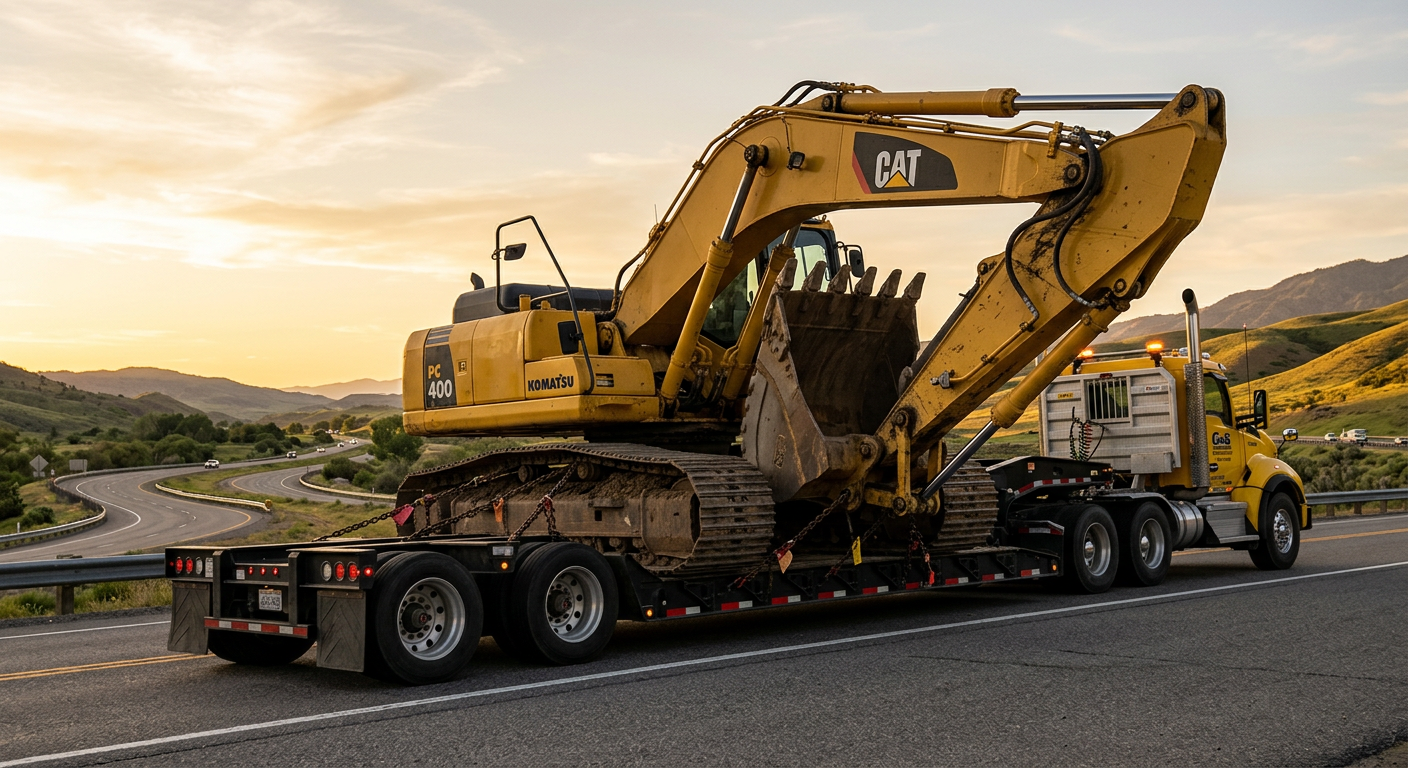
The go-to for large excavators, dozers, and anything over 40,000 lbs. The low deck height (18–22 inches) lowers the center of gravity during transport and makes loading tall machines easier.
- Typical capacity: 35,000–80,000+ lbs
- Deck height: 18–22 inches
- Best for: Large machines, over-height loads, highway transport
Tag-Along (Gooseneck) Trailers
Popular with small to mid-size contractors. Pulled by heavy-duty pickup trucks. Good for mini excavators, compact equipment, and attachments.
- Typical capacity: 12,000–30,000 lbs
- Deck height: 24–30 inches
- Best for: Owner-operators, frequent short hauls
Never rely solely on rated capacity. A trailer rated for 25,000 lbs might not safely haul a 22,000-lb machine if the weight distribution puts too much on a single axle. Always check axle ratings AND gross vehicle weight rating (GVWR) independently.
Trailer Selection Quick Reference
Flatbed / Tilt Deck
- ✅ Easy loading with tilt mechanism
- ✅ Versatile — haul equipment, materials, pallets
- ✅ Lower purchase cost
- ❌ Limited to lighter machines
- ❌ Higher deck = higher center of gravity
Lowboy
- ✅ Handles the heaviest machines
- ✅ Low center of gravity = safer transport
- ✅ Easier loading for tracked equipment
- ❌ Expensive ($30,000–$80,000+ new)
- ❌ Requires CDL and often permits
Loading Procedures Step by Step
Loading is where most damage and injuries happen. Follow this sequence every time:
1. Site Assessment
Before you even lower the ramps:
- Ground conditions — Is the surface level and firm? Soft ground causes trailers to shift and tip. Use timber mats or plywood under the trailer stands if the ground is soft.
- Grade — Ideally load on flat ground. If you must load on a slope, position the trailer so the machine drives uphill onto the deck.
- Overhead clearance — Check for power lines, tree branches, and structures. A raised boom contacting a power line is fatal.
2. Trailer Preparation
- Set parking brake on the tow vehicle
- Chock trailer wheels on both sides
- Lower ramps fully and verify they’re locked
- Check ramp weight rating — ramps have separate ratings from the trailer deck
- Extend outriggers or stabilizer jacks if equipped
3. Machine Loading
- Tracked machines: Drive straight on. Never angle tracked equipment onto ramps — uneven track loading causes tip-overs.
- Wheeled machines: Center the machine on the ramps. Have a spotter guide you if visibility is limited.
- Boom and attachments: Lower all booms, arms, and buckets before driving onto ramps. Raised attachments shift the center of gravity dangerously high.
- Speed: Idle speed only. Never throttle up on ramps.
4. Positioning on Deck
- Center the machine left-to-right on the trailer
- Position for optimal axle weight distribution (usually slightly forward of center)
- Lower all hydraulic components to their transport position
- Turn off the machine, set the parking brake, and remove the key
Never leave the machine running during securement. Hydraulic drift can cause booms to move, and accidental lever contact has caused machines to drive off trailers during tie-down. Engine off, brake set, key out — every time.
Securement: Chains, Binders, and Straps
This is where FMCSA regulations get specific — and where most violations occur.
The Basic Rule
The aggregate working load limit (WLL) of all tie-downs must equal or exceed 50% of the cargo weight. For a 40,000-lb excavator, you need at least 20,000 lbs of total WLL in your chains and binders.
Minimum Tie-Down Count
Per FMCSA 49 CFR §393.110:
- Under 5 ft long: 1 tie-down (if the machine is blocked or braced)
- 5–10 ft long: 2 tie-downs
- Over 10 ft long: 2 tie-downs plus 1 additional for every 10 ft (or fraction thereof)
Most heavy equipment requires 4 tie-downs minimum — one at each corner.
Chain Grades and Ratings
| Chain Grade | WLL per 3/8” | WLL per 1/2” | Best For |
|---|---|---|---|
| Grade 70 | 6,600 lbs | 11,300 lbs | General transport |
| Grade 80 | 7,100 lbs | 12,000 lbs | Heavy equipment (most common) |
| Grade 100 | 8,800 lbs | 15,800 lbs | Heavy haul, max capacity |
Use Grade 80 or Grade 100 chains for heavy equipment. Grade 30 (proof coil) and Grade 43 (high test) are NOT rated for overhead or transport securement. Using the wrong grade chain is a common — and dangerous — mistake.
Binder Types
- Ratchet binders: Easier to operate, precise tension control. Preferred for most applications.
- Lever (snap) binders: Faster but can release violently if the handle isn’t fully seated. Higher injury risk.
Tie-Down Points
Always chain to designated tie-down points on the machine — usually reinforced lugs or hooks welded to the frame. Never chain to:
- Bucket teeth or cutting edges
- Hydraulic cylinders or lines
- Track shoes or rubber tracks
- Handrails or steps
- The boom or arm
If you’re unsure where the tie-down points are, check the operator’s manual. Every manufacturer marks approved lifting and tie-down locations.
Weight Limits, Permits, and Legal Requirements
This is where transport gets complicated — and expensive if you get it wrong.
Federal Weight Limits
- Gross vehicle weight (truck + trailer + cargo): 80,000 lbs on Interstate highways
- Single axle: 20,000 lbs
- Tandem axle: 34,000 lbs
- Bridge formula: Additional limits based on axle spacing
When You Need Permits
CDL Requirements
If your combined vehicle weight rating (GCWR) exceeds 26,001 lbs and the towed unit weighs more than 10,001 lbs, you need a Class A CDL. This applies to most equipment hauling scenarios beyond small compact machines.
State permit systems vary wildly. Some states offer single-trip permits online in minutes. Others require 3–5 business days and route-specific approval. Plan ahead — especially for interstate moves. Services like Oversize.io and TruckPermits.com can handle multi-state permitting.
Pre-Transport Machine Prep
Before loading any machine for transport, complete these steps:
Fluid Check
- Verify no active leaks — hydraulic, coolant, fuel, or oil drips during transport create DOT violations and environmental liability
- Top off coolant if temperatures will drop below freezing during transport
- Diesel fuel should be at least half full to prevent condensation in the tank
Mechanical Prep
- Retract all cylinders to their transport position
- Pin the boom if the machine has a transport lock
- Remove or secure loose attachments (buckets should be pinned, not floating)
- Fold mirrors and remove any antennas or tall accessories
- Disconnect batteries on older machines to prevent electrical drain or accidental start
Documentation
- Record the machine’s hour meter reading before and after transport
- Take photos of all four corners and any existing damage — this protects you if a hauler damages your machine
- Keep the machine’s registration, insurance, and any lien documentation accessible
Common Mistakes That Damage Equipment
Case Study: Hydraulic Cylinder Damage from Chain Placement
A contractor chained a mid-size excavator to the trailer using the bucket cylinder mounting pin as a tie-down point. During highway transport, vibration and chain tension bent the cylinder rod, resulting in a $4,200 repair and 6 days of downtime. The machine had clearly marked tie-down lugs on the undercarriage that would have prevented the damage entirely.
Lesson: Always use manufacturer-designated tie-down points. If you can’t find them, check the operator’s manual before chaining.
Case Study: Trailer Tire Blowout from Overloaded Axle
An operator loaded a 32,000-lb wheel loader onto a 35,000-lb rated trailer — within capacity on paper. But the machine was positioned too far back, overloading the rear axle by 4,000 lbs. A rear tire blew on the highway, causing the trailer to sway and the load to shift. Total damage: $12,000 to the trailer, $3,500 to the machine’s cab from chain impact, and a DOT fine.
Lesson: Overall capacity isn’t enough. Check individual axle weights and distribute the load properly.
Other Common Transport Mistakes
- Not securing loose attachments — A detached bucket on a flatbed becomes a projectile in a sudden stop
- Leaving the key in the ignition — Vibration can cause hydraulic levers to shift, moving booms during transport
- Ignoring tire pressure on the trailer — Under-inflated tires on heavy loads cause blowouts. Check before every haul.
- Rushing the loading process — Every year, operators are killed or seriously injured driving machines onto trailers too fast or at an angle
Hiring a Heavy Haul Company vs. DIY
Self-Hauling
- ✅ Lower per-move cost if you own the trailer
- ✅ Schedule flexibility — move when you want
- ✅ You control loading and securement quality
- ❌ CDL requirement for larger loads
- ❌ Permit hassle for oversize moves
- ❌ Full liability if something goes wrong
- ❌ Maintenance and insurance costs for the trailer
Hiring a Heavy Haul Company
- ✅ They handle permits, routing, and compliance
- ✅ Their insurance covers transit damage
- ✅ CDL and specialized equipment included
- ✅ Experienced with oversize/overweight loads
- ❌ Costs $2–$5+ per mile for heavy loads
- ❌ Scheduling depends on their availability
- ❌ Less control over how your machine is handled
When to Hire Out
- Interstate moves over 200 miles
- Machines over 60,000 lbs
- Over-dimensional loads requiring escorts or route surveys
- Any time you don’t have the right trailer or CDL
When to Self-Haul
- Local moves under 50 miles with properly rated equipment
- Compact machines under 20,000 lbs
- Frequent moves where owning a trailer makes financial sense (typically 3+ moves per month)
Insurance and Liability Considerations
Your standard business auto policy probably doesn’t cover heavy equipment in transit — or covers it with significant exclusions.
What You Need
- Inland marine / equipment floater — Covers your machines during transport, not just at the jobsite
- Motor truck cargo insurance — If you’re hauling other people’s equipment
- Trailer interchange insurance — If you’re borrowing or renting trailers
- Umbrella / excess liability — Heavy equipment accidents produce large claims
Always get a certificate of insurance from any hauler you hire. Verify their coverage is active and sufficient. A hauler’s verbal assurance means nothing if their policy lapsed last month.
Damage Documentation
Before every move:
- Walk around the machine and photograph all sides
- Note existing damage on a written condition report
- Have both parties sign the report
- Repeat the process at delivery
This 10-minute process has saved contractors hundreds of thousands of dollars in disputed damage claims.
Final Checklist Before You Roll
Print this out and keep it in your truck:
Before Loading:
- Ground is level and firm under trailer
- Trailer wheels chocked, parking brake set
- Ramps locked and rated for machine weight
- Overhead clearance checked
Loading:
- Machine driven straight onto deck at idle speed
- All booms, arms, and buckets lowered to transport position
- Machine centered and positioned for proper weight distribution
- Engine off, parking brake set, key removed
Securement:
- Minimum 4 chains at designated tie-down points
- Aggregate WLL ≥ 50% of machine weight
- All binders fully tightened and handles secured
- Loose attachments pinned or separately secured
Compliance:
- Total weight within trailer and axle ratings
- Permits obtained if oversize or overweight
- CDL valid if required
- Lights, flags, and “Oversize Load” banner if required
Final:
- All trailer lights functioning
- Tire pressure checked on trailer and tow vehicle
- Condition photos taken
- Route planned (bridge clearances, road restrictions)
Track Every Move with FieldFix
Transport events create wear and tear that’s easy to lose track of. FieldFix lets you log transport hours, document machine condition before and after moves, and track the real cost of getting your equipment where it needs to be.