Complete Used Heavy Equipment Buying Guide: How to Evaluate Pre-Owned Machines
Learn how to inspect, evaluate, and negotiate used heavy equipment purchases. Avoid costly mistakes with our comprehensive buyer's checklist.
Key Takeaways
- Inspect hours AND condition — low hours with poor maintenance is worse than high hours with good records
- Always get maintenance records — no records = walk away or discount heavily
- Budget 10-15% for immediate repairs on any used equipment purchase
- Hydraulic system health is the most expensive problem to fix — check it thoroughly
- Undercarriage on tracked machines can cost $15,000-$40,000 to replace
- Use FieldFix to track costs from day one and know your true cost per hour
Buying used heavy equipment can save your operation 40-60% compared to new machines. But that savings evaporates quickly if you buy a lemon. Every year, contractors lose millions on used equipment that looked great in photos but hid expensive problems under fresh paint and detailed undercarriages.
This guide will teach you how to evaluate used heavy equipment like a professional buyer — from the first photos to the final handshake.
Why Buy Used Equipment
The economics of used equipment are compelling. A new mid-size excavator costs $150,000-$250,000. The same machine with 3,000 hours might sell for $90,000-$140,000 — a savings of 40% or more.
New equipment depreciates 15-20% the moment it leaves the dealer lot. Let someone else absorb that hit. A well-maintained machine with 3,000-5,000 hours still has 70-80% of its useful life remaining — at half the price.
But here’s the critical caveat: used equipment is only a good deal if the machine is sound. A machine with hidden problems can cost more than new equipment when you factor in downtime, repairs, and lost productivity.
The True Cost Calculation
Before you start shopping, establish your budget with realistic expectations. The purchase price is just the beginning.
The Real Budget Formula:
Purchase Price + Transportation + Immediate Repairs + Fluids/Filters + First Year Maintenance = True Acquisition Cost
For any used equipment purchase, budget these additional costs:
- Transportation: $2-$10 per mile depending on machine size
- Immediate repairs: 10-15% of purchase price (conservative estimate)
- Fluids and filters: $500-$2,000 for complete service
- Initial inspections: $300-$800 for professional evaluation
A $100,000 excavator located 500 miles away actually costs approximately:
- Purchase: $100,000
- Transport (500 miles × $6/mile): $3,000
- Repair reserve (10%): $10,000
- Initial service: $1,500
- True cost: $114,500
This is still significantly less than $200,000+ for new, but the number matters for your financing and cash flow planning.
Pre-Purchase Inspection Checklist
Every used equipment purchase deserves a systematic inspection. Here’s what to check before you spend a dollar:
Initial Assessment (Photos/Video)
Before visiting the machine in person, request:
- Cold start video — Shows true starting condition
- Walk-around video — All four sides plus top
- Undercarriage photos — Close-ups of tracks, rollers, sprockets
- Hour meter photo — Verify hours match listing
- Maintenance records — Service history, repair invoices
- VIN/Serial number — Run a lien check
Red Flag: Sellers who refuse to provide cold start videos often have starting problems they’re hiding. The machine may need glow plugs, batteries, or have compression issues.
On-Site Inspection Protocol
When you arrive to inspect the machine:
- Arrive unannounced if possible, or earlier than scheduled
- Ask that the machine NOT be warmed up — you want a cold start
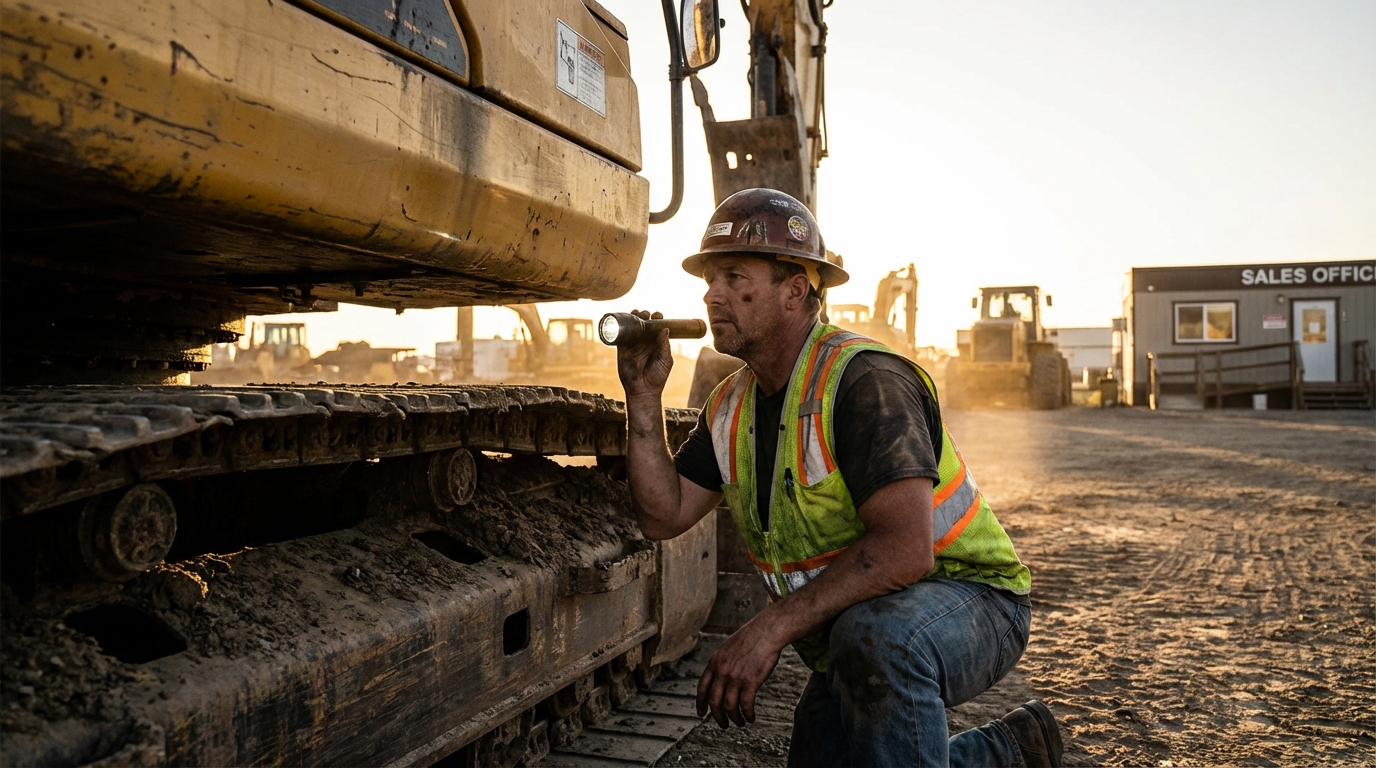
- Bring a flashlight, rag, and notepad
- Plan for 2-3 hours minimum for thorough inspection
- Bring a knowledgeable friend or hire an independent mechanic
Evaluating Machine Hours
Hours are the universal metric for equipment wear, but they don’t tell the whole story.
Hours vs. Condition Matrix
Low hours don’t guarantee good condition. Consider these scenarios:
Scenario A: 2,000 hours, no records, rental fleet
- High idle time (rental abuse)
- Multiple operators (varying skill levels)
- Deferred maintenance (rental companies cut corners)
- Risk level: HIGH despite low hours
Scenario B: 5,500 hours, complete records, single owner/operator
- Consistent operation
- Regular maintenance
- Known history
- Risk level: LOWER despite higher hours
The ideal machine has moderate hours with complete maintenance documentation. Be skeptical of very low hours on older machines — they may have sat unused (its own set of problems) or the hour meter may have been replaced.
Hour Meter Verification
Check for hour meter tampering:
- Compare to service records — Do oil changes match expected intervals?
- Examine wear patterns — Does seat, joystick, and pedal wear match hours?
- Check ECM hours (if equipped) — Electronic control module may store separate hour count
- Review telematics data if available
Reading Maintenance Records
Maintenance records are the single most important factor in evaluating used equipment. Machines with complete records command premiums for good reason.
What Good Records Look Like:
- Oil changes every 250-500 hours
- Filter replacements on schedule
- Hydraulic fluid changes every 2,000-4,000 hours
- Track adjustments and measurements
- Any repairs with parts receipts
Red Flags in Maintenance Records
Watch for these warning signs:
- Large gaps — Months with no service entries
- Missing major services — No hydraulic fluid changes, no coolant flushes
- Repeated repairs — Same component fixed multiple times
- Sudden ownership changes — Often coincide with major problems
- Handwritten records only — Easy to fabricate
No Records Available
If the seller has no maintenance records:
- Assume worst-case maintenance — Price accordingly
- Budget for complete fluid replacement — All oils, coolant, hydraulic fluid
- Expect surprise repairs — Something was deferred
- Discount 15-25% from comparable machines with records
Hydraulic System Deep Dive
The hydraulic system is the lifeblood of heavy equipment — and the most expensive to repair. A main hydraulic pump costs $5,000-$15,000 plus labor. A complete hydraulic system overhaul can exceed $30,000.
Visual Inspection
- Check all hoses — Look for cracks, bulges, seepage, and age
- Inspect fittings — Tightened or replaced fittings indicate past leaks
- Examine cylinders — Chrome pitting, scoring, or rust on rams
- Look under the machine — Stains reveal leak history
Operational Testing
With the machine running and warmed up:
- Cycle all functions slowly — Watch for jerky or uneven movement
- Cycle all functions rapidly — Listen for pump whine or cavitation
- Hold functions under load — Watch for drift (cylinder bypass)
- Check response time — Sluggish response indicates internal wear
Critical Test: Raise the boom fully loaded, shut off engine, wait 5 minutes. The boom should not drift down more than 1-2 inches. Significant drift indicates worn cylinders or control valves.
Hydraulic Fluid Analysis
Request or perform hydraulic fluid analysis:
- Metal particles — Indicate pump or motor wear
- Water contamination — Causes accelerated wear
- Viscosity — Wrong viscosity damages components
- Silicon — Indicates dirt ingestion
A $30-50 fluid analysis can reveal thousands in hidden problems.
Engine and Powertrain
The engine is the heart of the machine. Modern diesel engines can run 15,000-20,000 hours with proper maintenance, but neglected engines fail much sooner.
Cold Start Evaluation
A cold start reveals engine health:
- Cranking time — Should start within 3-5 seconds (diesel)
- Smoke color — Blue smoke = oil burning. Black smoke = fuel issue. White smoke = coolant leak
- Idle stability — Should settle to smooth idle within 30 seconds
- Unusual noises — Knocking, ticking, or grinding
Running Evaluation
With the engine at operating temperature:
- Oil pressure — Should stabilize at proper range
- Coolant temperature — Should reach and hold operating temp
- Exhaust smoke — Clear or light grey at steady RPM
- Blow-by — Remove oil cap; excessive pressure indicates ring wear
Example: Engine Oil Analysis Results
A recent evaluation of a 2019 excavator with 4,200 hours revealed:
| Parameter | Result | Normal Range | Status |
|---|---|---|---|
| Iron (Fe) | 45 ppm | 0-50 ppm | ✅ Normal |
| Copper (Cu) | 18 ppm | 0-20 ppm | ✅ Normal |
| Silicon (Si) | 28 ppm | 0-20 ppm | ⚠️ High |
| Viscosity | 14.2 cSt | 12.5-16.3 | ✅ Normal |
The elevated silicon indicated an air filter issue — a $50 fix caught before it became a $5,000 problem.
Transmission and Final Drives
- Check transmission fluid — Color, smell, particles
- Listen during operation — Grinding or whining
- Observe track movement — Both tracks should pull equally
- Test turning — Sluggish or uneven turning indicates final drive wear
Undercarriage Assessment (Tracked Machines)
For excavators, dozers, and track loaders, the undercarriage is often the most expensive replacement — $15,000 to $40,000 depending on machine size.
Components to Measure
Measure or have measured:
- Track shoes — Measure grouser height against new specs
- Track links — Check for stretch (pin and bushing wear)
- Rollers — Look for flat spots, leaks, wobble
- Idlers — Check for play and leaks
- Sprockets — Examine tooth wear pattern
- Track tension — Too tight accelerates wear, too loose causes damage
Professional Undercarriage Inspection
For machines over $50,000, pay for a professional undercarriage evaluation. Most dealers and independent shops offer this service for $200-400. They use wear gauges that give precise measurements and remaining life percentages.
Structural Integrity
Check the machine’s frame and structural components:
Frame and Boom
- Cracks — Inspect all welds, especially boom root and stick connections
- Previous repairs — Look for weld repairs, grinding marks, paint variations
- Bent components — Sight down boom and stick for straightness
- Pin bores — Check for wallowing (oval holes)
Warning: Fresh paint on specific areas often hides crack repairs. Be extra suspicious of recently repainted booms or frames on otherwise dirty machines.
Bucket and Attachments
- Cutting edge wear — Easy to replace, but factor cost
- Tooth adapters — Worn adapters waste money on teeth
- Structural cracks — Buckets can crack at attachment points
- Proper fit — Ensure attachments match machine specs
Electrical Systems
Electrical problems are frustrating and time-consuming to diagnose. Check:
Basic Electrical
- Battery condition — Age, corrosion, cold cranking amps
- Wiring harness — Look for repairs, rodent damage, chafing
- All lights — Work lights, running lights, turn signals
- Horn — Simple test of electrical continuity
- Backup alarm — Safety requirement
Electronic Systems
- Display panel — All gauges and indicators functional
- Error codes — Check for stored fault codes
- Sensors — Temperature, pressure, level sensors all reading
- Telematics (if equipped) — Transfer account information
Red Flags That Kill Deals
Walk away from any deal showing these warning signs:
Deal Breakers:
- Seller refuses cold start — They know it won’t start easily
- Missing or inconsistent serial numbers — Possible theft or fraud
- Frame cracks at structural joints — Major safety and value issue
- Milky hydraulic or engine oil — Water contamination = internal damage
- Excessive blow-by — Engine needs overhaul
- Major cylinder drift — Hydraulic system needs work
- Undercarriage below 20% — Budget $20,000+ for replacement
- Seller won’t allow independent inspection — What are they hiding?
- Price too good to be true — It always is
- Rushed sale, pressure tactics — Legitimate sellers allow time
Negotiation Strategies
Armed with your inspection findings, negotiate effectively:
Document Everything
Create a punch list of issues with estimated repair costs:
- Undercarriage at 40% = $8,000 prorated value reduction
- Hydraulic hoses need replacement = $1,500
- Missing service records = $5,000 risk premium
Present this professionally — not as complaints, but as documented findings that affect value.
Know Market Values
Research comparable sales:
- IronPlanet/Ritchie Bros auction results — Actual sale prices
- MachineryTrader listings — Asking prices (usually negotiable)
- Equipment Watch — Industry valuation data
- Local dealer pricing — Benchmark against retail
Negotiation Script
“Based on my inspection, I found the following items that need attention: [list]. Comparable machines with better condition are selling for [price]. Given these findings, I’m comfortable at [your offer].”
Where to Buy Used Equipment
Dealers
- ✅ Often warranty available
- ✅ Machines typically serviced
- ✅ Financing options
- ❌ Higher prices (15-25% premium)
- ❌ May not know full history
Auctions (Ritchie Bros, IronPlanet)
- ✅ Competitive pricing
- ✅ Large selection
- ✅ Some inspection reports available
- ❌ As-is sales
- ❌ Competition can drive prices up
Private Sales
- ✅ Best prices typically
- ✅ Can meet owner, learn history
- ✅ More negotiation room
- ❌ No warranty
- ❌ Higher risk
Rental Fleet Dispersals
- ✅ Lower hours sometimes
- ✅ Known maintenance (usually)
- ❌ Rental abuse common
- ❌ Multiple operators
Post-Purchase Setup
Congratulations on your purchase. Now set yourself up for success:
Immediate Actions
- Complete fluid analysis — Baseline all fluids
- Full service — Change all filters, fluids if unknown
- Professional inspection — Identify any issues missed
- Register in fleet management — Start tracking from hour one
Pro Tip: Add your new machine to FieldFix immediately. Track every hour, every maintenance item, every cost. When it’s time to sell, complete records increase resale value 10-15%.
Documentation Setup
Create a maintenance file including:
- Purchase documents (bill of sale, title)
- Pre-purchase inspection notes
- Initial fluid analysis results
- Serial numbers for all major components
- Maintenance schedule based on hours and manufacturer specs
First 100 Hours
During the initial break-in period with your “new” used machine:
- Check fluids daily — Watch for sudden consumption
- Listen carefully — Learn the machine’s normal sounds
- Monitor temperatures — Establish normal operating ranges
- Document everything — Build your maintenance history
Track Your Equipment Investment from Day One
FieldFix helps you track every hour, every cost, and every maintenance item. Know your true cost per hour and never lose another service record.
Free for up to 3 machines. No credit card required.
Final Thoughts
Buying used heavy equipment is part art, part science, and part detective work. The best deals go to prepared buyers who:
- Know what to inspect
- Understand true costs
- Document findings professionally
- Negotiate with data, not emotion
- Track everything post-purchase
That $80,000 excavator might be worth $60,000 or $95,000 depending on condition. Your inspection skills determine which price you pay.
Take your time. Walk away from bad deals. The right machine at the right price is worth waiting for.
Need help tracking your fleet’s maintenance and costs? FieldFix gives you the data you need to make smart equipment decisions. Get started free →