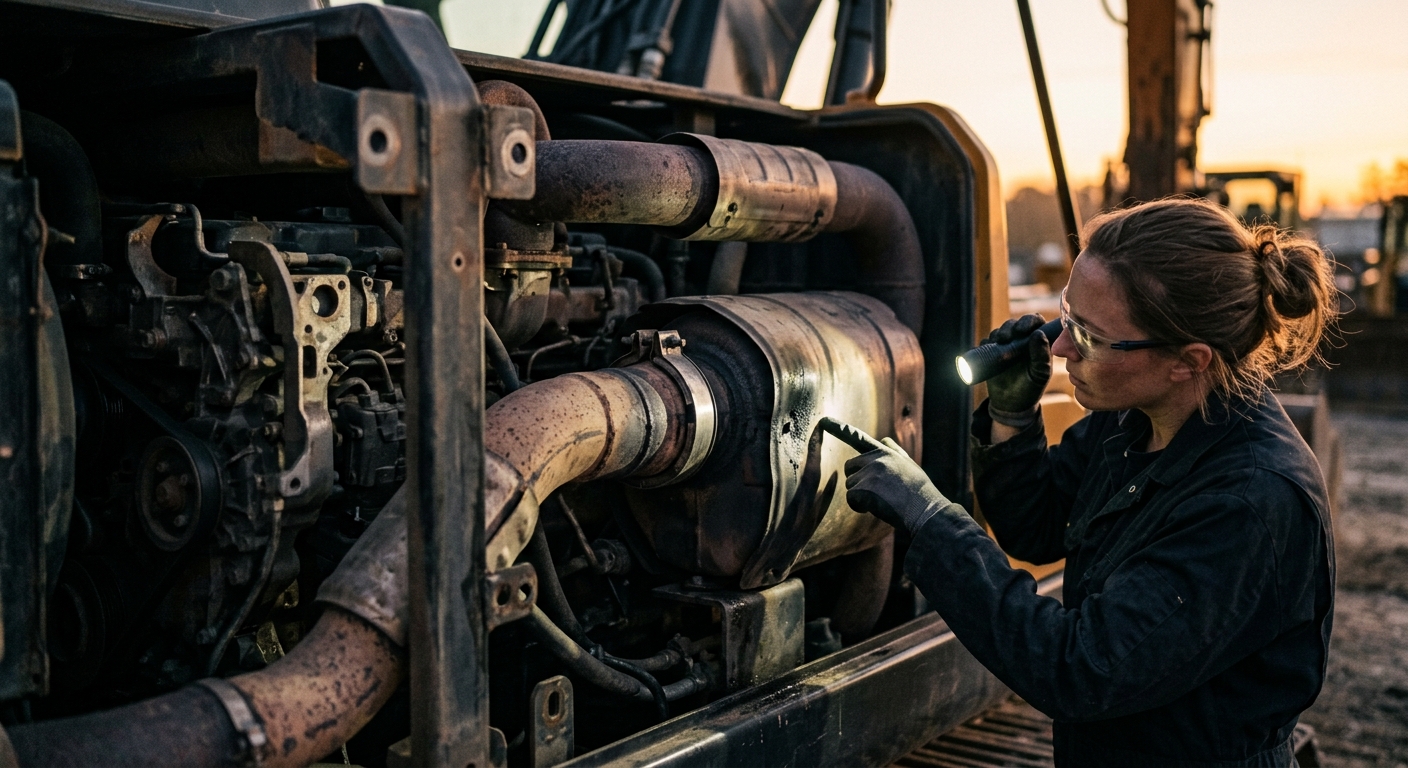
Heavy Equipment Exhaust Leak and Heat Shield Inspection Guide
Learn how to spot exhaust leaks, cracked manifolds, failed flex pipes, and missing heat shields before they cause fires, downtime, and power loss.
Key Takeaways
- Exhaust leaks rarely stay small. A little soot at a clamp can turn into cooked wiring, cab fumes, or turbo performance issues fast.
- Heat shields are not cosmetic sheet metal. They protect hoses, harnesses, insulation, and operators from serious heat exposure.
- Most early warning signs are visible without special tools: soot streaks, hot spots, rattles, burnt paint, loose brackets, and melted loom.
- A 10-minute inspection during service can prevent expensive failures that look “sudden” later.
- FieldFix helps crews document repeat exhaust issues and track repairs.
Exhaust systems on heavy equipment live a brutal life. They deal with constant vibration, thermal cycling, mud, debris, and corrosive moisture. That is exactly why exhaust problems get missed.
And when they get missed, the damage spreads. A minor manifold leak can heat-soak a wiring harness. A missing heat shield can cook a hydraulic hose. A cracked flex pipe can dump fumes where an operator breathes them or where combustible debris piles up.
This guide breaks down how to inspect heavy equipment exhaust systems and heat shields before a small leak turns into downtime or a repair bill.
Why Exhaust Leaks Get Ignored
Exhaust issues are classic slow-burn problems. The machine still starts. It still works. It might even run fine under light load. So crews keep moving and the leak keeps growing.
There are a few reasons these problems slide down the priority list:
- The system is partly hidden behind guards and shielding
- Leaks often sound minor at idle but worsen badly under load
- Soot and burnt paint get mistaken for “normal diesel mess”
- Teams replace the failed nearby part but miss the heat source that killed it
Hard truth: If you replace the same hose, sensor pigtail, boot, or piece of insulation twice in the same area, stop blaming bad luck. You probably have an unresolved exhaust leak or missing heat protection.
What Components Usually Fail
Not every machine uses the exact same exhaust layout, but the failure points are pretty consistent across excavators, loaders, dozers, skid steers, and other diesel-powered equipment.
Exhaust manifold and gasket
The manifold sees intense heat cycles every day. Bolts loosen, studs stretch, gaskets fail, and castings crack. A manifold leak usually leaves soot trails near the head or flange, often paired with a sharper ticking noise at cold start.
Flex pipe or bellows section
This section exists because engines move. The exhaust system needs some give as the engine torques, the frame twists, and the machine bounces around rough ground. When the flex section cracks, you often get a louder exhaust note, visible soot, and accelerated failure of nearby insulation or brackets.
V-band clamps and flanged joints
Clamps loosen. Flanges warp. Hardware corrodes. These joints are convenient service points, which means they are also recurring leak points if assembled poorly, over-tightened, or re-used with damaged sealing surfaces.
Muffler, pipe supports, and brackets
The muffler is not just a can hanging off the side. It is a heavy, vibrating hot component that needs support. Once a bracket cracks, the entire system starts moving more than it should, which overloads clamps, flex joints, and the manifold connection upstream.
Heat shields and insulation blankets
These pieces fail in boring ways: rusted fasteners, vibration cracks, lost hardware, torn insulation, bent panels after service, or shields removed and never reinstalled. That “temporary” missing shield becomes a permanent failure multiplier.
Common failure sources
✅ Usually mechanical:
- Loose hardware after repeated heat cycles
- Vibration from rough terrain or worn mounts
- Corrosion at seams and brackets
- Poorly supported exhaust weight
❌ Usually self-inflicted:
- Shields left off after repair
- Incorrect clamp torque
- Forcing misaligned pipes together during install
- Ignoring a rattle until it becomes a crack
Why Heat Shields Matter More Than People Think
People love to underestimate heat shields because they look simple. Thin metal. A few bolts. Maybe an insulation wrap. Doesn’t seem important until it disappears.
It is important.
Heat shields do three jobs at once:
- They reduce radiant heat reaching nearby hoses, wiring, sensors, and plastic parts.
- They lower the chance that dry debris, oily residue, or trash packed in the engine bay reaches ignition temperature.
- They help control operator and technician exposure to hot surfaces during service.
Think in line-of-sight. Radiant heat does not need direct contact to ruin components. If a hot exhaust section has a clear shot at a wire loom, DEF line, hydraulic hose, or composite panel, the damage clock is already ticking.
Without proper shielding, components near the exhaust age faster even if they do not fail instantly. Rubber hardens. Harness clips get brittle. Sensor connectors discolor. Paint blisters. Adhesive-backed insulation lets go. Then the weird electrical issues start showing up and everybody wastes time chasing symptoms instead of the heat source.
The Most Common Warning Signs
Most exhaust system failures leave clues before they become major.
Visual signs
- Dry black soot at a flange, clamp, manifold edge, or flex section
- Burnt paint, heat discoloration, or rust streaking around joints
- Melted loom, hardened hoses, or brittle zip ties nearby
- Missing bolts, broken weld tabs, or cracked support brackets
- Torn insulation blanket or shield rubbing against another part
Audible signs
- Ticking on cold start that fades as metal expands
- A sharper exhaust bark under throttle
- Metallic rattling from a loose shield or bracket
- A droning resonance at a narrow RPM range
Performance and safety signs
- Fumes drifting into the cab area
- Higher under-hood temperatures than normal
- Operator complaints about smell or noise after long runs
- Heat damage to parts that should not be failing so often
Cab fumes are not a “deal with it” issue. If an operator is breathing exhaust, pull the machine from service until the leak path is found. Carbon monoxide and other exhaust gases are not something to tough out.
How to Inspect the System Safely
You do not need to overcomplicate this. A good inspection is mostly about being systematic and not burning yourself like an idiot.
Start cold when possible
The best time to inspect is before startup or after the machine has cooled. You can touch guards, wiggle brackets, inspect fasteners, and trace the routing without guessing which part is still hot enough to brand your forearm.
Follow the system end to end
Start at the engine outlet and work downstream:
- Manifold and gasket area
- Turbo outlet or first pipe section
- Flex joint or bellows
- Clamps and flanges
- Muffler or aftertreatment housing
- Tailpipe, discharge direction, and supports
- Every shield, blanket, standoff, and fastener along the way
Look for evidence, not perfection
You are not judging whether the system is pretty. You are checking whether it is sealed, supported, and protected.
Inspection tip: Use a bright flashlight and a small inspection mirror. Soot loves to hide on the backside of flanges and under pipe joints where a quick glance misses it.
Run it and re-check if needed
If the cold inspection suggests a leak but you want confirmation, start the machine and observe from a safe position. Listen for ticking, hissing, or rattle changes as RPM climbs. Never reach into a running engine bay to feel for leaks. Exhaust components get hot fast and moving belts do not care about your schedule.
Check surrounding damage
A good exhaust inspection does not stop at the pipe. Look at the neighborhood:
- Wiring harness routing
- Hose clearance
- Belly pan debris buildup
- Sound insulation condition
- Plastic panels or guards with heat warping
- Soot on components that should be clean
Example: The fake electrical problem
A compact machine kept throwing intermittent sensor faults after long shifts. The sensor itself was replaced twice. The real issue was a missing heat shield over a nearby exhaust elbow that slowly baked the harness until resistance changed with temperature. The “electrical problem” was really an exhaust protection problem the whole time.
Repair or Replace: Making the Right Call
Not every exhaust issue needs a full system overhaul, but not every crack deserves a half-ass patch either.
Usually acceptable repairs
- Replacing clamps, studs, nuts, and gaskets
- Reinstalling missing shields with correct hardware
- Replacing a damaged flex section
- Repairing or replacing a cracked support bracket
- Swapping out a rusted pipe section before it fails completely
Repairs that deserve caution
Welding on exhaust parts in place can work in some cases, but it is easy to do badly. If the system is misaligned, unsupported, or already thin from corrosion, a weld bead is just lipstick on a future failure.
Patch it
✅ Makes sense when:
- The issue is isolated
- Base material is still solid
- Alignment is correct
- Supports and shields are intact
Replace it
✅ Makes sense when:
- Cracks have spread from multiple stress points
- Brackets and neighboring sections are failing too
- Corrosion has thinned the pipe
- The same repair has already failed once
The smart question is not “Can we make this hold today?” It is “Will this still be right after 200 more hours of vibration and heat?”
Building an Inspection Schedule
Exhaust inspections work best when they are built into routines instead of left to memory.
Daily operator walkaround
- Listen for new noise at startup
- Note any exhaust smell in cab or around the engine bay
- Look for missing shields, loose panels, and obvious soot
- Report new rattles immediately instead of waiting for service day
Weekly or every 50-hour service check
- Inspect clamps, brackets, and flex sections
- Check for heat damage to nearby hoses and harnesses
- Verify shields are tight and not cracked around mounting points
- Clean debris from high-heat zones so you can actually see what is going on
Planned maintenance interval
- Re-torque hardware where the OEM procedure calls for it
- Inspect manifold studs and gasket edges
- Check engine and exhaust mounts for excess movement
- Review prior repair notes to see if the same area keeps returning
Real-World Failure Examples
Example: The bracket that killed the flex pipe
An excavator kept eating flex pipes every few months. The pipes were not the root problem. A muffler support bracket had cracked, which let the exhaust assembly bounce and twist. Each new flex pipe took the abuse until it split again. One bracket repair solved the “bad flex pipe” problem for good.
Example: The soot trail nobody chased
A loader showed a narrow black streak near the manifold for weeks. Since power felt normal, nobody touched it. Eventually the leak cooked a nearby wire loom and triggered shutdown events that looked unrelated. The final repair included manifold hardware, loom repair, and lost production time that would have been avoided by treating the soot as the warning it was.
The Cost of Delay vs. Early Repair
This is where the math gets stupid in the worst way. Early exhaust repairs are usually cheap compared with downstream damage.
A minor exhaust repair often prevents a bigger chain reaction:
- Higher noise becomes a cracked pipe
- A cracked pipe becomes heat damage
- Heat damage becomes electrical faults or hose failure
- Electrical faults or hose failure become downtime and job delays
That is the maintenance version of “it was just a small leak.”
Final Checklist for Crews and Fleet Managers
If you want one practical standard, use this:
- Treat soot like evidence, not dirt
- Treat missing heat shields like missing guards
- Investigate repeat heat damage in the same area
- Fix support issues upstream instead of replacing the same failed part forever
- Log the repair so the next service can confirm it actually stayed solved
FieldFix workflow win: When operators log exhaust noise, fumes, or visible soot in real time, mechanics can compare the report with past repairs on that machine. That helps teams catch repeat failures, spot weak repairs, and stop the same hot-zone problem from burning hours every month.
Exhaust system maintenance is not glamorous, but it is one of those boring disciplines that protects everything around it. The leak itself is often cheap. The collateral damage is what wrecks your week.
Stop Small Exhaust Issues From Becoming Big Downtime
FieldFix helps you log machine issues, document inspections with photos, and track repeat failures across your fleet so the same exhaust leak does not keep coming back disguised as a new problem.
Try FieldFix to organize maintenance records, flag recurring trouble spots, and keep more equipment working instead of waiting on repairs.