Heavy Equipment Fire Suppression System Inspection Guide: What to Check Before a Small Fault Becomes a Total Loss
Learn how to inspect heavy equipment fire suppression systems, catch failures early, document checks, and reduce the risk of catastrophic machine fires.
Heavy equipment fires are already expensive. A failed fire suppression system makes them brutal. That is the difference between a controlled incident and a charred machine sitting in the mud while production stops, insurance gets involved, and everyone asks why the suppression system did not activate.
Many fleets do a decent job talking about fire risk in general. Fewer fleets treat the fire suppression system itself like a maintenance asset with failure modes, inspection requirements, and service intervals. That is a mistake. These systems live in vibration, dust, heat, weather, washdowns, and abuse. If you do not inspect them like any other critical machine system, you are gambling with a component that only has to fail once to do real damage.
This guide covers what operators, mechanics, and fleet managers should actually check on heavy equipment fire suppression systems, how often to check it, and how to document it so it does not become a forgotten safety sticker.
Why fire suppression systems matter
Forestry mulchers, compact track loaders, excavators, dozers, grinders, harvesters, and other high-heat machines work around dry debris, oil residue, and pressurized fuel or hydraulic systems. Those ingredients create a bad recipe. Fire suppression systems are there to interrupt that chain fast enough to save the machine, protect the operator, and limit collateral damage.
Engine-bay fires escalate fast. Suppression delays of even a minute can turn a repair event into a total loss.
Vibration, dust, debris, UV exposure, and washdowns constantly attack hoses, nozzles, brackets, and detection lines.
The system may sit unused for years, then get one chance to work exactly as designed.
The ugly part is that a failed suppression system often looks fine from ten feet away. The cylinder is still mounted. The pull handle is still there. The label is faded but present. Meanwhile the pressure is out of range, the nozzle is packed with grime, or the detection tubing has been rubbing on sheet metal for months.
How heavy equipment fire suppression systems work
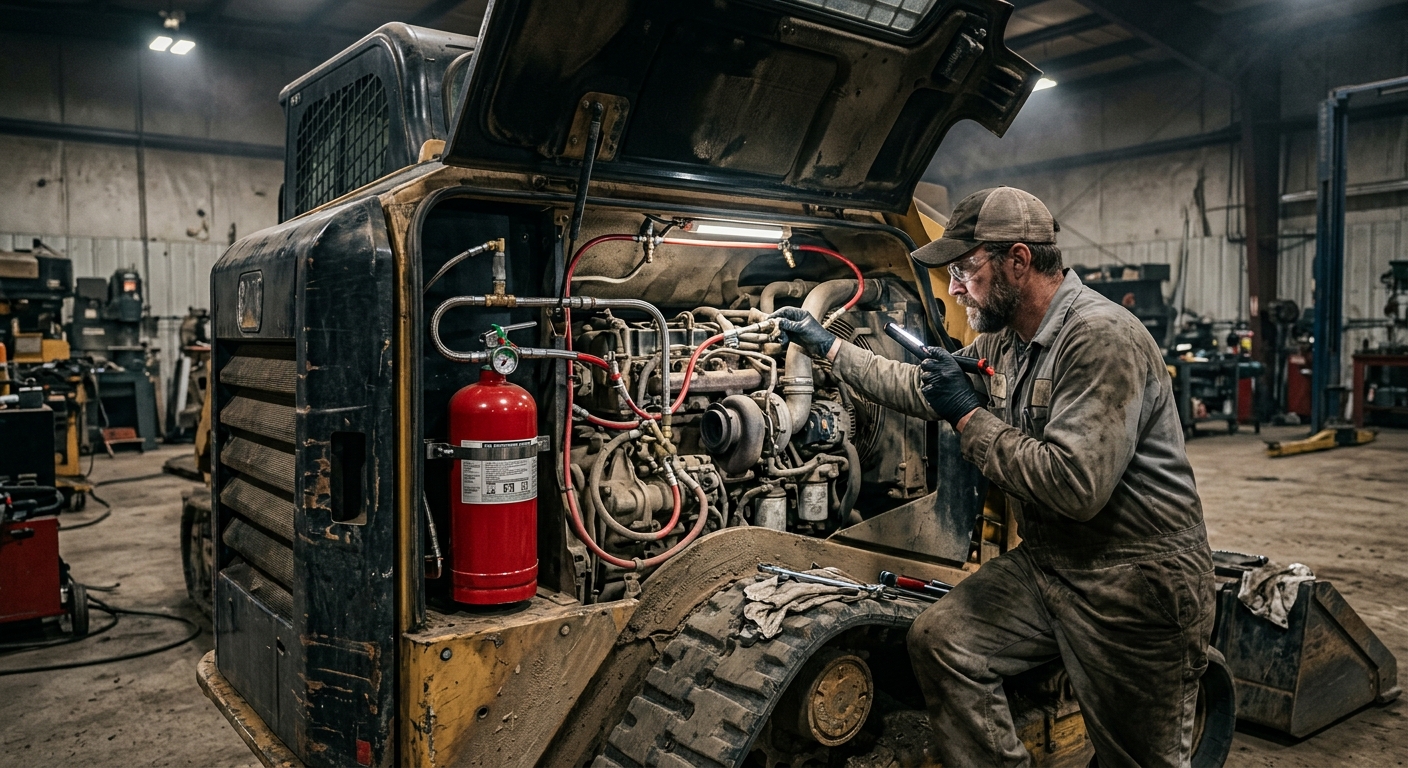
Most heavy equipment systems use a suppression agent stored in a cylinder, a detection method that senses heat or flame, and a distribution network that directs the agent toward likely ignition zones. Some systems trigger automatically. Some require the operator to pull a handle or hit an actuator. Many combine both.
Common components include:
- Agent cylinder with pressure gauge
- Detection tubing, linear heat detection, or electronic sensors
- Distribution hoses or pipe runs
- Nozzles aimed at engine, turbo, hydraulic pump, battery, and fuel-risk zones
- Manual pull stations or in-cab actuation controls
- Alarm circuit or shutdown integration on some machines
The important maintenance principle is simple: the system is only as good as its weakest component. One blocked nozzle or damaged detection line can ruin the whole response. That is why inspection cannot stop at “the bottle is still there.”
Daily inspection points for operators
Operators should not be asked to perform a full certification check every morning. They should, however, catch obvious problems before startup. A fast visual routine can prevent a system from quietly sitting disabled for weeks.
Daily operator checks should include:
- Confirm the cylinder is mounted securely and the bracket is not cracked or loose
- Check the pressure gauge is in the normal operating range if the design includes a visible gauge
- Verify safety pin or tamper seal status matches the system design and is not broken or missing
- Look for damaged pull cables, bent handles, or blocked access to manual actuators
- Confirm hoses, tubing, and wiring are not hanging loose, rubbed through, pinched, or oil-soaked
- Look at visible nozzles for mud, paint, oily debris, insect nests, or physical damage
- Note any recent washdown, collision, repair, or engine-bay work that could have disturbed routing
- Report warning lights, alarm faults, or discharged indicators immediately
These are not complicated steps, but they do require discipline. When the machine is caked in mulch, dust, or clay, the fire system is easy to ignore. That is exactly when it needs attention.
Scheduled inspection and service intervals
Daily checks catch obvious issues. Scheduled inspection catches the failures that hide behind guards, dirt, and routine familiarity. Your exact intervals depend on the manufacturer, the agent type, and insurance or site requirements, but the general structure should look like this.
Weekly or every 50 operating hours
- Wipe down cylinder labels, gauge face, and visible fittings so defects are easier to spot
- Inspect brackets, clamps, and routing points for vibration wear
- Verify nozzle aim has not shifted away from the protected zone
- Check detection tubing for abrasion, flattening, heat damage, or contamination
- Inspect manual actuation path for cable kinks, corrosion, and free movement
Monthly or every 250 operating hours
- Open access panels and inspect all protected compartments
- Verify nozzles remain unobstructed and caps or blow-off covers are intact if the system uses them
- Check hose routing near turbochargers, manifolds, batteries, and articulation zones
- Inspect electrical alarms, shutdown interlocks, and status indicators if equipped
- Review prior inspection logs for repeat defects that were marked but never resolved
At PM service or manufacturer-required intervals
- Perform full functional inspection according to system manufacturer procedures
- Weigh or pressure-check cylinders if required
- Replace damaged detection tubing, nozzles, seals, or brackets with approved parts
- Confirm proper nozzle coverage after engine or hydraulic modifications
- Schedule certified technician service where required by policy, insurer, or OEM guidance
Common failure points to catch early
Most suppression failures are boring. That is what makes them dangerous. They happen slowly enough to normalize.
The most common failure points are:
- Low or lost cylinder pressure from leaks or age
- Corroded or seized manual actuators
- Detection tubing rubbed through on sheet metal or clamps
- Nozzles clogged by grease, dirt, paint, or insect nests
- Brackets cracked by vibration until the cylinder shifts
- Hoses rerouted badly after unrelated engine or hydraulic repairs
- Alarm circuits left disconnected after troubleshooting
- Outdated service tags with no reliable record of last inspection
What good fleets do
- Treat fire suppression as a maintained system, not a sticker item
- Document defects and verify closeout
- Reinspect after any engine-bay repair or washdown
- Use approved parts and certified service when required
What gets fleets burned
- Assuming annual inspection alone is enough
- Ignoring out-of-range gauges because the machine still runs
- Letting nozzles disappear under grime
- Trusting verbal memory instead of logged service records
Automatic vs manual system considerations
Automatic systems are valuable because they reduce response time when the operator is distracted, disoriented, or outside the machine. Manual systems are simpler and can still be effective, but they depend on quick recognition and a working actuation path. Neither approach is maintenance-free.
Automatic systems need special attention on detection hardware, alarm faults, and shutdown integration. A disabled sensor circuit can leave the system looking present but functionally blind. Manual systems need clear access, intact cables, and operators who actually know when and how to trigger them.
If you are evaluating systems for a high-risk application, the choice is not just about price. It is about machine duty cycle, debris exposure, insurance requirements, and whether the operator realistically has time to respond before the fire gets away from them.
Documentation, training, and compliance
An inspection that is not documented is barely real. If a machine catches fire and the suppression system fails, you do not want the maintenance story to be “we usually look at those.” You want dated records showing normal readings, prior repairs, service intervals, and exactly who verified the system after the last engine-bay repair.
At minimum, document:
- Date and hour reading
- Machine ID and location
- Cylinder pressure or status result
- Detection line condition
- Nozzle condition and coverage check
- Manual actuator condition
- Alarm or shutdown test result where applicable
- Corrective action taken and verification of completion
Training matters just as much. Operators should know what normal looks like. Techs should know which defects require immediate lockout. Supervisors should know that “we will fix it later” is a reckless answer when the protection system is compromised.
Example: one loose bracket, one burned machine
A mulching contractor had a suppression cylinder mounted behind a side panel where vibration slowly cracked the bracket. The bottle shifted, the discharge hose rubbed on a sharp edge, and the line eventually failed. When debris ignited near the turbo, the operator pulled the manual actuator, but agent never reached the nozzles. The root cause was not the fire. It was months of undocumented vibration damage that nobody inspected closely enough.
Field example: what a missed inspection cost
Imagine a compact track loader working in land clearing. The crew knows debris packs into the rear compartment every day, so they clean it when they can. A hose was replaced two weeks ago. During that repair, the fire suppression tubing was unclipped and later resecured a little too close to a hot shield. No one documented it. No one rechecked nozzle aim or line clearance.
The operator does a normal walkaround, sees the cylinder, and moves on. The gauge is dusty but still visible enough to look fine. Midafternoon, a small hydraulic mist reaches a hot surface and ignition starts in the same compartment. The automatic system should discharge, but the heat-damaged detection section fails to trigger correctly. By the time the operator recognizes the problem and reaches the manual control, the fire has spread behind the paneling.
Now the bill includes:
- Major machine damage or total loss
- Crew downtime and schedule delays
- Rental replacement cost
- Insurance claim scrutiny
- Lost confidence in equipment readiness
That is the real reason inspection matters. The suppression system does not need a dramatic defect to fail. It just needs one unnoticed compromise in the wrong place.
Final takeaway
Fire suppression systems earn their keep on the worst day, which is why they need attention on ordinary days. Inspect the cylinder, routing, nozzles, detection hardware, and actuation path. Reinspect after repairs, washdowns, and heavy debris exposure. Log every check, every defect, and every correction.
The best fleets do not rely on memory or assumptions. They build fire suppression inspections into the same maintenance workflow as PMs, leak repairs, and safety checks. That is how you turn a critical backup system into something you can actually trust.
FieldFix helps crews log machine inspections, track recurring defects, document repairs, and keep fire suppression checks attached to the right asset and service interval. If your maintenance records still live on clipboards or in someone’s head, it is time to fix that.