Heavy Equipment Line Boring Repair Guide for Worn Pin Bores
Learn when heavy equipment line boring is the right repair for worn pin bores, how to spot damage early, and how to avoid costly structural downtime.
Loose buckets, sloppy couplers, and attachments that never seem to sit square all point to the same ugly truth: steel is wearing where it was never supposed to wear.
That is when owners start hearing the phrase line boring.
It is simply the repair process used when a pivot bore has worn out of shape and the surrounding structure needs to be restored to the correct centerline and diameter. When done well, it saves booms, sticks, couplers, loader arms, and attachment ears from becoming far more expensive problems. When delayed too long, it becomes one more lesson in why small wear issues should never be ignored.
What line boring actually is
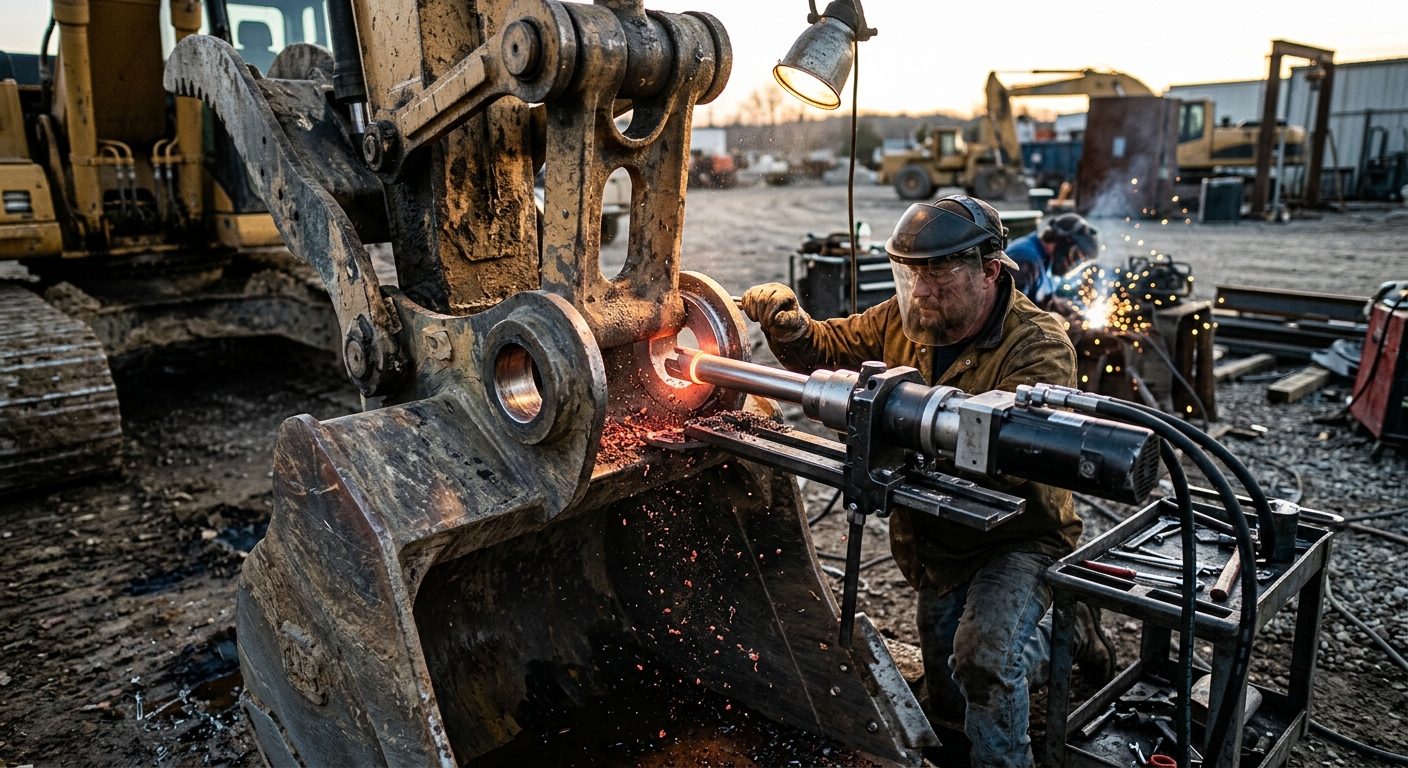
Line boring is a machining process used to restore worn pivot bores so the bore size, shape, and alignment match the original design. On heavy equipment, that usually means the repair shop or mobile machinist first welds up the damaged bore area, then machines it back to the correct dimension with a line boring setup that references the true centerline across the joint.
That centerline part is the whole game.
If a bore is merely enlarged but still round and aligned, you may have simpler repair options. But most serious wear does not happen neatly. The hole eggs out. The bore shifts. One side wears harder than the other. The pin starts loading off-center. The attachment gets loose in one direction first. Eventually the entire joint stops moving the way the engineer intended.
Line boring fixes that by restoring geometry, not just filling metal and hoping for the best.
This is why a random field weld is not an acceptable substitute. You can add metal with a welder. You cannot restore concentricity, alignment, and fit tolerance by eyeballing it. That is how you end up with a machine that technically went back together but still wears parts like crazy.
Why pin bores wear out
Pin bores do not usually fail because of one dramatic event. Most of them wear out through a boring chain of neglect, contamination, and impact.
The most common root causes look like this:
- Bushings wear beyond service limits and are not replaced in time
- Greasing gets skipped or done poorly
- Dirt and fines turn the joint into abrasive paste
- Operators side-load the attachment or slam the linkage
- Oversized attachments increase stress at the pivot
- Loose components keep running because the machine is still “usable”
The important thing to understand is that bushings are sacrificial. They are supposed to wear first so the expensive parent metal does not. Once that sacrificial layer is gone, the machine starts eating itself.
Excavators are especially vulnerable at bucket ears, stick-to-bucket joints, boom foot pivots, and quick coupler interfaces. Loaders see it in lift arm pivots, bell cranks, and linkage joints. Attachments such as grapples, thumbs, hammers, and compactors can get ugly fast because they live in dirt, shock, and abuse.
- Replacing bushings before they are completely hammered out
- Greasing on schedule and after wet or dirty work
- Keeping contaminants out of joints and zerks clean
- Matching attachments to machine size and duty cycle
- Training operators to avoid side-loading and violent direction changes
- Running with visible play because "it still works"
- Letting worn bushings spin in the housing
- Ignoring clunking, geometry changes, and uneven wear
- Using poor-fit aftermarket pins with bad tolerances
- Treating grease as a cure for already-damaged structure
One of the sneakiest failure modes is spinning bushings. Once the bushing starts rotating where it should be fixed, the housing itself becomes the wear surface. At that point, every hour you keep running is a transfer of repair cost from a replaceable component into a structural member.
Warning signs your machine may need line boring
Operators usually notice the symptoms before anyone says the words worn pin bore out loud.
Watch for these signs:
- A bucket or attachment clunks when the joint changes direction
- You can see visible movement between the pin and surrounding structure
- The attachment sits crooked or no longer feels tight
- Fine grading gets harder because the linkage feels vague
- New pins and bushings wear out way too quickly
- Cracked paint or rust bleed shows up around ears or bosses
- Grease purges out metallic, dirty, or unevenly around the joint
- The joint takes grease poorly because passages are damaged or packed with contamination
If you replace pins and bushings but the joint still has slop, that is a major clue. It usually means the wear has already transferred into the bore itself.
How to inspect bores before the damage snowballs
You do not need a machine shop to catch most bore problems early. You need consistency, a trained eye, and actual documentation.
Start with a clean joint. Dirt hides movement. Grease hides cracks. Then cycle the machine and watch the pivot point as the load reverses. That is when wear tends to reveal itself.
A practical inspection routine looks like this:
- Clean the pivot and remove packed debris.
- Watch the joint while the operator changes direction slowly.
- Look for delay, knock, or visible movement before the linkage picks up load.
- Check surrounding paint for cracking, rust bleed, or polished metal.
- Measure pin, bushing, and bore wear if movement looks excessive.
- Photograph the condition and log it against the asset record.
Measurement matters because wear can be deceptive. A joint may not look terrible from five feet away, but a dial indicator, bore gauge, or precise measurement against spec will tell the truth fast.
If you run multiple similar machines, compare one suspect unit to a healthy one. That side-by-side check is often enough to show just how much slop has crept into the damaged machine.
The best fleets also connect operator reports to technician follow-up. “Bucket feels loose” should become a dated inspection record with photos, measurements, and a repair recommendation.
When to replace bushings versus weld and line bore
Here is the blunt version.
If the wear is still limited to pins and bushings, replace the wear parts and move on. If the housing is loose, the bushing is spinning, the bore is egg-shaped, or the centerline is off, you are probably in weld-and-line-bore territory.
Use this framework:
- Replace pins and bushings when the housing is still round and within tolerance
- Repair retaining features when the bushing fit is borderline but the main structure is still sound
- Weld and line bore when the bore is elongated, misaligned, or damaged in the parent metal
- Reevaluate the entire joint when cracks, distortion, or repeated failures suggest a deeper structural issue
This distinction matters because the wrong repair path wastes both money and uptime. Installing new wear parts into a bad bore is like putting fresh tires on a bent rim. Sure, you can bolt it together. No, it will not behave the way it should.
The real cost of waiting too long
Line boring sounds expensive, which is exactly why many owners delay it. The problem is that delay usually multiplies the bill.
A planned repair might involve disassembly, weld buildup, precision boring, new pins and bushings, and a few scheduled days of downtime.
A delayed repair can add cracked ears, damaged geometry, extra fabrication, more parts, rental replacement cost, and crew delays in peak season.
That last category is where the pain really lives. Downtime during a slow month is annoying. Downtime during a booked schedule is brutal. If your primary excavator or loader goes down mid-project because a loose joint finally became a structural repair emergency, the machine shop invoice is only part of the damage.
This is why smart fleets do not ask only, “How much will line boring cost?” They ask, “What will it cost if we keep pretending we can wait?”
How to evaluate a line boring repair vendor
Not every welding truck with a boring bar is the same. You want someone who understands both machining accuracy and why the joint failed in the first place.
When choosing a vendor or repair shop, ask:
- How will you establish the true centerline?
- What measurements will you use before and after repair?
- Are you welding up the bore first and machining back to spec?
- How do you verify bore alignment across multiple ears or pivot points?
- Will you inspect surrounding cracks, bosses, and wear surfaces while the machine is apart?
- What fit tolerance do you target for the new pin and bushing setup?
The best vendors talk about alignment, tolerance, root cause, and adjacent damage. The weaker ones talk mainly about “tightening it up.”
That phrase is a red flag. Tight is not the goal. Correct is the goal.
How to prevent needing line boring again
Once a machine has needed line boring, treat that joint like a monitored risk point from then on.
Build a prevention plan around four habits:
1. Replace wear parts before the parent metal becomes the wear part
Do not run pins and bushings until they are fully destroyed. Service them while they are still doing their job.
2. Grease with discipline
Greasing is not glamorous, but it is still one of the cheapest structural protection steps on the machine. Follow manufacturer intervals, adjust for dirty conditions, and make sure the grease is actually purging the way it should.
3. Train operators on abuse patterns
Side-loading, slamming attachments, prying with poor geometry, and running loose couplers all shorten joint life. A good operator can save thousands in linkage wear without touching a wrench.
4. Track repeat wear in software
If the same joint keeps needing attention, that is not bad luck. That is a pattern. Log measurements, photos, prior repairs, and operator notes so you can see whether the joint is stable, wearing faster than expected, or pointing to a deeper issue.
- Measure wear trends and repair on your schedule
- Catch spinning bushings before bores get damaged
- Use repair history to spot repeat offenders in the fleet
- Budget for structural wear before peak season hits
- Wait for loud clunks and obvious slop
- Burn through new pin kits in damaged housings
- Discover structural repairs in the middle of active jobs
- Pay more because the repair expanded while you waited
Line boring teaches the same lesson every time: small wear issues are cheap right up until they are not.
If your fleet runs excavators, loaders, couplers, buckets, thumbs, or any other pin-heavy attachments, the real win is catching the wear conditions that make line boring necessary in the first place.
FieldFix helps contractors track inspections, log wear photos, document repeat failures, and catch repair patterns before loose joints turn into line boring emergencies. If your equipment earns money by the hour, your maintenance records should protect every one of those hours.
Related Articles
September 4, 2026
Heavy Equipment Fall Service Planning Guide: How to Prevent Winter Downtime
September 3, 2026
Horizontal Directional Drill Maintenance: The Complete HDD Service Guide for Contractors
September 2, 2026