Heavy Equipment Maintenance Schedule by Hours: The Complete Interval Guide
Complete heavy equipment maintenance schedule from 10 to 6,000 hours. Know exactly what to service at every interval to prevent costly breakdowns.
Key Takeaways
- Every machine has a service clock — ignoring intervals is the fastest way to destroy equipment value
- 10-hour (daily) checks catch 80% of problems before they become catastrophic
- 250 and 500-hour intervals are where most owners fall behind — and where most failures originate
- Tracking hours manually doesn’t scale — digital maintenance logs eliminate missed services
- This guide covers every major interval from daily walkarounds to 6,000-hour overhauls
Most equipment owners know they should change the oil. Fewer know when to replace hydraulic return filters, adjust valve lash, or flush the cooling system. The result? Machines that cost two or three times more to operate than they should — not because the equipment is bad, but because the maintenance schedule was ignored.
This guide breaks down every major service interval for heavy equipment — excavators, skid steers, compact track loaders, dozers, and wheel loaders. Whether you run one machine or fifty, these intervals are the difference between a 10,000-hour machine and a 4,000-hour headache.
Why Maintenance Intervals Matter
Maintenance isn’t a cost center. It’s a profit protector.
Every manufacturer publishes recommended service intervals for a reason. Those intervals are based on engineering tolerances — how long fluids maintain their protective properties, how much wear components can absorb before failure cascades, and how quickly contaminants accumulate in closed systems.
Skip a 500-hour oil change and you might get away with it once. Skip it three times and you’re looking at bearing failure, scored cylinder walls, and a rebuild that costs more than a used truck.
Daily / 10-Hour Service
The daily walkaround is the single most important maintenance task you’ll ever perform. It takes 10–15 minutes and catches problems when they’re $50 fixes instead of $5,000 emergencies.
Every day before starting the machine:
- Walk around the machine. Look for leaks, loose bolts, damaged hoses, cracked glass, and anything that wasn’t there yesterday.
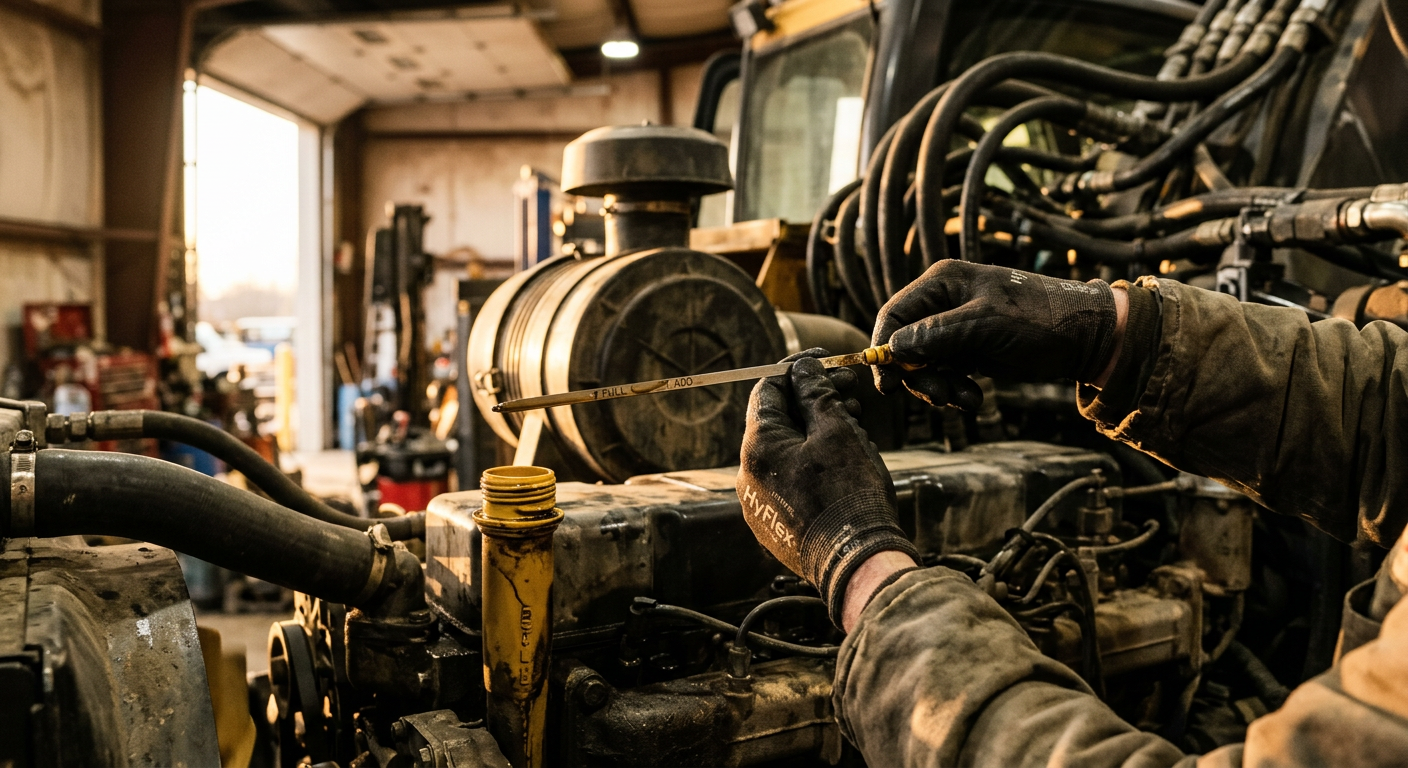
- Check engine oil level. Cold engine, machine on level ground. Top off if needed — never overfill.
- Check hydraulic fluid level. Arms retracted, bucket flat on ground. Sight glass or dipstick depending on the machine.
- Check coolant level. In the overflow tank, never open a hot radiator cap.
- Inspect air filter indicator. If it’s in the red zone, service the outer filter. Don’t touch the inner (safety) filter unless replacing the outer.
- Check DEF level (Tier 4 machines). Running out mid-job triggers a derate that can shut you down.
- Grease all daily points. Boom, stick, bucket pins, swing bearing — whatever your operator’s manual specifies.
- Test all controls. Cycle hydraulics, check brakes, verify all gauges are reading normal.
- Clean the cab. Wipe gauges, clean windows, remove debris from the floor. A clean cab is a safe cab.
- Inspect tracks/tires. Check track tension (two-inch sag on most machines), look for cuts, missing lugs, or embedded objects.
50-Hour Service (Weekly)
The 50-hour service adds tasks that don’t need daily attention but can’t wait for the 250-hour interval.
- Drain water from the fuel/water separator. Moisture accumulates in diesel tanks, especially with temperature swings. Water in fuel destroys injectors.
- Check battery terminals. Clean corrosion, tighten connections, verify charge.
- Inspect belts. Look for cracks, glazing, or excessive slack. A thrown belt at 2,500 RPM causes collateral damage.
- Lubricate all 50-hour grease points. Swing gear, turntable bearing, and any points not on the daily schedule.
- Clean radiator and oil cooler fins. Compressed air from the inside out. Clogged coolers cause overheating — the number one killer of diesel engines.
- Check tire pressures (wheeled machines). Uneven pressure causes uneven wear and handling problems.
250-Hour Service
This is where most small operators start falling behind. The 250-hour interval introduces fluid changes and filter replacements that cost real money — but skipping them costs dramatically more.
At every 250 hours:
- Change engine oil and filter. Use the grade and spec from your operator’s manual. Not all 15W-40 is the same — check for CK-4 or the manufacturer’s required spec.
- Replace fuel filters (primary and secondary). Dirty fuel filters restrict flow, causing hard starts and power loss.
- Inspect and clean the air filter. Replace if damaged or after 3 cleanings. Never blow compressed air from the outside in.
- Check all fluid levels and top off. Hydraulic, coolant, transmission, final drive.
- Inspect hydraulic hoses and fittings. Look for weeping, bulging, abrasion, or cracked fittings. A blown hydraulic hose can cause burns and fires.
- Check and adjust track tension (tracked machines). Overtight tracks accelerate sprocket and roller wear. Too loose and they throw.
Real-World Example: The $28,000 Oil Change
A landscape contractor running a compact track loader skipped three consecutive 250-hour oil changes to “save money.” At 1,800 hours, the engine seized. Oil analysis from the last sample (taken at 900 hours) already showed elevated iron and silicon — clear signs of accelerated wear and dust ingestion from a failing air filter. Total cost: $28,000 for a reman engine plus two weeks of downtime. The three oil changes would have cost $270 total.
500-Hour Service
The 500-hour service is a comprehensive checkpoint. Everything from the 250-hour interval, plus:
- Replace hydraulic return filter. Contaminated hydraulic fluid is the leading cause of pump and valve failure.
- Replace hydraulic pilot filter (if equipped). Clogged pilot filters cause sluggish or erratic controls.
- Change final drive oil (tracked machines). Both sides. Check for metal particles on the drain plug — they indicate gear wear.
- Inspect swing drive oil level and condition. Dark, burnt-smelling oil means it’s breaking down.
- Replace the fuel/water separator element. Not just draining — the full element.
- Inspect and adjust fan belt tension. Replace if cracked or glazed.
- Clean or replace the cab air filter. Your operator breathes through this. Treat it accordingly.
- Test the battery under load. Voltage alone doesn’t tell you battery health. A load test does.
1,000-Hour Service
The 1,000-hour service is a major milestone. This is where you start replacing components that have a definite service life and inspecting systems that degrade slowly.
Everything from previous intervals, plus:
- Replace hydraulic oil (or at minimum, test it). Full system drain and fill if oil analysis shows degradation. Many manufacturers specify 2,000-hour hydraulic oil change intervals, but contamination or overheating can shorten that dramatically.
- Replace the inner (safety) air filter. This is the one you don’t touch during normal service — it’s only replaced at 1,000 hours or when the outer filter is damaged.
- Inspect turbocharger. Check for shaft play, oil leaks, and boost pressure. A failing turbo introduces oil into the intake, causing runaway risk.
- Adjust valve lash (if applicable). Some engines require periodic valve adjustment. Others use hydraulic lifters. Check your manual.
- Flush and replace coolant (or test with refractometer). Coolant breaks down over time — pH drops, corrosion inhibitors deplete, and the cooling system starts eating itself from the inside.
- Inspect all structural pins and bushings. Check for excessive play, cracking, or galling. Worn pins cause sloppy controls and accelerate wear on everything connected to them.
- Check and adjust all pivot points. Boom, stick, bucket, and swing.
- Test the hydraulic system pressure. Relief pressures, case drain flow, and cycle times tell you the real health of your hydraulic system.
2,000-Hour Service
At 2,000 hours, you’re evaluating the long-term health of the machine. This is where you decide if you’re maintaining an asset or pouring money into a liability.
- Full hydraulic system fluid change. Drain, flush, refill with OEM-spec fluid. Replace all filters — return, pilot, suction screen.
- Replace all coolant hoses. Rubber degrades from the inside out. Hoses that look fine externally can be paper-thin internally.
- Inspect and repack swing bearing. Clean old grease, inspect for play or rough spots, repack with fresh grease.
- Rebuild or replace cylinders showing drift. Cylinder seals have a definite service life. Drift under load means seals are worn.
- Inspect undercarriage wear (tracked machines). Measure sprockets, rollers, idlers, and track links against service limits. Decide: turn, replace, or rebuild.
- Full electrical system inspection. Check wiring harnesses for chafing, rodent damage, and corrosion. Test all sensors and switches.
- Transmission service (wheeled machines). Fluid and filter change, pressure testing.
2,000-Hour Decision Point
Signs the Machine Has Life Left:
- Oil analysis trends are stable or improving
- Undercarriage at 50% or less wear
- No structural cracks
- Hydraulic cycle times within spec
- Engine compression is even across cylinders
Signs It’s Time to Plan an Exit:
- Escalating repair costs (trending above 50% of monthly payment)
- Multiple systems failing simultaneously
- Structural cracks in boom or frame
- Undercarriage past 70% wear
- Excessive blowby or oil consumption
4,000–6,000-Hour Major Overhaul
This is rebuild territory. Most machines in demanding applications (demolition, mining, heavy excavation) will need major component attention between 4,000 and 6,000 hours. Machines in lighter duty (grading, utility work) can push further.
Typical major overhaul items:
- Engine overhaul or replacement. In-frame rebuild (pistons, rings, bearings, seals) or full reman.
- Hydraulic pump rebuild. Especially if case drain flow has been trending upward.
- Complete undercarriage replacement (tracked machines). This is often the single largest maintenance expense — $15,000 to $40,000+ depending on machine size.
- Swing motor and bearing replacement. If the swing has gotten noisy or slow, this is when it gets addressed.
- Full cab refurbishment. Seat, controls, glass, HVAC. An uncomfortable operator is an unproductive operator.
- Complete wiring harness inspection and replacement of damaged sections.
How to Track Service Intervals
Knowing the schedule is half the battle. Actually tracking it across multiple machines, operators, and job sites is where most fleets fall apart.
Methods, ranked from worst to best:
- Memory. Worst option. You will forget. Guaranteed.
- Notebook in the cab. Better than nothing, but notebooks get lost, wet, and ignored.
- Spreadsheet. Works for 1–2 machines. Breaks down at 3+. Nobody updates it consistently.
- Dedicated fleet management software. The only method that scales. Automated reminders, photo documentation, cost tracking, and trend analysis.
Key features to look for in any tracking system:
- Hour-based reminders (not just calendar-based — machines don’t care what day it is)
- Photo attachments for documenting condition and work performed
- Cost tracking per service to calculate true cost-per-hour
- Multi-machine dashboards so nothing slips through the cracks
- Service history export for warranty claims and resale documentation
Common Mistakes That Void Warranties
Manufacturers are looking for reasons to deny claims. Don’t give them one.
- Using non-spec fluids. If the manual says CK-4 oil or OAT coolant, that’s not a suggestion.
- No service records. “I definitely changed the oil” doesn’t hold up without documentation.
- Exceeding service intervals. Most warranties allow a 10% grace period on intervals. Beyond that, you’re on your own.
- Unauthorized modifications. ECU tunes, DPF deletes, and aftermarket hydraulic modifications void coverage on affected systems.
- Ignoring warning lights. If the machine logged a high-temp event and you kept running it, the damage that follows isn’t covered.
Building Your Custom Schedule
The intervals in this guide are general. Your specific schedule should account for:
- Operating conditions. Dusty environments = more frequent air filter service. Hot climates = shorter coolant change intervals. Wet conditions = more frequent greasing.
- Duty cycle. A machine running 8 hours a day in heavy excavation ages faster than one doing 4 hours of light grading.
- Machine age. Older machines with higher hours often benefit from shortened intervals as tolerances loosen.
- Oil analysis results. If analysis shows your oil is still in spec at 250 hours, you might extend to 300. If it’s breaking down at 200, shorten accordingly. Let the data decide.
Start with the manufacturer’s recommendations. Adjust based on your conditions. Document everything.
The machines that last 10,000+ hours aren’t lucky — they’re maintained. Every hour you spend on scheduled maintenance saves multiple hours of unplanned downtime. Every dollar you spend on filters and fluids saves multiples in rebuild costs.
The schedule isn’t glamorous. It’s not exciting. But it’s the difference between owning equipment and being owned by it.
Never Miss a Service Interval Again
FieldFix tracks maintenance schedules, calculates cost-per-hour, and sends alerts before services are due — not after something breaks. Free for up to 3 machines.